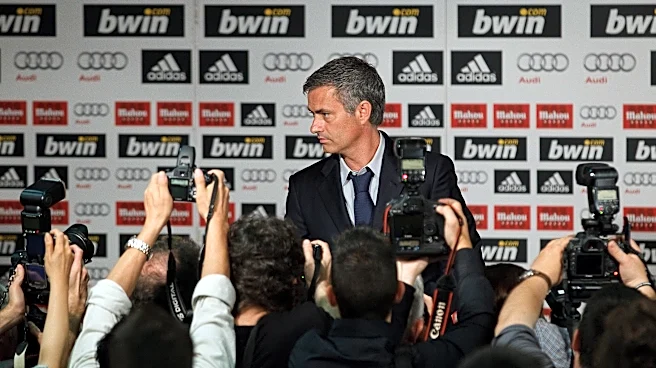

A report from David Ornstein and Mario Cortegana at The Athletic, published earlier today, names José Mourinho as Florentino Pérez’s preferred candidate to replace Álvaro Arbeloa, who took over in January after Xabi Alonso was sacked and is now expected to be dismissed himself at the end of the season.
Some senior figures inside the Bernabéu are reportedly opposed to a Mourinho return, but the president has the final say. Mourinho’s contract at Benfica runs until 2027, though it includes a €3 million
break clause that can be activated within ten days of the Portuguese season ending.
When Fabio Capello came back to Real Madrid in 2006, nine years had passed since his previous spell there. Carlo Ancelotti’s wait was six. Zinedine Zidane barely waited at all — he walked out in May 2018 and was on the bench again by March 2019, the shortest separation any returning Madrid coach has managed. If Ornstein and Cortegana have it right, José Mourinho is about to make all of those gaps look short. 13 years since 2013.
Madrid are about to finish a second consecutive season without a major trophy. The last time that happened was in the mid-to-late 2000s, before Florentino’s second presidency, and it’s the kind of statistic that lands at the Bernabéu like an accusation. Xabi Alonso was hired to be the long-term answer, and he lasted six months. Arbeloa was the emergency interim, and he didn’t move the needle. Bayern Munich knocked Madrid out of the Champions League quarter-finals. Barcelona are 11 points clear at the top of LaLiga. The dressing room, by most accounts, is far from ideal.
Over the last decade, except for Xabi Alonso, whenever Florentino has faced this kind of moment, his instinct has been the same. Carlo Ancelotti was summoned from Everton after Zinedine Zidane left the club for a second time, hired to steady a side that had just watched its manager quit in protest. It worked. Carlo won LaLiga and the Champions League in year one. Another double arrived in 2024. The idea is minimalist in principle: when the team wobbles, bring back someone who already knows how it works.
Mourinho fits the template with one important difference. Ancelotti was a calmer — diplomatic, deferential to senior players, almost allergic to public conflict. Mourinho is the opposite. If there’s a storm brewing, he is more likely to feed it than tame it. Madrid know what that looks like, because they lived it from 2010 to 2013, and they know it doesn’t always end where the club wants it to. Florentino is reaching for someone whose loyalty to him personally has survived 13 years and six other clubs.
In February, during a Champions League tie between Real Madrid and Benfica, Vinicius Jr reported to the referee that Gianluca Prestianni had racially abused him on the pitch. In the press, Mourinho implied Vinicius had brought it on himself with the way he had celebrated his goal. He later issued a statement saying he is opposed to discrimination of any kind. Prestianni was recently given a six-game ban for homophobic conduct in a separate incident, but the timing did Mourinho no favours.
That is the relationship Mourinho would walk into. Less than three months ago, on live-air, he suggested that one of the most important players at his potential next club was partly to blame for the racial abuse aimed at him. Unless Mourinho fixes things with Vinicius directly, this would be a massive problem.
The tactical fit seems insignificant in the current context. This squad did not respond to the change Xabi Alonso demanded. They are unlikely to respond to anyone who asks for change on that scale. It is unlikely that Mourinho would demand such a drastic change in their style of play. Pressing has been a problem at Real Madrid, but it is not a problem that Mourinho would be expected to solve. Manchester United in 2017–18, Tottenham Hotspur in 2019–20, AS Roma in 2022–23 — his teams posted PPDA figures of 10.25, 10.94, and 12.59. Real Madrid’s PPDA over the last three seasons has sat in roughly the same range, between 10.5 and 12.
Mourinho’s successful teams have been built on defensive quality and a balance of explosiveness and pragmatism in attack. Cristiano Ronaldo and Ángel Di María, Eden Hazard and Willian, Heung-min Son and Lucas Moura — winger combinations with a goal threat on one flank and a tireless off-ball worker on the other. The question is whether the current Real Madrid squad has those profiles, and whether Mourinho will be allowed the signing he wants to complete the pair.
The other half of the attack would interest him more. The abundance of number 10s in Jude Bellingham, Arda Güler, and possibly Nico Paz behind Kylian Mbappé is exactly the kind of central spine Mourinho has built attacks around throughout his career.
Defensive continuity has been the other foundation of his most successful sides. John Terry and Ricardo Carvalho at Chelsea. Lúcio and Walter Samuel at Inter. Sergio Ramos and Pepe at Real Madrid. John Terry and Gary Cahill when he came back to Stamford Bridge.
In 2026, consistency at the back is like a distant dream for Real Madrid. Éder Militão’s fitness cannot be trusted. Dean Huijsen has just arrived, but has not necessarily established himself. Antonio Rüdiger’s contract is still unresolved. The club has not had a settled centre-back pairing for more than three years. Can Mourinho make it work?
Whatever questions exist about his tactical fit and how the dressing room will respond to him, one thing is guaranteed with Mourinho: the press conferences will be box office again. Ancelotti, Zidane, Xabi Alonso, Arbeloa — all of them, most of the time, seemed to be reading from the same diplomatic script. That will change with Mourinho.
José Mourinho has built his career on trust. He will go to war for the players who give him theirs, and they go to war back. He will go to war against the ones who do not. The necessity of this return can be argued on plenty of grounds, but the intrigue cannot be doubted. It is José Mourinho, after all.