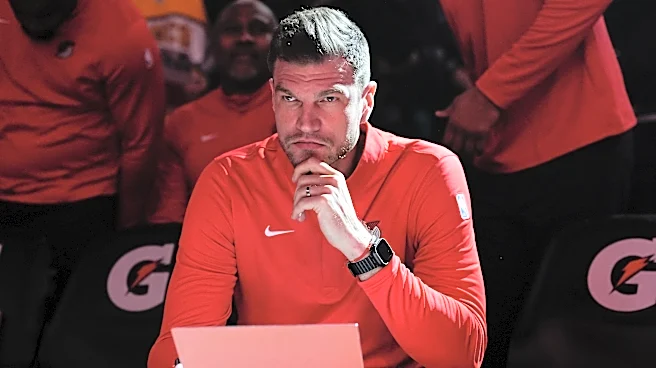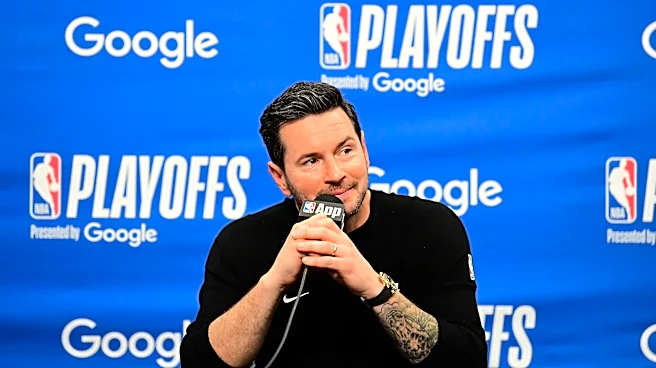







Welcome to our annual Lakers season in review series, where we’ll look back at each player on the team’s roster this season and evaluate if they should be part of the future of the franchise. Today, we wrap our series with a shift away from the players and towards the head coach, JJ Redick.
Maybe it’s a product of the internet-fueled brain rot that distorts the passage of time these days, but it feels like five years have passed since the debates about JJ Redick’s qualifications to be an NBA head
coach, spurred on by his post-playing days podcast career and never having coached at any level beyond his grade-school-aged sons’ teams.
Or maybe it’s the fact that after two full NBA campaigns under his belt, Redick has so quickly and thoroughly dismissed those concerns as irrelevant, it seems like ancient history that ever mattered in the first place.
Either way, it’s no small feat that Redick has put all of that talk behind him to the point that it is hard to imagine him doing anything else besides coaching now. Consecutive 50-win seasons and playoff appearances with home court advantage in the first round do have a way of shifting the perception of a coach under the type of scrutiny Redick was just two years ago.
The degree to which this matters at this point may not be very much at all.
After all, I think JJ would be the first to tell you that, beyond even the wins and losses, he simply wants to be judged on whether he has maximized the group of players he coaches in a specific season. But the fact that we’ve gotten to that point with Redick at all this early into his career is worth mentioning as meaningful — and the fact that this seems to be the only standard he’s being held to at all now even more so.
Yes, there have been growing pains and things have been far from perfect, but I think it’s abundantly clear now that Redick is viewed only as a coach. And, after two seasons, it’s fairly clear he’s a pretty good one.
How did he coach?
Coming off a rookie season that saw his roster upended by a franchise-altering trade, Redick’s second year was also a challenging one due to injuries and player availability impacting a roster that, even with multiple holdovers, did introduce three new rotation players, including two starters.
Whether it was LeBron missing all of training camp and the team’s first 14 games with sciatica, Austin Reaves missing substantial time with two calf strains and an oblique injury, and Luka Dončić missing the team’s final five games and the entire playoffs with a hamstring strain, Redick had to navigate a season where his best three players rarely played together and, when they did, were adjusting to the ever-shifting roles borne from that lack of shared court time.
Redick, though, handled this deftly, creating an environment where roles were backed by communication, understanding, and belief in the players’ abilities to take on whatever was put in front of them. This was exemplified both by the team’s incredible month of March and then in the team’s playoff upset of the Rockets.
In the former, a string of good health was backed by a redefined pecking order that saw Redick cater to Dončić and Reaves as his primary ball handlers and shot creators while LeBron took on a more supportive role as an off-ball worker who focused on doing more with less. Credit the players — particularly LeBron — for being able to adapt on the fly, but Redick also deserves his flowers for formulating this sort of plan and for having the wherewithal to organize the team in a way that, in one stroke, optimized the group while also diminishing the role of a player whose reputation and cachet is as substantive as LeBron’s.
And then, in the latter playoff stretch, with both Dončić and Reaves injured, Redick not only turned back to LeBron as an on-ball creator and primary leader, but crafted offensive game plans that prominently featured Marcus Smart and Luke Kennard as primary scorers and ball-handlers and defensive schemes meant to play into Houston’s lack of experience and guard play by pressuring the ball and forcing turnovers.
In essence, Redick took two totally different groups with different strengths on both sides of the ball and created environments where both experienced great success. Because this is a player’s league and the Lakers were obviously led by historically great individual players, Redick really did not get the credit he deserved in real time. But hindsight really does reveal how much of a strong coaching job the dichotomy of these two stretches required.
Overall, then, it’s more than fair to say that Redick had an excellent year coaching.
He wasn’t perfect by any means and you could certainly nitpick some of the decisions he made over the course of the year, but there were very few, if any, times where I could honestly say I didn’t understand a choice he made, even if I disagreed with it. Which, honestly, is all you can ask for from a coach as an outsider. Can this be explained rationally? If the answer is yes, you don’t have to agree.
Further, I’d argue there was a general adaptability and willingness to change course when something wasn’t working, which really mattered towards the team’s success this year.
Whether it was the aforementioned reorienting of the team’s hierarchy around Luka and Austin or the ultimate shift he made to bring Rui off the bench in favor of Smart, Redick often got to where he needed to be with this roster rather than stubbornly sticking to ideas that would have been easier to stomach politically. And while it’s fair to wonder if he could have done some of these things sooner, I think it’s more important you get there eventually — because some coaches never do.
So, credit to Redick. He still has learning and refining to do, but the trajectory he’s on is positive and I believe in where this team can go with him as the head coach.
What is his contract situation moving forward?
By all accounts, Redick is under contract for several more seasons after receiving a contract extension following his first season that reportedly tacked on two more years to what was originally a four-year deal. That would leave Redick with four years still on this deal now, which positions him well to be the Lakers’ coach for the foreseeable future.
Even beyond that contractual security, though, it is also clear that Redick has a strong relationship not only with Dončić, but with LeBron and Austin. This sort of alignment with your team’s best players can often mean more than the number of years left on your deal or even the sort of support you might have from your general manager.

Should he be back?
Unequivocally, yes. While this is clearly Luka’s team from the player side of things, Redick feels nearly as indentured as the team’s head coach. And just as the team will clearly try to acquire the sorts of players who best complement Dončić and his skill set, I also believe the team will target players who fit into how Redick wants to play while possessing the character and skill set that Redick has established as pillars for the team.
You can follow Darius on BlueSky at @forumbluegold and find more of his Lakers coverage on the Laker Film Room Podcast.