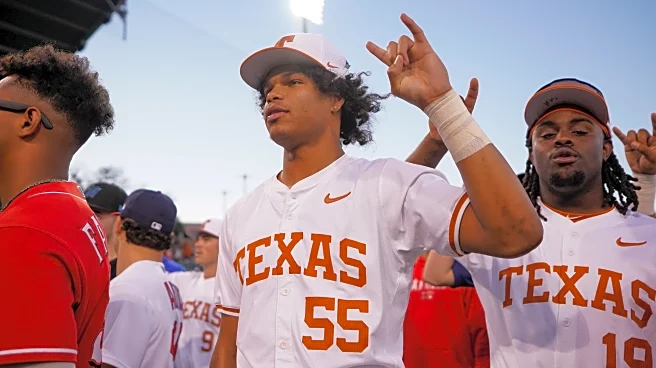

On a Texas Longhorns team that features enough talent to rank No. 3 in D1 Baseball’s preseason poll, the outfield is the one area where second-year head coach Jim Schlossnagle’s team faces some question
marks.
Those question marks don’t apply to Seton Hall transfer Aiden Robbins, who has received some preseason All-America buzz after choosing Texas over a host of other SEC powers after two standout seasons in South Orange.
The 6’2, 205-pounder was an instant-impact player as a freshman in 2024, starting 43 games and tying for the team lead with six home runs, leading the Pirates in slugging percentage at .512, finishing second on the team with a .302 batting average and 31 RBI, and slotting second in the Big East with five triples.
In 2025, Robbins took the next step with a sensational season, earning first-team All-Big East honors by leading Seton Hall in batting average (.422), runs (63), hits (86), doubles (19), total bases (133), walks (44), on-base percentage (.537), slugging (.652), stolen bases (20), and multi-hit games (26). Robbins also hit six home runs and drove in 38 in finishing fifth nationally in on-base percentage and sixth nationally in batting average.
From the right side, Robbins boasts a sweet swing with line drive power to all fields and enough athleticism to stretch singles and steal bases.
But whether Robbins plays center field or ends up in right, his starting role represents the only real certainty in the outfield after Texas lost Butler transfer Jack Moroknek and Georgia State transfer Kaleb Freemen to the 2025 MLB Draft.
It’s a tough time in the calendar to go find more help from the NCAA transfer portal, so quickly landing a former top-100 prospect in LSU transfer Ashton Larson represented something of a best-case scenario for Texas.
A 6’2, 210-pounder from Overland Park (Kan.) St. Thomas Aquinas, Larson was the No. 78 overall prospect and No. 13 outfielder in the 2023 recruiting class, according to Perfect Game. Selected in the 20th round of that year’s MLB Draft by the Minnesota Twins, Larson opted to honor his commitment to the Tigers.
Larson initially appeared on track to fulfilling his potential in Baton Rouge, playing in 53 games (40 starts) and batting .298 (42-for-141) with nine doubles, three home runs, 16 RBI and 25 runs as a freshman, making 33 appearances in right field, four in left field, and three at designated hitter.
In conference play, Larson was particularly good, batting a team-best .337 (28-for-83) in SEC regular-season games with eight doubles, three home runs, 10 RBI, and 16 runs. But injuries derailed Larson as a sophomore as he battled for playing time in a crowded outfield, receiving only five starts and hitting .256 in 39 at bats with a strikeout rate of 35.9 percent.
Despite those struggles, Larson fits the profile that Schlossnagle prefers — he’s a left-handed batter who can work the count with a .406 on-base percentage over his two seasons at LSU with a short swing and quick hands.
Larson is competing with sophomore Jonah Williams and freshman Anthony Pack Jr. for playing time in the outfield.
As the No. 10 prospect in the 2025 recruiting class, according to the 247Sports Composite rankings, Williams faces difficult decisions this spring about how to split his time between football and baseball.
The NCAA has strict mandates surrounding on-field time, so with the possibility of more playing time at safety this fall under new defensive coordinator Will Muschamp and returning defensive pass game coordinator Blake Gideon, who recruited Williams out of Galveston Ball, there will be more pressure on Williams to give up practice time on the diamond.
I would anticipate, as Jonah becomes more of a priority in the defense in football, that they’re going to want him around more, and that’s okay, that’s part of the deal,“ Schlossnagle said last month. I’ve been through that several times with football-baseball players, and it’s actually not that tough to navigate. Number one, you’ve got to make sure that you stay within the confines of the rules, because he’s only allowed 20 hours a week of activity. So luckily, a baseball game, even though, if it lasts seven hours, it only counts as three. But, yeah, we’ll work our way through it. And if anybody can handle that, Jonah can.”
There certainly aren’t any legitimate concerns that the 6’3, 213-pounder can handle those demands — he’s just that special — but there’s little doubt that Williams is behind his ideal developmental trajectory in both sports because of injuries over the last 16 months. Williams suffered a season-ending broken collarbone playing high school football as a senior that limited his offseason work with the baseball program. When he did get on the diamond, a hamstring issue nagged him throughout the season and into preseason camp on the gridiron.
Even since football season ended, Williams has been rehabilitating instead of switching his focus entirely to baseball.
“I don’t think he’s all the way back healthy, but he’s close,” Schlossnagle said during his Monday appearance on the Around the Horns podcast.
At stake is the gap between where the prodigious natural talent of Williams can take him during the 2026 baseball season and where he could be with the necessary practice reps to improve.
In 20 games as a freshman, including 15 starts, Williams flashed his upside, especially in clutch moments, batting .327 with 10 RBI and showing high-level bat-to-ball skills from the left side. And so although Williams only had a strikeout rate of 16.7 percent, he also drew just three walks. His three doubles were his only extra-base hits — to take the next step as a hitter, Williams needs to be able to more consistently drive the ball, an area of his game that may continue to lag due to the combination of injuries and his split focus.
Among the freshmen, the position player most likely to earn significant playing time is Pack, whose confident approach to the game earned a favorable comparison to Adrian Rodriguez from his head coach.
“He’s confident. He carries himself well, he’s bright eyed,” Schlossnagle said earlier this month. “And then you get in the practices, in the games, and he’s not spooked. He doesn’t take success and think he’s figured it out, and he doesn’t beat himself up with failure and have bad body language. He really knows the signs. He really knows the base-running system and all of those things that are kind of within your control, that you can learn.”
Ranked as the No. 32 player overall by Perfect Game, Pack is a speedster who produces surprising power from his 5’10, 190-pound frame.
“Great hitter, contact, quick guy who gets on base, controls the strike zone well, he lays off bad pitches, just gets on base any he can,” sophomore pitcher Dylan Volantis said.
One of the question marks surrounding the outfield is whether the Longhorns have enough depth behind the top four players to overcome injuries, a notable limiting factor for the 2025 team when slugger Max Belyeu broke his thumb and Williams suffered his hamstring injury.
The hope is for senior Jayden Duplantier to return to a utility and pinch-running role — his opportunities trying to hit in high-leverage situations went severely wanting. Competition for Duplantier include another potential utility player in freshman Maddox Monsour, who has shown promising signs with his bat recently, including a two-day stretch that featured a grand slam and a three-run home run against top-line Texas pitching. Also in the mix is another freshman, Will Hill, who has a promising blend of speed and power, and College of Charleston transfer Dariyas Pendergrass, a left-handed bat with plenty of experience.
When Schlossnagle regularly bemoans the lack of ideal program depth, he’s primarily talking about his outfield at this point, so in addition to needing the more unproven players like Williams, Larson, and Pack to step forward, the Longhorns also need some injury luck.