





Steve
Since becoming President of Baseball Operations and bringing Kriss Gross into the fold as VP of Amateur Scouting, David Stearns has primarily gone with players that fit a specific mold- younger, less experienced players who possess athleticism and encouraging batted ball data in limited at-bats- with his first-round pick since coming to the Mets, but there are no hitters that really excite me likely to be available when the team make their first pick. The batters who are likely to be available and reasonable
selections for the 27th overall pick have warts that concern me, such as hitters with in-zone swing-and-miss concerns or trouble lifting the ball, or players that are below-average athletes and/or below-average defensively at their positions and are better fits at first base than anywhere else on the diamond. For quite a few years now, the organization has had difficulties improving a number of players who have had these kinds of qualities at various levels of the minor league ladder, and I don’t know how much faith I have at this point in the organization being able to maximize those kinds of players.
Keeping with that in mind, I would like to see David Stearns and Kris Gross not go with their usual MO this year; there’s no indication that they will be, and the Mets have supposed connections to hitters, but a man can dream. The 2026 MLB Draft class is considered pitching-rich, and I’d like to see the Mets select a pitcher this year.
Of the prep pitchers who I think will be reasonably available when the Mets make their pick, I think Logan Schmidt or Coleman Borthwick have the highest upside. Schmidt, who attended Ganesha High School in Pomona, California, and Borthwick, who attended South Walton High School in Santa Rosa Beach, Florida, both have plus fastballs, sitting in the mid-to-high-90s. Schmidt complements his with a slurve that sits around 80 MPH and an upper-80s changeup. Borthwick complements his with a mid-80s slider and a mid-80s changeup. Schmidt has a commitment to LSU, while Borthwick has a commitment to Auburn.
Complicating matters a bit is the fact that the Mets don’t have a second-round pick, don’t have a fifth-round pick, and have the third-smallest bonus pool in the 2026 MLB Draft. While it would be an exaggeration to say that the Mets need to pick the right player with their first selection, there’s a steep drop off in talent between their first-round selection at 27 overall and their next pick, the 92 overall pick in the third-round. Historically, of the 61 players who were drafted with the 92 overall pick, 23 played in the majors, and of those 23, 12 produced 1.0 WAR or better, with J.A. Happ, Aaron Civale, and Tyrone Taylor being the most productive players taken there in the 21st century. Just last year, with the Mets losing out on their second-round pick due to signing Juan Soto, they selected Antonio Jimenez with their next pick. Jimenez has been…less than impressive in his minor league career thus far. Combine that with Peter Kussow’s season-ending labrum surgery, Peyton Prescott still rehabbing from his 2025 Tommy John surgery, and Nathan Hall being very slowly eased back into game shape after 2025 UCL internal brace surgery, and you can see how missing on earlier selections when you have limited picks can really set an organization back.
The level of risk in high school pitchers, from injury or from the steep learning curve going from amateur high school ball to professional ball, is high, making the selection of a prep hurler a potential roll of the dice in which snake eyes potentially means a draft class compromised at the top. Case in point: Brody Bumila, who had more upside than either of the aforementioned high school pitchers. He had UCL internal brace surgery in 2025, which concerned me enough that I probably would have passed if he was still on the board at 27, and sure enough, it was just revealed earlier this week that he has a true UCL injury and will now be having Tommy John surgery.
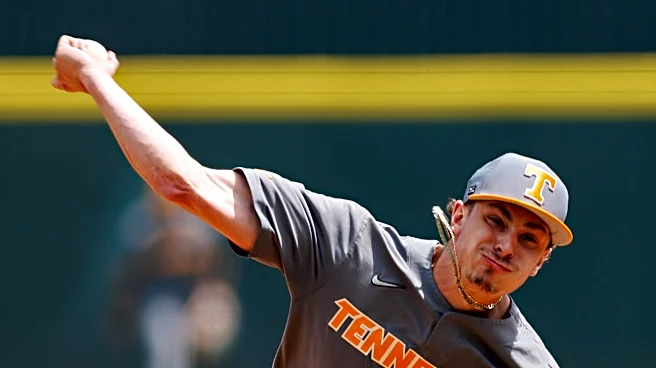
A selection of a more proven, more reliable collegiate arm would mitigate that risk, and among college pitchers in the 2026 MLB Draft class that would likely be available when the Mets make their first pick, I think Tegan Kuhns or Cole Carlon have the highest upsides. Kuhns is a right-hander from the University of Tennessee, while Carlon is a left-hander from Arizona State University. Kuhns throws a mid-to-high-90s fastball and complements it with a high-70s curveball, low-80s slider, and mid-80s changeup. Carlon, on the other hand, throws a fastball that sits in the high-90s and complements it with a high-80s slider, high-70s curveball, and mid-80s changeup.
Whatever happens this year, given the current state of the minor league system, any kind of talent infusion is welcome.
Lukas
Let’s quickly review the reality of the Met’s draft situation. Because they spent beyond the third luxury tax last year, their first round pick dropped 10 spots to #27 overall. Because they signed Bo Bichette (oops), they’ve lost their 2nd and 5th round picks in the draft as well. That means that they have the third smallest pool of any team at $6,730,900.
Let’s also quickly review the last two draft picks the Mets have made in a similar position, Carson Benge and Mitch Voit. Both were two-way college players drafted mostly as hitters. Both were draft eligible sophomores. Both had twitchy athleticism and a track record of college success. Both showed promising bat speed traits. And both desperately needed a swing change (well, Benge sort of made his in college already, but you get the point). Both took below slot deals (Voit significantly more so than Benge). Putting those pieces of evidence together, you get a decent idea of what the Mets might do with their pick this year. They’re likely looking for a college hitter with promising athletic and bat speed traits, but who also has the sort of flaws that will make him available at 27 for less than slot. Someone who is a draft eligible sophomore and/or a two-way player is a bonus.
Chris Rembert seems to fit this mold quite well. He’s not a two-way player, but he is a draft eligible sophomore slashing .343/.399/.459 in the SEC (and posted a 1.431 OPS on the cape last summer). There’s contact skills, bat speed, and for the moment an up the middle profile, though he’s not the same tier of defender as Voit or Benge. Right now, he’s limited by a swing that doesn’t tap his raw power and gets the ball on the ground far too often. Fix the bat path though? Then you might have a fun little 2B/3B dynamo that the Mets can steal at the back of the first round while saving money to boot.
I am going a bit off the board for my second name here, and I’ll note up front that I don’t
think he’d actually get selected at #27: Caden Ferraro, outfielder at Texas Tech. That said, he’s had some late buzz and ticks all the right boxes; bat speed, good approach, high-end in-zone contact (92% in 2026), more walks than strikeouts, and emerging power. If the Mets can optimize his spray a bit and get him pulling the ball in the air more frequently, there’s serious power potential. Even without that, he’s a good all round offensive player, albeit one that likely doesn’t offer a ton of defensive value. Maybe that’s not a 1st round pick in most contexts, but you could do worse if you were looking to cut early and reallocate that money elsewhere.My original name here was Brody Bumila before it was announced he had a UCL injury. He’s now not likely in the first-round picture any longer.