

Twelve months ago, we argued that the media driven doom-and-gloom around Real Madrid’s finances, like the discussion around the billion-euro stadium, the concert-noise fiasco, the supposedly suffocating transfer policy, it simply wasn’t reality. The club had built one of the sturdiest financial structures seen across any sport and had the headroom to invest whenever the board chose to pull the trigger.
Call this article Part II to last season’s piece.
Given Madrid is about to spend €120 million on a teenager,
another potential €65M on an 30-year-old superstar, €60M on Cucurella, €23M on Dumfries, some loftier wages/bonus structures for high-profile free agents—the question is fair to ask: is this a one-time aggressive summer pushing Madrid past their own financial guardrails or is this type of transfer outlay the new normal? The club spent nearly €200M last summer and look set to pay €275M this summer. Does this mean a big sale is coming? Is the Vini renewal off the table?
Those questions will all be answered. The best way to answer those questions is to run the same three-metric health check we ran last summer in Part I— salary-to-revenue, amortization-to-revenue, and cash flow versus debt — but this time against audited 2024/25 numbers rather than projections, and with some assumptions going into the new season.
Long story short, the club is in a great position even after the potential Diomande+Rodri deals, and even including a Vinicius renewal. Despite a projected quarter-of-a-billion-euro outlay, every core ratio still lands inside the club’s own guardrails.
The 2025/2026 approved budget called for approximately €1.25 billion of revenue. The underlying business is now firmly operating in the €1.2–1.3 billion annual revenue range and growing each year. In 2021, the club generated approximately €640 million in revenue. Madrid have essentially doubled that revenue base in four years. An insane feat that deserves greater recognition.
That means a €200 million transfer window or a 16% increase in wages does not carry the same relative financial weight that it would have carried before the stadium redevelopment and commercial expansion.
Player Salaries as a Percentage of Revenue
This has always been the number that best captures Madrid’s discipline, and 2024/25 is the cleanest reading yet. Total wages rose only €9M (2%) to €514M while revenue jumped €112M . The wage bill actually fell as a share of income, landing at roughly 43%. For context, this is a club that during the COVID seasons was pinned above 70%, well beyond the 50% ceiling the European Club Association treats as the gold standard. Mbappe is on the books, and the ratio still improved.
So what happens when you drop this summer’s business on top?

Even after potentially adding six major contracts, Madrid would still be operating below the 50% threshold that the club has spent years working to restore. Model it out on a projected ~€1.30B of 2026/27 revenue and the wage bill lands around 44%, still comfortably inside the 50% line. The Mbappe-era question (“can they keep paying elite wages and stay disciplined and add RM level talent to the squad in subsequent years?”) now has two years of answers: yes.
Amortization as a Percentage of Revenue
The headline transfer expenditure will inevitably attract attention.
Assuming Madrid pay approximately:
€120–130 million for Diomande
€65–75 million for Rodri
€83-100 million for Cucurella, Dumfries, Konate, Bernardo (*incl bonuses)
The combined transfer commitment would be approximately €275–300 million.
But clubs do not typically recognize the full cost of a transfer in the year the player is purchased. The fee is capitalized and spread across the contractual term. A €125M signing on a six-year deal isn’t a €125M expense; it’s roughly €21M a year.
Even at the upper end of the proposed fees, the two transactions (Rodri, Diomande) would probably add €37–41 million of annual amortization.
A €275M gross outlay this summer adds only about €50M to the annual amortization line, assuming five-to-six-year contracts. That’s the magic of the mechanism, and it’s exactly the point we made last year about a “war chest” not being spent all at once.
Stack that on the 2024/25 base of €116M, annualize last summer’s signings (Huijsen, Carreras, Mastantuono, Alexander-Arnold), and net off the fully-amortized players leaving, and 2026/27 player amortization projects to roughly €180M — about 14% of revenue. After the club spent 2024/25 sitting at a remarkably low ~10%, it climbs back toward the top end of their guardrails but still lands under the 15% prudence line.
The club remains well below the 23% level seen during COVID (ECA qualifies 25% as the max threshold and dangerous if above that metric) following the purchases of Eden Hazard, Luka Jovic, Eder Militao, Ferland Mendy and Reinier.
Metric 3 — The thing that makes it all work: Revenue
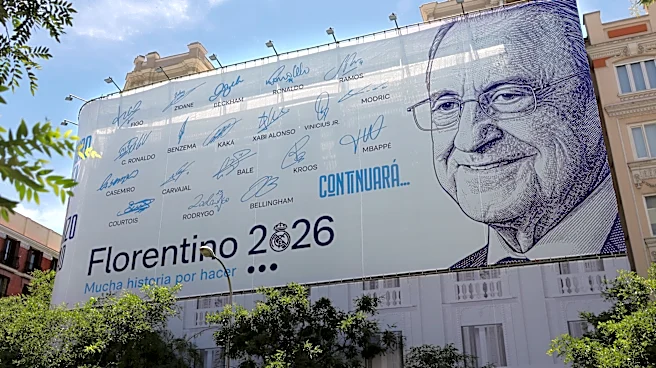
None of the above is possible without the denominator doing the heavy lifting, which is revenue that continues to grow. What concerned me about Enrique Riquelme’s presidential campaign was his focus on cutting costs rather than growing revenue. Florentino and his board have done a tremendous job in growing the club’s revenue streams, which is the ultimate driver in allowing the club to flex it’s muscle in the transfer market. Every stream inside the club’s control grew again in 2024/25: marketing/commercial up 18%, membership and stadium income up to €326M, and international competitions and friendlies up 26% to €190M as the finished Bernabeu ran a full events calendar for the first time. The lone laggard is the same one as always: broadcasting fell 10% to €162M. It’s why Florentino and Madrid continue to look for other opportunities to control TV broadcasting rights or earn their fair share.

The concert-noise saga flagged last year? Still irrelevant. The stadium income comes primarily from hospitality, sponsorship, VIP seats, and matchday, those are the big levers.
The Academy Has Quietly Financed a Major Portion of the Window
The most remarkable part of Madrid’s summer may be the income brought in from former academy players. Madrid’s strategy of selling academy players while retaining 50% of their economic rights has become an extraordinarily productive financial model. Wrote about the concept of La Fabrica being a “cash cow” six years ago, and it still holds true. This summer has demonstrated the full power of that model.
Reported proceeds connected to academy players and retained rights include:
Nico Paz retained rights / transfer proceeds
€60M
Víctor Muñoz retained rights
€20M
Álvaro Rodríguez retained rights
€12.5M, potentially rising
Miguel Gutiérrez retained rights
€9M
Álex Jiménez retained rights
€10–15M
Fran García-related proceeds
€4M
Mario Martín and other academy transactions
€7–10M
Estimated total
€122.5–130M+
Madrid have generated approximately €125 million this summer from players who were not meaningful members of the current first-team squad. Fran Garcia was the only player on that list to play more than 10 first team games for the club.
And because academy players generally carry little or no remaining book value, most of the proceeds can be recognized as accounting profit immediately. If Gonzalo Garcia goes for €40-50M, that number gets even larger:

On an accounting basis, Madrid’s academy sales are immensely valuable because the players carry little remaining book value. Approximately €125 million of proceeds could translate into close to the same amount of profit from player disposals. If given the choice of selling an academy prospect for €30M or a first team player still carrying book value for the same offer, the financial metrics will lean towards selling the academy player. The two €30 million fees are not recorded equally, the first-team player’s remaining book value must be deducted from the sale price. So selling players with no book value brings in €125M on the year, meanwhile Rodri and Diomande, would add only approximately €38 million of annual amortization.
Summer 2026
Run the whole thing together and the picture is almost boringly solid:
• Salary-to-revenue: ~44% (target <50%) ✓
• Amortization-to-revenue: ~14% projected (target <15%) ✓
• Gross summer outlay: ~€275M in fees → only ~€50M added annual amortization
• Profit from academy/fringe sales: €120M+, near-pure profit
• Cash flow: EBITDA €208–243M covers €40M stadium service ~5×
• Net debt (ex-stadium): €12M — effectively zero
• Cash reserves: €166M · Equity: €598M · Debt/EBITDA: 0.0×
The bottom line hasn’t changed from last year and this type of summer can be the new normal for Madrid assuming revenue holds or continues to grow. Madrid can sign Rodri and Diomande, hand free-agent wages to Silva and Konate, buy Cucurella and Dumfries, and still walk out of this window inside every internal guardrail they set for themselves. This is the framework Florentino and his team have built over 20 years as president and he is seeing the fruit of his labor.