
From the moment Derrick White joined the Celtics, there hasn’t been a more seamless fit alongside Jayson Tatum and Jaylen Brown. You could see it in his debut, when his first two plays created a layup and a dunk for the Jays. Right away, it was clear he’d fill the gaps and support Boston’s stars.
White does role player things at an All-Star level, all while playing on one of the league’s best value contracts. His ability to scale his role up or down depending on what the lineup needs has left much
of the NBA searching for their own version of him.
Boston, however, may have already found the solution.
Rather than searching for the next Derrick White, the Celtics have quietly begun using him as the blueprint for developing more.
Over the years, White’s game has expanded as he’s taken on a larger role as a creator. He’ll always be a connective player, but his impact is now far more visible within Boston’s offense.

As White has more responsibility to create advantages, someone else has to extend them. Fortunately for the Celtics, their growing army of Derrick Whites is up to the task.
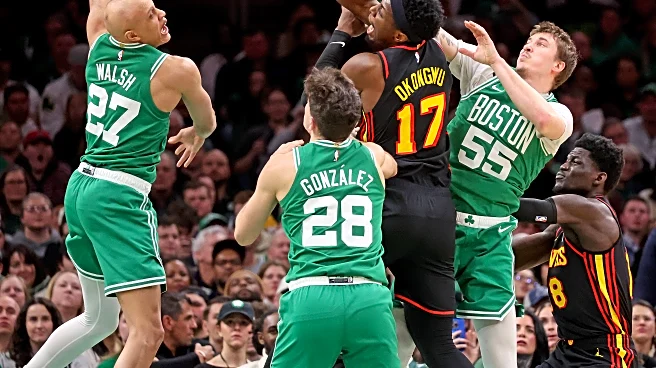
Boston’s newest wave of role players — Baylor Scheierman, Hugo Gonzalez, Jordan Walsh, and Ron Harper Jr. — aren’t being asked to manufacture offense on their own. That responsibility already belongs to Boston’s stars.
Instead, they’re asking them to do something far more specific: attack advantages and keep the ball moving. The guiding principle is simple. When the ball finds you, decide immediately. Shoot. Drive. Pass. Just don’t let it stick.
It’s the idea of “.5 offense”, which refers to making a decision within half a second of the catch. It has become a defining trait of Boston’s role players this season.
White brought that philosophy with him from San Antonio, and it’s a significant part of what’s made him so effective throughout his career. He always knows exactly how to kill a defense in rotation.
Now Boston is asking its young role players to operate the same way. When teams are in scramble mode, instant decisions lead to breakdowns and open looks.
The amount of true one-to-one comparisons is small. It is not my goal to argue that any of these players are the same, or project to be as good as White. But they are pulling from the area of his skill set that makes him a perfect complement to any lineup.
The results often show up in smaller moments, but that fast processing is a large reason why the Celtics have maintained a top-two offense in what many expected to be a down year.
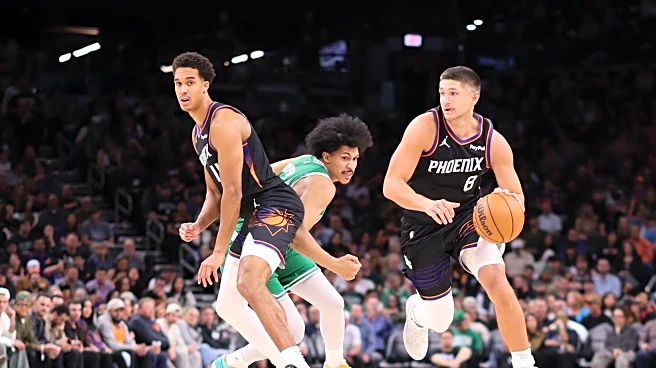
This possession starts with Payton Pritchard beating the closeout, getting a deep paint touch, and kicking out to Gonzalez. Hugo and Harper Jr. effectively have a 2-on-1 as Brandon Podziemski tries to cover both until a teammate rotates. Hugo’s quick pass sends Podziemski to the corner, but Harper Jr. doesn’t wait a beat before giving it right back. Kristas Porzingis is the closest defender in rotation, but Gonzalez made up his mind right away that he’d attack while they’re on their heels.
The margins are thin in the NBA. If Harper Jr. or Hugo hold the ball a touch longer, the advantage falters. Being decisive is the key to a more dangerous offense. When you have Tatum, Brown, White and Pritchard leading the attack, the game doesn’t need more isolation.
This is a similar circumstance as the previous clip. Brown draws several defenders on the drive, and his kick out forces the defense to rotate. Like Podziemski, Keon Ellis attempts to cover two to buy his team time. He rotates, but keeps himself in the passing lane, ready to fly back toward Simons. Scheierman, identifying that immediately, holds Ellis in no-man’s land with a brief glance and ball fake before pulling the open shot.
When you have an edge this significant, hesitating is the only bad choice.
Here, it’s a situation in the clutch against the Knicks that features a comparable rotation by Miles McBride. Jordan Walsh may have had a brief window to shoot, but McBride commits fully to the closeout. As quickly as it arrives, the ball is out of Walsh’s hands and off to White. Walsh simply keeps the advantage alive, trusting the next decision in the chain.
The right play can be fluid in these cases, but it boils down to how fast you can identify and attack a defense under pressure. There’s rarely a bad time to shoot in Mazzulla’s offense, though if you’re passing up a shot it should be for an option that keeps things humming.
There is simplicity in good execution, and it can be destructive for defenses when it leads to repeated breakdowns.
Whenever a Celtics role player has a breakout moment, the reaction tends to be the same. How do they keep finding these guys? Where do they keep coming from?
For years, Derrick White has been the Celtics’ ultimate advantage extender. The player who understands exactly how to punish a defense that’s already rotating. Now that same philosophy is showing up across the roster.
Baylor Scheierman, Hugo Gonzalez, Jordan Walsh, and Ron Harper Jr. aren’t being asked to become Derrick White. But they are learning to play the part of the game that makes him so valuable. Fast, confident decisions will take them a long way.
According to Sports Info Solutions, the Celtics currently rank 1st in the NBA in Advantages Reduced per 100 possessions. Essentially, this measures how often a team’s edge stalls out through hesitation or poor decision-making. While their creators spark the initial scramble, the young role players help to ensure that an advantage is rarely wasted.
The Celtics may never find another Derrick White. By teaching his brand of basketball, they might not need to. The organization’s attention to detail has already helped develop several new connective pieces into real contributors.