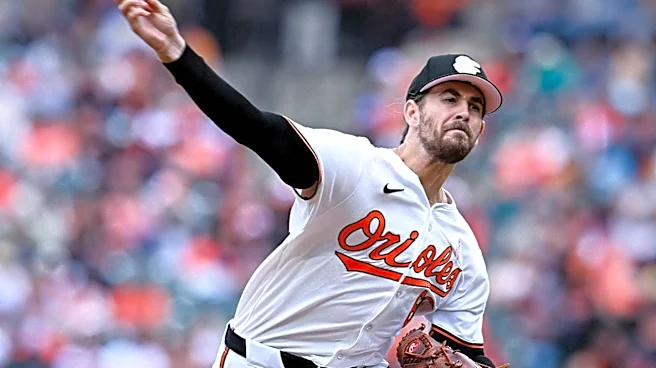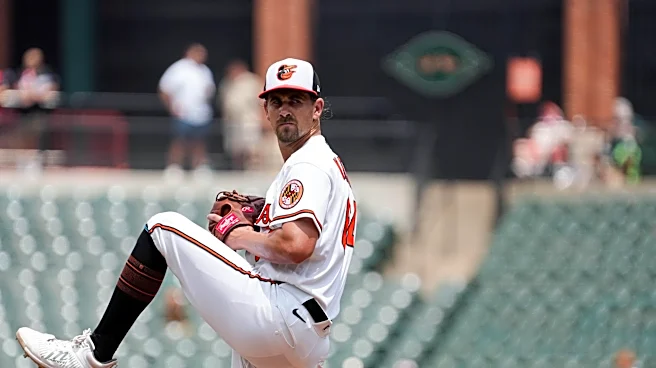






The Orioles have had a lot of things go wrong in 2026, but let’s just pause to appreciate the fact that, for one sweltering July afternoon at Camden Yards, something finally went right. Dean Kremer, back after a nine-week absence with a right quad strain, threw six innings of one-run ball to snap his team’s four-game skid and beat the White Sox, 6-1. It was vintage Kremer: unspectacular stuff, with four strikeouts, one walk, a lot of soft contact. And just the stopper outing that the Orioles needed,
as their staff and their team struggle with injuries and inconsistencies.
Unspectacular but dependable has been the story of Dean Kremer’s career (his hair is spectacular, but that’s another story). Last year was typical, as he posted a 4.19 ERA, 1.21 WHIP, and a 142:45 strikeout-to-walk ratio over 31 outings and a team-leading 171.2 innings. Over his career, pretty similar: a lifetime 4.23 ERA and 1.281 WHIP across parts of seven seasons. Kremer is, almost to a T, the definition of league average (a 96 ERA+ suggests he’s just a notch below).
But maybe we’ve underappreciated Dean Kremer. It was a shock, to me at least, when the multi-year veteran was optioned to Triple-A Norfolk at the start of this season, deemed unworthy of a rotation spot by the front office what with newcomers Shane Baz and Chris Bassitt on the team, and Zach Eflin and Kyle Bradish back and ready to pitch. We’re rarely excited to see the name “Kremer” penciled in for the start that day, but considering what Baltimore’s rotation has been through this year, I think we should roll out the orange carpet for him.
Consider the state of things around here, pitching-wise. Zach Eflin’s season ended after a single start. Chris Bassitt is on the 15-day IL after having a bone spur removed from his back. Kyle Bradish, back from Tommy John surgery, has been maddeningly uneven, capable of stringing together the kind of dominant stretches (back-to-back gems in mid-June, including eight scoreless innings in Anaheim) that recall his 2024 near-Cy Young form, but also clunkers where he suddenly loses control. Shane Baz keeps flashing the upside that made him a four-prospect return but he, too, is frustratingly inconsistent. Trevor Rogers started the season with an ERA above 10.00 in May. Improbably, Brandon Young, an undrafted 27-year-old who started the year in Triple-A, may quietly be turning the best season of any Orioles starter, sitting on a 3.11 ERA with a 6-2 record across thirteen starts. And Trey Gibson, a well-regarded prospect, is carrying an ERA north of 7.00 in eight appearances (seven starts).
So where does Kremer fit in, now that he’s been reactivated? Kremer’s activation came with two corresponding moves: catcher Dom Keegan was designated for assignment, and, more relevantly for this conversation, the 24-year-old Gibson was optioned back to Norfolk, along with lefty Josh Walker. Gibson seems like he just isn’t ready: that answers the immediate question. Kremer didn’t push out Brandon Young, who’s been one of the best stories on the pitching staff all season. He pushed out the struggling Gibson based on performance, which makes that call an easy one.
The more interesting question is what happens next, once Bassitt himself is back in the mix. Baltimore has flirted with a six-man rotation before, and the appetite for it hasn’t gone away. Elias himself left the door open on it back in spring training, framing the five-man start to the season as “a calendar decision rather than a capability verdict.” Orioles beat writers have been thinking along the same lines: one recent SI analysis argued that “a six-man rotation when Kremer comes back makes all the sense in the world,” noting that trying to squeeze 180 innings out of a pitcher who spent two months hurt would be needlessly risky.
My guess: expect a soft six-man look before a hard one. The O’s don’t have to commit to it formally: they can simply use built-in off-days to space Kremer’s next couple of starts out, buying him extra rest without officially subtracting a bullpen arm. But if Bassitt returns healthy in the next few weeks, the numbers game becomes unavoidable: Rogers, Bradish, Baz, Bassitt, Young, and Kremer make six established arms for five spots, and Baltimore would be stupid to non-tender or bury any of them.
Then there’s the W-L record issue, too. So far, Orioles public faces are insisting that the team still sees itself as a buyer, but at 40-48, that gets harder and harder to justify. A formal six-man rotation, at least for a stretch, feels like the path of least organizational resistance—especially for a team that doesn’t need to squeeze every marginal inning out of a thin roster before the July 31 deadline sorts out who’s actually staying and who’s going.
For now, though, the answer is simpler than the six-man speculation suggests. Albernaz called Kremer on his return a “steadying” presence, someone who can “navigate the game and control his emotions, slow heartbeat,” the kind of veteran presence the club had missed. Kremer didn’t take anyone’s job so much as reclaim his own, and maybe for that, we should be glad.