

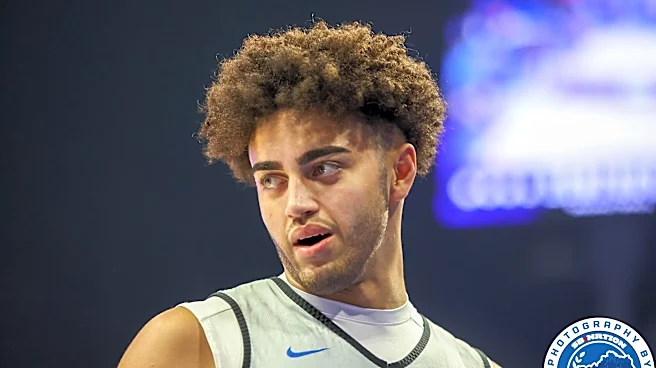
Elijah Gertrude has spent most of his Virginia career waiting.
He waited on a knee that had to be rebuilt twice. He waited behind a backcourt that won 30 games. And when he did get on the floor, it was usually after the outcome had been decided.
This preseason, the wait may finally be ending.
Gertrude, a 6-foot-4 guard from Jersey City, N.J., was a four-star recruit and a top-40 prospect nationally, per 247Sports, when he committed to Tony Bennett in 2022. He is now the last remaining scholarship holdover
from the Bennett era. Last season, he appeared in 17 games, played about six minutes a game and made two of his 14 three-point attempts.
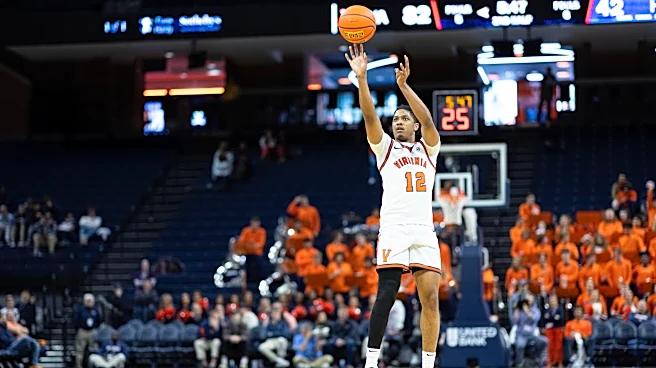
Through two exhibitions this fall, he looks like a different player. He led Virginia with 10 points in the loss to Vanderbilt in Charleston. Against Richmond last Friday, he scored 11 on 3-of-5 from three and played 17 minutes, more than Jurian Dixon, Chance Mallory or Nolan Adekunle.
“He’s shooting the ball much better. He’s handling the ball much better. He’s defending at a high level,” Odom told VirginiaSports.com last week. “He’s a guy that we’re gonna count on this season.”
After three years of rehab and garbage time, Gertrude is finally healthy, and two exhibitions suggest he can win a share of the backup minutes at the two. But only if he plays within himself, makes open threes and stays out of foul trouble.
This is the sixth in our series of preseason profiles. Our profiles of Chance Mallory, Christian Harmon, Jurian Dixon, Kalu Anya and Sam Lewis can be found here.
Two seasons, 33 games
Gertrude was not supposed to play as a freshman. He tore his ACL before his senior season at Hudson Catholic and missed the entire year, and he arrived in Charlottesville still building the leg back. He was planning to redshirt in 2023-24 until backup point guard Dante Harris rolled his ankle in practice, and Bennett threw him into his debut against No. 14 Texas A&M on Nov. 29, 2023.
For a month, he made the most of it. Over his first seven games, Gertrude averaged 13.3 minutes and scored a career-high 13 points against NC Central. More notably, he showed the defensive tools that made him a coveted recruit. Per 40 minutes in that stretch, he averaged 3.4 steals and 2.2 blocks.
Then his role faded. From January on, he played 6.8 minutes a game and shot 6-of-26 from the field. He finished the season with 3.4 points per game in 16 appearances.
That spring, the knee gave out again. On April 30, 2024, Gertrude was riding a scooter near Memorial Gymnasium when he hit a manhole cover and re-tore the same right ACL, with additional damage to the knee. He had surgery that May and missed all of 2024-25.
When he returned under Odom last season, he was still getting his legs back under him. He got an early look, playing 10 to 13 minutes in each of the first four games, but shot 5-of-14 in that stretch, and Virginia’s backcourt of Dallin Hall, Mallory, Malik Thomas, Jacari White and Sam Lewis left little room. Over his final 13 appearances, Gertrude averaged 4.6 minutes. He finished with 1.7 points per game.
There were flashes. With 1:24 left in a 90-61 win over NC State at John Paul Jones Arena, Gertrude crossed over, drove the lane and threw down a one-handed slam across his body. It was a reminder of the athleticism that made him a four-star recruit, and the kind of play that has made him a fan favorite.
But most of his minutes have come in games that were already decided. Eleven of his 17 appearances last season came in games decided by 20 or more points. In the five career games he has played that were decided by 10 or fewer, he is 2-of-14 from the field. Between two knee reconstructions and a roster full of veterans, he has rarely had a real chance to show what he can do.
The fight for the backup two
Odom has made clear that last season was not a condemnation of Gertrude’s abilities. “There’s no shame in not being a part of the rotation last year,” he said this month. But earning a spot this year will not be easy.
Virginia is deep again. As many as 13 players have a case for minutes. But depth is not the same as quality. I do not expect this bench to match last year’s, when Mallory, White and Ugonna Onyenso gave Virginia starter-level production off the bench. At points last season, you could argue that those three were not only better than some of the starters but among the most important players on the team. As a result, I expect Virginia’s starters to play more this season, somewhere in the range of 25 to 30 minutes a night.
Bart Torvik’s projections agree. Virginia’s top five are projected to play about 30 minutes apiece, leaving roughly 50 minutes a night for everyone else.
For Gertrude, the opening is at the two. With Lewis starting at shooting guard in the bigger lineup Odom has used in both exhibitions, the backup minutes there come to roughly 10 to 12 a night, alongside Mallory or Jan Vide at the point. Gertrude is competing for them with Dixon, the UC Irvine transfer whom I initially projected as Virginia’s sixth man, and Harmon, who has not played yet but is expected back soon, according to UVA.
The opening is narrow, but it is there.
So far, Gertrude has the edge. Against Richmond, he played 17 minutes to Dixon’s 11 and made three threes while Dixon went 0-of-2. Through two exhibitions, Gertrude is 4-of-7 from three, and Dixon is 1-of-4. Still, Dixon and Harmon were both all-conference performers a year ago, so Gertrude beating out both would be a surprise after much of the offseason discussion. The preseason does not guarantee minutes, but it is a positive start.
Torvik’s model is not convinced. It projects Gertrude to play 5 percent of Virginia’s minutes, about two a game, the lowest of anyone in its top 10. While I do not buy Torvik’s numbers exactly, they are a reminder of how far he has to climb.
What I will be watching
Gertrude has the tools. Here is what will decide whether he earns minutes.
Composure and shot selection. In his limited minutes, often in garbage time, Gertrude has tried to prove himself. He has forced shots and manufactured offense, and at times he has not looked composed. The numbers back that up. In games decided by 20 or more points, he has taken 15.3 shots per 40 minutes. For context, Dixon took 17.4 per 40 last season as UC Irvine’s No. 1 option. In closer games, Gertrude’s rate drops to 10.9. With a defined role and better players around him, he should not need to manufacture anything. Richmond was a good start: seven shots, three made threes and no turnovers. Fewer forced shots and a few assists will tell me he is playing within the offense.
The three-point shot. This has been the question since he committed. In 2022, Streaking the Lawn wrote that the next step in his game was extending his range. Three years later, he is 3-of-29 from three for his career, and he never made more than one in a game until he went 2-of-2 against American last December. This preseason, he is 4-of-7. Playing next to Mallory and Vide, he will get open catch-and-shoot looks. If he makes enough of them that defenses cannot ignore him, he will stay on the floor. His free throws (57.1 percent for his career) also need to improve.
Fouls. Gertrude has committed 4.3 fouls per 40 minutes in his career, and he picked up five in 17 minutes against Richmond. For a backup who will play in short stints, foul trouble cancels out the defense he is out there to provide. He needs to stay aggressive on the ball without picking up cheap fouls.
The defense, at full health. This is his best case for minutes. As a freshman, Gertrude averaged 2.9 steals and 1.8 blocks per 40 minutes, and his block against Vanderbilt was Virginia’s only one of the game. “He’s long and he’s quick, so he can deflect passes,” Odom said. Virginia committed more turnovers than it forced last season (389 to 376), so a guard who creates them has value. Last season was still about getting his legs back. This offseason, by Odom’s account, was about his game. If he can slow the game down to leverage his physical tools on defense and his steal rate returns to freshman levels in real minutes, he will be hard to keep off the floor.
Villanova next Thursday, the Drexel opener on Nov. 3 and Arkansas on Nov. 8 should go a long way toward settling the backup-two rotation.
What would count as success
Per 40 minutes for his career, Gertrude has produced 12.8 points, 5.1 rebounds and 2.0 steals. But that sample is small and scattered across two seasons, so minutes are the better measure. At his career rates, five minutes a night is worth about 1.5 points, and 10 minutes is worth about three.
The floor: last season again. Once Harmon is healthy, Gertrude is the odd guard out. He sees a few minutes a night, mostly in blowouts, scores one or two points and is still pressing when he gets in. That is essentially Torvik’s projection.
What I would call a success: a real role in the backup-two timeshare. He plays four to seven minutes most nights, scores two or three points and makes open threes at a respectable rate on limited attempts. More importantly, he plays in close games and big nonconference games, not just blowouts, and holds up defensively in short stints without foul trouble.
The breakout: he wins the backup two job outright over Dixon and Harmon and takes most of those minutes, eight to 10 a night, scoring three to five points. He leads the team in steal rate, and Odom trusts him in close games against the best guards on the schedule.
My pick is the middle tier, something I do not think I would have predicted before the last two exhibitions. That may not sound like much, but for a player who has spent three years either rehabbing or watching, earning trusted minutes on one of the nation’s best teams would be a real step.
It would also be a fitting reward. Gertrude stayed through Bennett’s retirement, an interim season and a year with almost no minutes, when some speculated he would transfer. That loyalty is a big part of why fans have embraced him. In an era when players with his résumé usually leave for a bigger role somewhere else, he chose to stay and compete for one here.
Now, healthy and with a real opening, he has a chance to earn it.