



Often, we hear about those who contributed to the New York Yankees’ best years in franchise history. Those names are etched not just on the walls of Yankee Stadium, but also on some in Cooperstown through the Baseball Hall of Fame and, of course, in the videos of their work in the biggest moments.
But quite a few who departed the organization prior to their winning ways would help them reach greatness in a roundabout fashion. And we’ll talk about one of those players today, who not only left before
the best years of the club, but also found the best years of his career along the way with another.
Sterling Alex Hitchcock
Born: April 29, 1971 (Fayetteville, NC)
Yankees Tenure: 1992-95, 2001-03
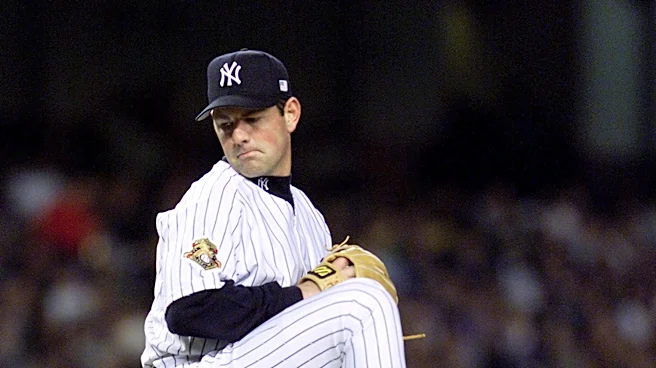
Sterling Hitchcock was born in North Carolina and attended Armwood High School in Seffner, Florida. Selected in the ninth round of the 1989 MLB Amateur Draft by the Yankees out of Armwood, despite initially committing to the University of South Florida to play ball he signed with the club instead, earning himself a $50,000 signing bonus.
Hitchcock had a quiet confidence about him, and scouts loved the lefty’s approach, ultimately earning him multiple appearances on Baseball America’s Top 100 Prospects list. He worked his way up the ranks of the minor leagues before jumping from Double-A Albany-Colonie straight to the majors, making his MLB debut in pinstripes at the age of 21 on September 11, 1992. He tossed six innings against 39-year-old George Brett’s Kansas City Royals, allowing six hits, one walk, and three earned runs, though he only fanned a couple batters and took the loss. That was one of three games he pitched for the Yankees that season, and the other two didn’t go nearly as well. Hitchcock only saw seven innings across the two, giving up 12 earned runs in 13 total innings pitched with six walks and six strikeouts to his name. He finished with an 0-2 record and an 8.31 ERA.
Hitchcock spent most of 1993 at Triple-A Columbus and was only solid, but he did have a much better showing when he was tapped for another look at the big-league level. In 31 innings pitched, he struck out 26 batters and walked only 14 with an ERA of 4.65 in the six starts — including shutting out an up-and-coming Cleveland lineup through seven in his season debut on August 26th.
By overall ERA, Hitchcock’s 1994 was better, but it was honestly a year he’d probably have preferred to forget. He got himself in hot water by criticizing the Yankees’ organizational development strategies in spring training, and while he did appear in 18 games for New York in the first half, they were all out of the bullpen. Hitchcock never fully found his rhythm as a lefty reliever and was eventually optioned to Triple-A with a 6.27 ERA. At Columbus, he built back up as a starter, and he did have a 2.93 ERA across five starts for New York when given another chance in late July, but the players’ strike cut that season short on August 11th with the rebuilding Yankees holding the AL’s best record.

Manager Buck Showalter entrusted Hitchcock with a rotation spot in 1995, and he acquitted himself nicely at age-24, starting 27 games with 168.1 innings of league-average ball, recording 2.2 bWAR. He shined brightest down the stretch when the Yankees couldn’t really afford to lose any games as they desperately hunted down a Wild Card berth with a 22-6 final month. Hitchcock threw a complete game in a 2-1 victory over the Blue Jays on September 20th and followed it with seven innings of two-run ball in a win in Milwaukee on September 26th.
Given the ball for the regular-season finale in Toronto on October 1st, Hitchcock knew that if the Yankees won, then his team would snap its 14-year postseason drought. Rubén Sierra and Pat Kelly helped give him a 4-0 lead by the bottom of the second, and the lefty made it hold up with 5.1 innings, striking out six while allowing one run on five hits and two walks. He ran into some jams but mostly escaped them, and reliever Bob Wickman induced a double-play ball to escape his last hurdle in the sixth. The bullpen kept the Jays at bay and the Yanks — and Don Mattingly — finally had their playoff spot.
Alas, there was no room for Hitchcock in the playoff rotation, thanks to former Cy Young Award-winning starters David Cone and Jack McDowell, the surging Scott Kamieniecki, and another young southpaw by the name of Andy Pettitte, who outpitched him. Hitchcock was ineffective in relief in both of his ALDS appearances, and the Seattle Mariners won a New York heartbreaker in five games.
Following the 1995 campaign, the Yankees underwent some upheaval on and off the field and Hitchcock was deemed expendable for the right cost. Indeed, he was traded to those same Mariners as part of a package that brought over a legend of the late ’90s Yankees: Tino Martinez. He started 35 games for the M’s and racked up a 5.35 ERA before Seattle sent him to the San Diego Padres in a deal for Scott Sanders, a right-handed pitcher. The 1997 season was somewhat forgettable for the left-hander, but it was 1998 when Hitchcock really shone, not just in the regular season but in the playoffs as well.
Hitchcock pitched in 39 games (and started 27) for the pennant-winning Padres in 1998. He threw 176.1 innings and finished with 158 strikeouts and a 3.93 ERA, the lowest of his career for one season where he pitched at least 10 games with one team. But in the postseason, he received his flowers. Hitchcock not only won both of his starts in the NLCS with a 0.90 ERA, but also overall in the 1998 playoffs, he was 3–0 with a 1.23 ERA and 32 strikeouts. He was awarded the National League Championship Series MVP Award as a result of his heroic performance against a favored, All-Star-filled Atlanta Braves team.
In an absolute David vs. Goliath matchup in the Fall Classic against Hitchcock’s old club, the Padres were swept by the Yankees. Hitchcock gave it his best effort in Game 3 in San Diego, going pitch-for-pitch with former teammate Cone and only really getting burned by eventual World Series MVP Scott Brosius (as did Trevor Hoffman).
Hitchcock pitched for the Padres up until 2001. He dealt with injuries, including Tommy John surgery in June of 2000 when he only threw 11 games for the team. Shortly after returning to the team the next season, he was dealt back to the Yankees for a couple of minor-league players. New York wanted better rotation depth and was interested in seeing what the 30-year-old had to offer. His 4-4 record belied how he actually pitched (6.49 ERA) across 10 games, and once again he ended up near the back of the Yankees’ playoff depth chart.
Unfortunately, Hitchcock had rejoined the Yankees just in time to see their championship run come to a close, Luis Gonzalez’s World Series Game 7 heroics ending dreams of a fourth consecutive title. Hitchcock, at least, could lightly console himself with the fact that he’d won one of the games during the Yankees’ furious mid-series comeback in New York. After Brosius’ ninth-inning heroics tied Game 5 against Byung-Hyun Kim, the Yankees and Diamondbacks battled into the night. Manager Joe Torre called on Hitchcock in the 12th, and he smoothly retired the side in order on 10 pitches.
Rookie Alfonso Soriano walked it off in the home half of the 12th, and Hitchcock got the win to give New York a 3-2 series lead. If only it wasn’t the Yankees’ last of 2001.
Re-signed to a two-year deal that December, the Yankees ultimately decided in a hurry that they weren’t actually that interested in Hitchcock. A lower back injury delayed the start of his 2002 campaign, and he wasn’t given a spot in the rotation upon his return — only occasionally being given spot starts. Acknowledging that it’s hard to find consistency when you’re not pitching much, Hitchcock didn’t earn time either. In 47 games from 2002-03, he had a 5.46 ERA across 89 innings.
Hitchcock was traded to the Cardinals down the stretch in August 2003, and though he was solid in St. Louis, a swan song in San Diego turned sour in 2004. He hung up the spikes that September after just four MLB appearances. Hitchcock has appeared at Yankees Old-Timers’ Day in retirement but has otherwise led a pretty quiet life away from the game. We hope that includes a happy 55th birthday!
See more of the “Yankees Birthday of the Day” series here.