


There’s no sugarcoating it: the Yankees’ bullpen has looked real shaky to start the year. As a collective unit, their 4.22 ERA ranks 17th in MLB through Saturday’s action, and only four teams have blown more saves than their five. Exacerbating the issue is that their two late-inning options—David Bednar and Camilo Doval—have been only so reliable, with Doval in particular sporting an unsightly 7.56 ERA.
Granted, the bullpen wasn’t exactly considered a strength coming into the year, but there were
reasons for optimism; full seasons from Bednar and Doval, along with the departures of the scuffling Devin Williams and Luke Weaver, were supposed to stabilize the bullpen. The Yankees’ front office talked a big game about the 2025 Trade Deadline haul standing in for their offseason and an explanation for why they made no additions beyond the already-dismissed (and unused) Cade Winquest. However, things have not played out how they projected, and the flakiness of the relief corps was recently on full display against the Rays and Angels.
Despite this, all hope is not lost. While the surface results are discouraging, a look under the hood reveals that the bullpen isn’t pitching all that badly. Doval and Jake Bird may be running ERAs over 7.00 just now, but they’ve also been running into some bad fortune. The same can be said of Bednar, whose peripherals are actually indicative of an elite reliever in his prime. And on the bright side, the other relief options, including Tim Hill, Brent Headrick, and Fernando Cruz, are performing well. All in all, there’s enough talent here to keep the Yankees’ bullpen from becoming a weakness.
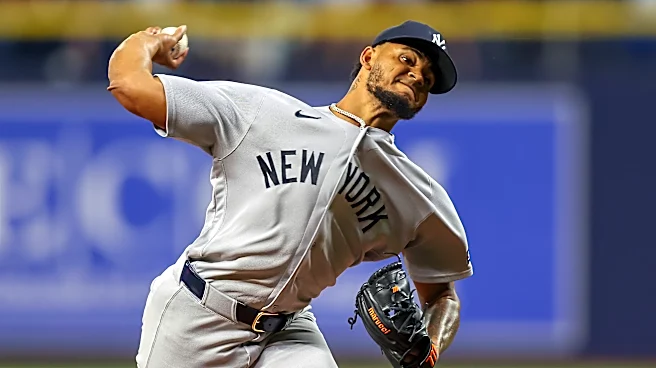
First, let’s take a closer look at Doval. The first thing that jumps out when looking at his stat line is that his ERA is nearly three full runs higher than his FIP in 8.1 innings of work. That would be cause for hope in itself, except that his FIP of 4.68 is still pretty bad. The main culprit so far has been giving up too many dingers, as Doval’s 2.2 HR/9 is by far the worst mark of his career; he was at a 0.6 HR/9 across 259.2 innings from 2022 through 2025. The dingers might have more to do with luck than any change in talent level, as his HR/FB% is an unsustainably high 22.2 percent, more than double his career mark. If we assume that Doval hasn’t suddenly become homer-prone, we can expect his ERA going forward to look more like his xFIP of 3.05.
Doval’s pitch data confirms that, ability wise, he’s the same pitcher he was in 2025. His pitch mix—a cutter and a sinker, both in the high 90s, along with a wicked high-80s slider—has remained the same, and he’s generating basically the same movement on all of them. He hasn’t been making tons of mistake pitches, either; his Meatball percentage is actually the lowest mark of his career. It’s just that, for whatever reason, opposing batters have punished his mistakes harder than ever. Will this trend continue? I don’t know, but Doval’s track record suggests that if he’s doing what he always does, the on-field results are going to trend upwards. I’d say it’s too early to be that worried about his performance.
With Bird, on the other hand, I understand the apprehension — and so, it seems, do the Yankees, given his recent demotion. Bird lacks Doval’s track record, and his recent results have been especially bad; the less said about his disastrous, brief run with the 2025 Yankees, the better. However, everything about Bird’s 2026 stat line suggests that he’s been more unlucky rather than outright bad. He has a 28.1-percent strikeout rate against a 3.1-percent walk rate, and he’s given up only one home run so far, good enough for a sterling 3.27 FIP. The reason why his ERA is a full four runs higher than that? A .400 BABIP and a 52.1-percent LOB rate, both aberrant and likely to normalize going forward.
Now, I’m not advocating for Aaron Boone to give Bird just as long a leash as Doval. There’s a reason why the Yankees deemed him to be the most expendable in the bullpen when they needed a fresh arm, sending him down on April 14th. But it would be a mistake to cut him outright. There’s something within Bird’s profile that’s compelling, and the Yankees wouldn’t have dealt for him last year if that wasn’t the case. Bird has the upside to be a dependable middle-inning option, and it’s worth finding out if he could actually become one; his peripheral numbers so far definitely suggest that he can.
Compared to Bird and Doval, Bednar is a much easier sell. While his ERA sits at a mediocre 4.15, basically everything else on his FanGraphs page is pristine. His K-rate sits at a healthy 28.6 percent, and he has yet to allow a single homer. Those two factors have allowed Bednar to post a spectacular 2.08 FIP despite a career-high BB rate (11.9%). The cause of his middling ERA is obvious: a .440 BABIP allowed, which is impossibly high for even the most hapless relievers. And no, Bednar isn’t getting hit hard; his hard contact rate is just 16 percent, less than half of the MLB average, and he hasn’t given up a single Barrel. Mark my words: El Oso will be just fine.
Perhaps the most encouraging feature of this year’s bullpen is that the other contributors have done quite well so far. Brent Headrick is pitching like an elite relief option, and Tim Hill continues to be ruthlessly efficient and always dependable. Fernando Cruz is walking too many guys, but he’s missing enough bats to not get burned, and even Paul Blackburn has been quietly solid in handling low-leverage work. Sure, Ryan Yarborough, Yerry De los Santos, and Angel Chivilli all project to be somewhere between bad and terrible, but no team can boast an entire bullpen’s worth of lockdown relievers. (Just ask the 2025 Dodgers.)
The Yankees have enough good stuff going on here to have an above average relief corps. They may never be as intimidating as the bullpens of those mid-to-late 2010s Yankees squads of Dellin Betances and Andrew Miller, but by and large, they’ll probably be good enough to get the job done.