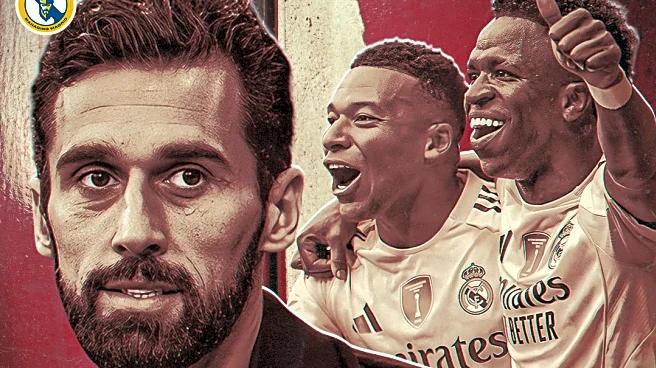


After watching Xabi Alonso navigate a tumultuous seven months as Real Madrid manager, Alvaro Arbeloa — one of his closest friends — saw up close what he needed to avoid.
Arbeloa and Alonso have similar tactical principles. They both want to control the play, to instigate, to press aggressively, to make use of their wing-backs high up the pitch with overloads and suffocating counter-pressing.
But Alonso had difficulty implementing those ideas with this particular group of players, and, as has been discussed
ad nauseam, shifted his tactics mid-way trough his brief Real Madrid career by regressing to a deeper line and deviating from the aggressive press from his first two-to-three months in charge.
People have asked this author questions like, ‘if the players didn’t listen to Alonso, why would they listen to… Arbeloa?‘. The truth is, it’s not always about how great a player was, or how big of a legend he was. Yes, sometimes it does matter, and people like Zinedine Zidane will attest to that — but there is more nuance to it. Sometimes people connect differently with certain people, for whatever reason. Maybe Arbeloa will be to Vinicius what Alonso couldn’t be. Time will tell. There are no clear answers yet.
SUBSCRIBE: The Managing Madrid Podcast on YouTube.
There is no exact science to coaching. Every situation requires something different. Where some players need tough love, others may require affection. Alonso’s approach with Vinicius, who had a sharp drop in form in the 2024 – 2025 season, was to treat him like any other player — to hold him accountable, sub him off when his legs tired, to give constant instructions and ask him to buy into the collective tactics. In Alonso’s eyes, Vinicius was not Cristiano Ronaldo nor Kylian Mbappe.
One of the perils of coaching Vinicius is that, be it right or wrong, you cannot expect a tranquil environment dealing with him like he’s a squad player. Vinicius is a powerful figure in the locker room with many close allies — from key players in the squad to the president himself.
Fans and some media have been critical of Alvaro Arbeloa’s insistence on praising Vinicius Jr even after poor games. Arbeloa has gone out of his way to shower compliments and defend Vinicius.
But Arbeloa is merely reading the room, and it’s hard to blame him for that. Fully knowing that benching the Brazilian has consequences, he is doing everything he can to summon the Ballon D’or version of Vinicius.
“Take Vinicius off? I don’t know if that’s clear,” Arbeloa said to a journalist in the pre-game press conference before the Monaco game. “He’ll be on the pitch as long as he’s available and performing as he is now. He’s a fantastic, exceptional player. As Real Madrid coach, if I want to have a chance of winning, I need him. I need Vinicius on the pitch.”
He is right, in some sense. If Real Madrid unlock the best version of Vinicius, the ceiling of this team is raised to that of a bonafide contender.
Vinicius and Mbappe never truly clicked apart from mild flashes here and there. Somewhere in there, there is a tactical explanation (Mbappe and Vinicius like occupying similar zones, neither have a target to play off of, and Mbappe makes different runs to the ones Vinicius was used to with Benzema, Joselu, or Bellingham). But simplifying it to tactics alone is naive. Vinicius was lights out to start the 2024 – 2025 season with Mbappe alongside him right up until the end of October which coincided with the infamous Ballon D’or snub. Correlation does not equal causation, but you are free to draw your own conclusions.
At some point, blaming Mbappe for everything becomes tiring and lazy. If not Mbappe, people blame Alonso, or the left-back alongside him who makes tireless runs without ever getting a sniff of the ball. There has to be accountability from Vinicius himself. Rarely do players get the perfect circumstances to thrive every season. The great ones perform no matter what storms arise around them.
Maybe Vinicius does need more of an Arbeloa than an Alonso. Arbeloa never achieved the heights that Alonso did as a player, but that may also allow him to connect with the players more. Alonso was a professor; Arbeloa may feel more comfortable getting his hands dirty and connecting with players at ground level. He has been very communicative with Vinicius daily.
And maybe Vinicius needs that kind of love. He lost leaders like Casemiro, Benzema, Kroos, and Marcelo over the years. This current generation has different challenges, and the nucleus of stars are young — yet to be polished into the leaders they might become one day.
But if this approach from Arbeloa now (one of constant praise, love, defense, and insistence of playing him regardless of form) doesn’t work, we then reach two years of this cycle of inconsistency — and big questions need to be asked: Is it worth handcuffing yourself to an extended contract when you know the Vinicius – Mbappe duo hasn’t worked? Are you willing to risk the next five years of Mbappe’s prime with an incompatible co-star?

This is a pivotal four-month stretch. It sounds dramatic, but the direction this heads in now defines the next two years. Does Arbeloa lead the team, in unlikely circumstances, to at least one major trophy? Does Vinicius rise and spearhead the project? Or does the honeymoon — the new manager-bounce — come crashing down after Benfica brought the team back down to earth? Does this all come back full circle, regressing to the mean? Does Arbeloa prove to be just a mere temporary stepping stone to a bigger name, or does he turn out to be exactly what the team needs?
There are more questions than answers, for now. The clues so far: Arbeloa seemed to have initially invigorated the team’s confidence while also getting them to buy in to his ideas. Labelling him as the ‘man manager’ might be unfair. He’s also introduced the tactical principles Xabi tried but couldn’t without ostracizing the team — but Xabi Alonso was able to do it too initially. The high line is back (temporarily? Permanently? I don’t know!), and the two (sometimes three depending on the game state, with Tchouameni dropping) center-backs are holding a high line while the wing-backs push up as wide forwards. There are overloads, there is verticality. But that also gets exploited against elite teams.
(Again, Alonso himself was able to introduce tactical principles early on, but couldn’t sustain it. Arbeloa may or may not run into a similar issue, but his connection with the players will be a determining factor.)
The Vinicius extension still looms, but the club have likely picked their path of renewal after dismissing Alonso. The Vinicius situation is both complicated and straight forward. It’s complicated because of his form post-October 2024 as well as the noise he brought forth during the brief Alonso reign. But it’s also straight forward in many respects: Vinicius does not want to leave and won’t be sold; and Real Madrid don’t want to lose a star for free. If his form returns, it’s a no brainer. If it doesn’t, the club will have to assess the complexity of the Vinicius – Mbappe dyad — but Real Madrid has not been ruthless in selling players in the modern era and that likely won’t change with Vinicius.
JOIN: Members-only bonus Real Madrid content.
But have we seen the ceiling of this Vinicius – Mbappe duo yet? It’s a rhetorical question. There is no way this has yet been maximized. If you constructed two players in a lab to murder dreams in transition and use their dribbling to break low blocks, you’d be hard pressed to cook up two better players — even if there are legitimate concerns about the zones they operate in, the first line of defense, and game states where the team lacks a target in the box.
But it all depends on how well they play, who is in their supportive ecosystem, and how everyone is managed. Maybe this team, along with this young nucleus, needs continuity and more building blocks. Maybe this team is akin to where Cristiano Ronaldo and Karim Benzema were in 2010. Maybe they aren’t meant to win together, yet, and are still in the fledgling stages of their arc — measured far differently by the time their careers end. Real Madrid have been using the cards they’ve been dealt with. They have not splashed on established stars in the transfer market other than bringing them in for free on grandiose contracts. Vinicius is the poster-child of their business model: Invest in young stars and develop them. Vinicius has paid dividends. He could have retired in 2024 and gone down as a Real Madrid legend. The club values that. We are not speaking about a mid-30’s post-peak star. We are speaking about a star that is struggling to keep his form up consistently over a significant period of time. There is still hope.
There are two ways of looking at it: 1) The Vinicius – Mbappe pairing was a mistake; or 2) It’s incredibly rare to have two superstars of this ilk as a tandem in one team — and wasting their window together with the wrong supporting blocks would be a monumental failure.
Realistically, it’s difficult to lean into number one, because it would mean you’ve already given up and accepted this won’t work, while patting yourself on the back that it was a marketing success. But you have to dig deep and and find the right balance of continuity and transfers to fit the project and timeline. Real Madrid are still not recovered from losing Luka Modric and Toni Kroos (naturally), and have to give themselves the benefit of the doubt that they have to be patient finding the right fit to help the midfield and give wings to the team.

The Vinicius – Mbappe pairing is not a crippling mistake; it is salvageable — but it’s only salvageable if Vinicius can return to being consistent. Mbappe has held his part of the bargain of giving Vinicius the left wing and mercilessly pounding in goals. Even during his own struggles, Vinicius’s production is decent: 44 G / A in the last 18 months. It is ‘decent’, and pales in comparison to the Vinicius we know and measure him by, but if he can get to his best, the discussion changes. Microanalysis of how Mbappe presses or doesn’t crash the six-yard box will fade into the background if the offensive tsunami hits its ceiling.
Real Madrid have nailed trophies on the back of good decisions in the past years, building their squad pragmatically and without panic — adding one or two lego pieces every summer. Once things hit the wall last season, they reacted by splashing 160m+ on defenders and Mastantuono. It’s going to take time bolting down a proper two-way squad with so many leaders leaving, and current ones being injured. Right now, mere kids — Asencio, Huijsen — are holding down the backline. If Güler is the solution to the team’s ball progression alongside Bellingham, he won’t be perfect right away, and he’ll need time to gel with Bellingham and form symbiosis with a player who likes to operate in similar zones. Neither Bellingham nor Güler have a reliable single pivot who can progress the ball consistency. All these conversations matter when we’re discussing the success and failures of the Vinicius – Mbappe dyad, but it doesn’t excuse the performances of the attackers either.
FOLLOW: Managing Madrid on Instagram.
It’s hard to pinpoint an exact diagnosis. Is there a shortage of talent? A problem in management? The wrong squad building? Two managers with two different philosophies — Carlo Ancelotti, Xabi Alonso — were unable to get this group of players to play well consistently. The jury is still out on Alvaro Arbeloa. Those criticizing the board’s squad building have to remember that reinforcements have arrived over the years, but some haven’t fulfilled their potential. Real Madrid invested heavily in young midfielders like Aurelien Tchouameni and Eduardo Camavinga. How much different does this look if those two play at the level of their promise?
The ‘6’ — the anchor — is vital to the team’s blood-flow. He is the organizer, the defensive heartbeat, the disrupter of attackers, the stopper, and the chief ball progessor. Ancelotti said after Toni Kroos’s departure that the team would “need to play differently”, but it’s not easy doing so in modern football. Football is all about pairings. Elite teams have figured this out. You need a controller, a progressive DM, a final-third creator, line-breaking wingers who press, and central target who can score, press, and be technically gifted with the ball at his feet. You can have Tchouameni on the field (and to pin Real Madrid’s problems on him is unfair) but you need to pair him with someone who is comfortable taking the load off his shoulders in the build-up phase. This is why Güler has been dropping deeper. This is where more minutes for Dani Ceballos is justified and why Arbeloa is taking a shot on Cestero.

The Benfica game was a reality check. It was a humbling experience after a couple games where the team finally looked cohesive again while trying to impose their will. But how many more reality checks does this organization need? They’ve had about 15 reality checks in the past year.
“I don’t have a clear explanation,” Mbappe said after the loss to Benfica. “We lack continuity in our play; it’s a problem we have to solve. We can’t be good one day and bad the next; that’s not what a championship-winning team does. It hurts a bit because we wanted to use February to improve, but we deserve the position we’re in.”
People often debate ‘man management’ vs ‘tactics’ as if they are two completely separate paths to success — but it’s a false dichotomy. You need both. No amount of ‘unity’ would’ve saved Real Madrid in that match against Jose Mourinho’s men. The ball circulation wasn’t incisive, and with the wing-backs pushed high with no coverage — and without an efficient counter-press — it was easy for Benfica to slice through Real Madrid’s high line with one pass before the third-man runner attacked the box for an easy chance.
And to bring it back full circle, Arbeloa’s insistence on Vinicius from above is a double-edged sword. In order to keep him on the field while the Brazilian was having a poor game, he sacrificed Güler — the man with six key passes and most likely to play the final ball — instead. He kept Gonzalo Garcia on the bench, and brought on Brahim Diaz (redundant, with Vinicius, Rodrygo, Bellingham, and Mbappe already operating outside the box), leading to more congestion and no targets.
These are the moments where Arbeloa will have to make tougher decisions.







