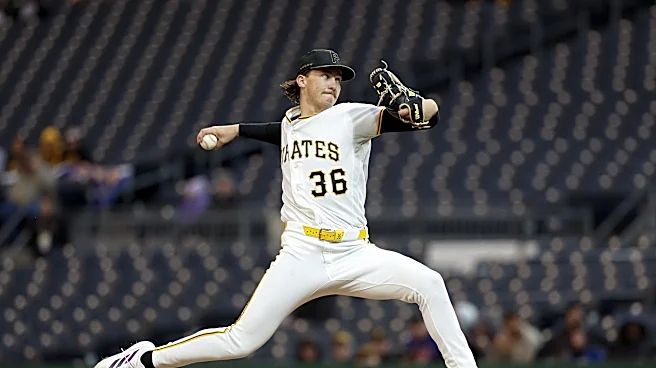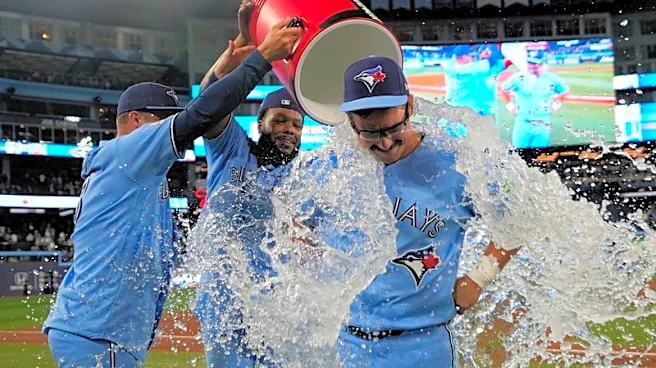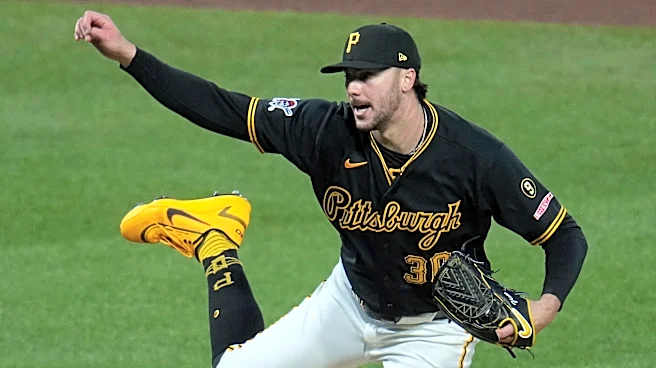




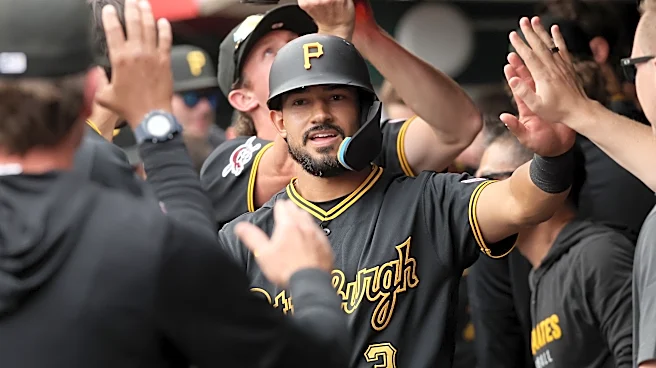
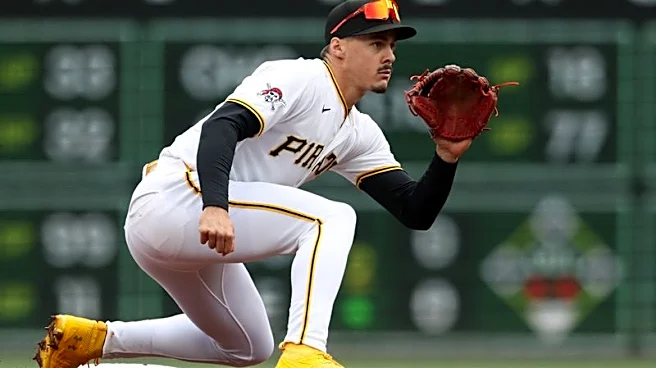
After five Triple-A games, Konnor Griffin forced the issue — .438/.571/.625 — and debuted in Pittsburgh’s April 4 home opener.
Less than a week later, the Pirates — hardly a perennial contender — announced a nine-year extension that keeps him under contract through 2034.
That’s not just a prospect promotion. That’s a team deciding to be aggressive.
For an organization searching for relevance, the Pittsburgh Pirates are acting like a club that wants to compete now — trusting talent, accelerating timelines,
and building around players as they prove ready.
And early on, it’s translating.
They’ve opened the season playing winning baseball — getting contributions from their young rotation (having Paul Skenes helps a lot) with just enough offense. It’s a small sample, and by June this could look very different.
But the intent is clear.
The Rockies are operating in a similar space: more competitive than projected, treading water behind just enough pitching and solid defense.
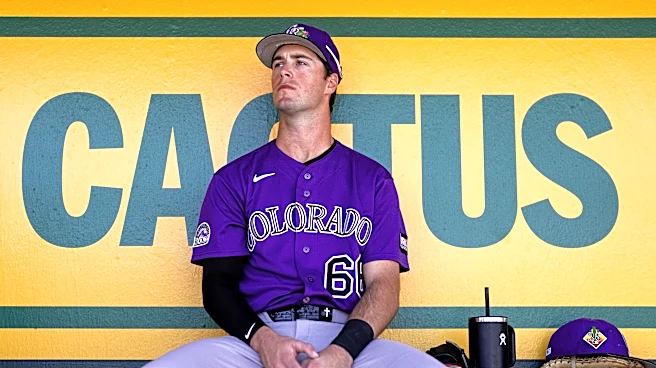
But where Pittsburgh had Griffin and pulled the trigger, Colorado has Charlie Condon (No. 1 PuRP) — and a lineup that still needs impact.
This lineup isn’t broken — but it’s still volatile
There are stretches where the Rockies’ offense looks competent — productive and capable of pressure.
But the volatility remains.
Strikeouts persist. Walk rates are low. And a swing-first approach means consistency can disappear quickly. When the offense is on, it looks pesky. When it’s not, it stalls.
There have been bright spots, but production hasn’t been evenly distributed — and that’s where cracks show.
The outfield, in particular, has struggled.

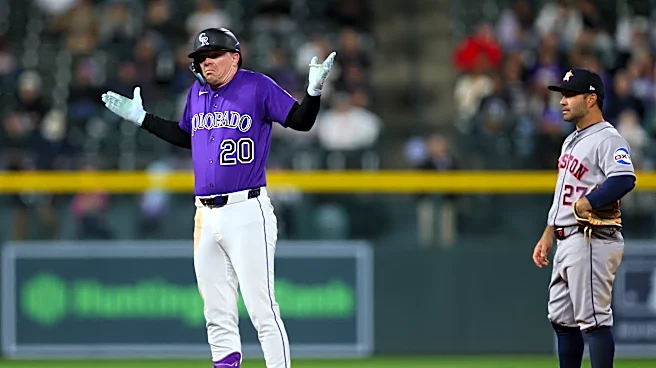
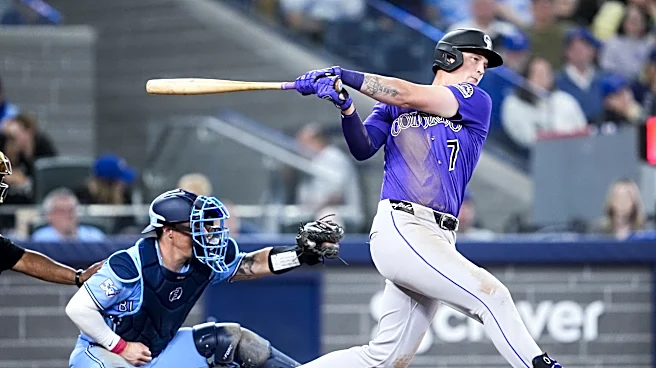
Jordan Beck, Brenton Doyle and Jake McCarthy — the projected starting outfield heading into the season — have opened cold. The trio has gone a combined 13-93 (.139) with one home run and a 30% strike-out rate entering Friday’s game.
Troy Johnston and Tyler Freeman have hit, but much of their value comes from versatility and time spent in the infield, not as everyday outfield anchors. As a result, the outfield’s offense hasn’t stabilized and is still leaving a clear gap in production.
Mickey Moniak is the clear exception — but comes with a massive trade-off.
He’s off to a hot start at the plate, and his bat has been vital. But he shouldn’t be anywhere near a baseball glove. Moniak has struggled defensively throughout his career, and the metrics reflect it. If he’s a key offensive contributor from the grass, the Rockies are accepting defensive risk.
That’s not a sustainable equation.
Charlie Condon is ready for the next evaluation
Condon’s case doesn’t hinge on projection anymore.
He had a loud spring — driving the ball with authority — and has carried that into pro ball. He’s produced at every level, and the power stroke is showing up more consistently.
To begin the minor league season, Condon produced a two-homer, five-RBI game in Oklahoma City on March 29th. After a brief absence for a minor procedure to remove a cyst, he returned to Triple-A Albuquerque and picked up right where he left off:
The sample is small, but the takeaway is consistent: performance isn’t slowing his timeline. Condon is batting .286/.405/.976 through 35 at-bats.
And it’s not just the bat.
Condon offers real flexibility — capable of playing first base or right field, and even sliding into a right-handed DH role at times, potentially pairing with Mickey Moniak as part of a platoon. That kind of versatility makes it easier to find a path to at-bats, not harder.
Questions remain, sure. He struck out in 28% of his Double-A plate appearances in 2025, and evaluators still point to recognizing spin as the next hurdle. But those aren’t questions that get answered in Albuquerque. They get answered in the majors.
Condon may be the most immediate answer, but he’s not the only one pushing the Rockies toward a decision.
The next wave isn’t one player — it’s a mix
Zac Veen (No. 9 PuRP) feels like the incumbent, even after opening 2026 on the injured list (right knee contusion) and having a tepid start to his season. The version seen this spring looked stronger and more impactful, highlighted by a 468-foot walk-off — if that holds, he can change the lineup.
Cole Carrigg (No. 4 PuRP) offers a different profile; a versatile, high-energy contributor hitting .265 with eight stolen bases at Triple-A, with development centered on refining approach and reducing chase. He’s not the centerpiece. He’s a multiplier.
Timing still matters — even beyond incentives
This isn’t just about service time, but it’s not not about service time either.
MLB’s Prospect Promotion Incentive (PPI) rewards early promotions with a draft pick, but it comes with guardrails — Top 100 eligibility, award thresholds, and a one-pick-per-organization cap.
For Condon, the decision is likely more traditional: service time, where teams balance long-term control against present-day impact and development.
Some organizations still manage timelines carefully; others — like Pittsburgh with Griffin — are accelerating them. The Rockies are somewhere in between.
At some point, it’s about belief
The Rockies have taken real steps forward — they’re more competitive, the lineup has flashes, and there’s something worth building on.
But the next step is reinforcing that progress, not waiting on it. Development still matters, but the most important questions get answered against major league pitching.
If this team is going to reward the progress it’s already made, it starts by trusting the talent that can push it forward.
On The Farm
Triple-A: Albuquerque Isotopes 8, El Paso Chihauhaus 10
The Isotopes (6-7) fell 8-10 in El Paso, but the offense continued to show life. Blaine Crim led the way with three hits, including a home run, while Nicky Lopez stayed scorching hot with another three-hit game—pushing his line to .375 with a .929 OPS. Braxton Fulford also chipped in, going 2-for-2 with a home run after entering as a defensive sub in the sixth.
On the mound, Gabriel Hughes had a tough outing, throwing 84 pitches and allowing five runs over 4.1 innings.
Double-A: Hartford Yard Goats 6, Reading Fightin Phils 9
The Yard Goats (3-4) couldn’t keep up in Reading, falling to the Fightin Phils 6-9. Connor Capel provided one of the few highlights, going deep to supply some early offense, but pitching told the story. Konner Eaton battled through 5.1 innings and was tagged for five earned runs, while Davison Palermo surrendered four more earned runs in just 1.2 innings of relief, putting the game out of reach.
High-A: Spokane Indians 9, Hillsboro Hops 11
The Indians (3-4) dropped a high-scoring game to the Hops. Jacob Humphrey led the way on offense with two hits and three RBIs, while Max Belyeu added two hits and two RBIs of his own — both staying hot early in the season. But despite the run support, pitching couldn’t hold up. Jackson Cox got the start and allowed four earned runs over four innings, though he did rack up eight strikeouts. The bullpen didn’t fare much better, with all three relievers surrendering multiple earned runs as the game got away.
Single-A: Stockton Ports 9, Fresno Grizzlies 5
Grizzlies (4-3) come up short against the Ports. Ethan Holliday went 2-for-5 and launched his first home run of the season, an encouraging sign as he looks to get going early in the year. On the mound, JB Middleton was excellent. He threw five innings of one-run ball with five strikeouts, continuing a strong start to his season — now allowing just two runs over his first nine innings
Broncos owners buy 40% ownership stake in the Colorado Rockies | The Denver Post
In this piece by the Denver Post, the Walton-Penner ownership group has purchased a significant minority stake in the Colorado Rockies, adding a powerful new financial partner to the franchise. While the Monfort family retains control, the move signals increased resources and potential organizational change. It’s a notable shift in ownership structure — and a clear sign of growing investment in the Rockies’ future.
Paul DePodesta Explains What Rockies’ Surprising Start in 2026 Offers | SI.com
In this piece by Sports Illustrated, Paul DePodesta frames the Rockies’ surprising early start less as a signal of success and more as a data point in a long rebuild. He emphasizes that the early competitiveness is encouraging but not definitive, stressing that the organization is focused on long-term development rather than short-term results. The takeaway: the Rockies may be playing better now, but in DePodesta’s view, what matters is whether that progress is sustainable over a full season.
Pirates, Rockies and Marlins off to great starts — is it sustainable? | MLB.com
In this piece by MLB.com, the Rockies are highlighted alongside the Pirates and Marlins as teams off to better-than-expected starts in 2026. It points out that while the early results are encouraging, it’s still very early — and whether this kind of play can hold over a full season is the real question. For now, the Rockies are showing signs of life, but like the others, they still have to prove it’s more than just a hot start.
Join the conversation!
Sign up for a user account and get:
- Fewer ads
- Create community posts
- Comment on articles, community posts
- Rec comments, community posts
- New, improved notifications system!
Please keep in mind our Purple Row Community Guidelines when you’re commenting. Thanks!