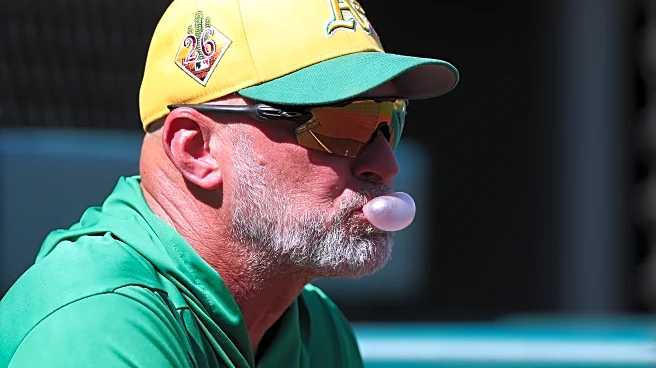



Mostly I write for our readers and commenters and the discussion it brings. Every now and again I write secretly hoping that someone who knows someone might put an elbow into a rib and say, “Hey, read this.” Long story short I hope this article gets from my fingers to Mark Kotsay’s ears — just for the good of the A’s.
First things first I want to recognize that Kotsay does many important things well, from keeping spirits up to making players feel supported to inspiring the team to play hard even when
it’s in a 1-20 stretch. These are not leadership qualities to be taken lightly.
The tactical piece is important too and the point here is that it can be learned and constantly improved upon. Here are some “growth opportunities” for the A’s 4-years-going-on-5 skipper:
“Infield In” — use it, don’t abuse it
The A’s simply bring the infield in too often, especially with runners at 2B and 3B. Important to remember is that the 2026 A’s figure to score a lot of runs, meaning they can afford to give up 1 run here or there so long as they stay away from crooked numbers.
Bringing the infield in with runners at 2B and 3B is extremely risky because with holes all over the infield it runs a significant risk of a base hit that can score 2 runs and set up an even bigger inning — where a ground ball out with the infield back might allow a run, but leaves just one runner on and 2 outs.
Tony La Russa was, I thought, particularly clever. He would often play the infield back but if the batter got to 2 strikes he might suddenly bring it in to guard against a batter “just putting the ball in play” and stealing an RBI. I think there’s a place for that, but more broadly if you have a team that can score a lot of runs but is at risk of giving up runs too, don’t bring the infield in with 2 runners in scoring position unless you’re so late in the game that any run is probably going to beat you.
Platoons — know your numbers
Playing platoon match ups is generally fine. If Colby Thomas is on the roster I will want to see him leveraged against LHPs as much as possible and the same is true of Darell Hernaiz. If Lawrence Butler needs days off to rest his knee, choosing games started by opposing lefties is fine.
But playing platoons just to play platoons is short-sighted, and this year’s team in particular demands that their manager understand the individual personnel.
If the A’s need to neutralize a tough LH batter late in the game, don’t go to Hogan Harris, whose wOBA against in his career so far is .350 vs. LH batters and .310 vs. RH batters. In contrast do go to RH reliever Mark Leiter Jr. With his splitter diving away from lefties he has a career .227/.298/.382, .295 wOBA track record whereas against RH batters it’s .268/.354/.469, .354 wOBA.
Tyler Soderstrom struggled against LHPs early in his career but came on like gangbusters the second half of last season. Let him hit lefties until he proves he can’t. And so on.
In other words, platoon very strategically but not robotically. There’s a huge difference.
Minimize how many relievers/game
As I discussed with pitching coach Scott Emerson in our recent interview, the future of bullpens lies in multi-inning “bridge relievers” that spare you parading 3-4 different relievers out there to try to hold a lead. JT Ginn is a candidate (assuming he pitches more like he did at the start of spring training and not like how he finished), as are Hogan Harris and, if called up to pitch in the bullpen, Mason Barnett or Kade Morris.
The idea that 4 talented but volatile relievers like Elvis Alvarado, Scott Barlow, Mark Leiter Jr. and Hogan Harris can piece together 12 outs successfully is fraught with danger. Try to get your starters through 6 IP if you can and see if you can lean on just 2 relief arms to “get it to the house”. It will also spare you having to use relievers as much on back to back days, which has been shown to be statistically less reliable
Insist on the fundamentals that anyone can perform
A leader’s job includes tough love and where it’s most appropriate in baseball is the basic fundamentals that are within each and every player’s skill set.
Hit the cut off man no matter how sure you are that “if you just heave it all the way to the plate…” You will save far more bases and runs if you just fire every outfield throw to the cut off man’s chest. {An exception can be made for a runner trying to score when there is no runner(s) behind him as there is no potential downside.}
Rundowns should not require more than 2 throws: one to run the runner back to the previous base until he is only 25 feet or so from the bag — at which point the short toss to the base has him tagged out. Anytime you see 3, 4, 5 throws you are seeing multiple throws that never needed to be made, opening up chances for other runners to advance and for mistakes to be made to botch the rundown entirely.
When you don’t have endless payroll to mask deficiencies you need to do the “little things” well and the fundamentals are, by definition, the parts of the game don’t require a super athlete, advanced experience, more strength or speed. You just need the discipline to do what you have been taught since high school — or really Little League — even in the heat of the moment.
The first time a fundamental is ignored, it’s ok to confront the player, point it out and say “never again,” and the second time it’s ok to bench them next game. They will come back the following day a better player for it and you will be a better team for it. That’s leadership.
Thank you for reading, Mr. Kotsay, and for all the great work you have done and are about to do. And thanks for taking all 4 points to heart and following through. We both just want the A’s to be the best team they can be, and compared to when you started reading the A’s have greatly improved for your eager devotion to following these 4 principles. Let’s have a great season!