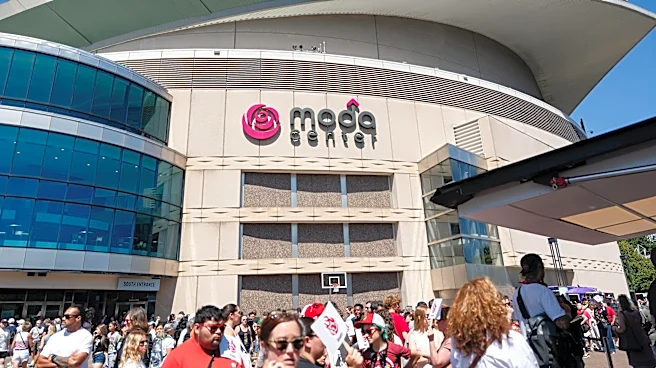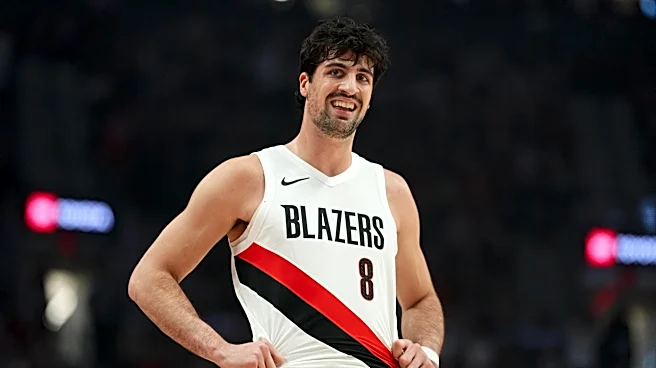




Controversial negotiations between the Portland Trail Blazers and the City of Portland over funding for renovations to the Moda Center Arena have dominate the news cycle in Rip City over the past few weeks. Each side has cited documents and media reports, accused the other of confusing the facts, and gotten grumpy in public over the pace of bargaining. Over all of this lies the specter of the Blazers leaving down under new owner Tom Dundon and his conglomerate of fellow owners, few of whom have actual
connections in Portland.
In the midst of this, Blazer’s Edge reader BlazerTag has come up with a comprehensive list of documents pertaining to these talks. In addition, he’s formulated a cogent argument to strip away some of the posturing and drama, looking at the nuts and bolts of legal precedent, agreements owed, and relocation requirements.
Graciously, BlazerTag has allowed us to post his documentation and argument here. Like all posts, it’s informed opinion rather than iron-clad law. But it’s complete, thorough, and logical…further proof that Blazer’s Edge has one of the best collections of brainpower on the internet.
Thank you to BlazerTag for this post. Whether it’s for document reference or informed argument, we hope you enjoy reading it.
Moda Center Negotiation Reference Guide
Fear, uncertainty, and doubt have clouded the Portland Trail Blazers’ residency in Portland ever since the team was sold to an ownership group led by Tom Dundon. Sensationalist media reports, posturing on both sides of the bargaining table, and the general public’s thirst for confirmation bias only serve to thicken the fog.
Knowledge provides clarity. These are some of the sources I used to dispel the myths, rumors, and misinformation feeding the confusion. The research gave me peace of mind that the only reasonable way out for the Blazers and the City of Portland is to come to an agreement that keeps the team here for decades.
A deal keeping the Blazers in Portland is win/win. Relocation is lose/lose.
Below the links to the aforementioned documents, I will write about some specific points I found interesting and how the information works together to form my conclusion.
Here’s the list:
Forbes List of the Most Valuable NBA Teams
Nielsen List of Designated Market Areas by Size
https://ustvdb.com/seasons/2024-25/markets
NBA Constitution and By-Laws
Moda Center Bridge Lease Summary
Moda Exclusive Site Agreement
https://efiles.portlandoregon.gov/recordhtml/16988077
Oregon Senate Bill 1501
Portland City Council Initial Term Sheet
Moda Facility Condition Assessment
Forbes list/Nielsen Markets
Let’s start simple: a franchise’s valuation is correlated to the size of the media market where the team plays its home games and the yearly revenue it generates. Generally speaking, a team located in Portland won’t be as valuable as one located in Los Angeles; a team in New Orleans won’t be as valuable as one in Portland.
Portland is the 23rd largest media market in the US. The largest media markets without an NBA team are #10 Tampa Bay, #13 Seattle, #22 Raleigh, #24 St. Louis, #26 Nashville, and #27 Pittsburgh.
The NBA is taking bids on expansion franchises in Seattle and Vegas, which will take the 13th biggest US media market off the table, but why haven’t we heard about the Blazers relocating to the tenth largest? Why aren’t we worried about Tampa Bay?
It all comes down to territorial rights, outlined in Article 10 of the NBA Constitution and By-Laws.
Subject to any rules, regulations, resolutions, or agreements of the Association, or any agreement between the affected 24 Members that has been approved by the Association, (i) the Territory of a Member shall be the territory within an area of seventy-five (75) air miles of the corporate limits of the city of operation…
These territorial rights come with the power to refuse another NBA team from conducting business within them.
Except in accordance with any rules, regulations, resolutions, or agreements of the Association, (i) a Team operated by a Member shall have no right to play in the Territory of another Member without the consent of the resident Member…
Tampa Bay is within the 75-mile territory of the Orlando Magic. We saw how this rule played out during the Covid season of 2020-21, when the Raptors had to ask the Magic’s permission to allow them to play their home games in Tampa Bay. The Magic granted an exception to their territorial rights, given the extraordinary circumstances, but have no reason to give them up on a permanent basis. A franchise in Tampa Bay would devalue the Magic.
Besides the territorial rights, another interesting tidbit I found was the curious case of the Detroit Pistons, a huge outlier to the “larger market=larger franchise valuation” general rule of thumb.
Why are the Pistons 27th in valuation despite being the 14th largest market? It all comes down to their stadium deal. Unlike the Blazers, the Pistons don’t control all the revenue in the stadium they play in. That honor goes to the Detroit Red Wings. The Hurricanes, Blues, Predators, and Penguins have similar deals in their stadiums, so any Blazers relocation to the 22nd, 24th, 26th, or 27th largest markets that includes a sublease from a hockey team will devalue the franchise.
Devaluing a franchise doesn’t make sense financially for the Blazers, it also doesn’t make sense for the league, who only want franchises to increase in value. Tom Dundon doesn’t get to make the relocation decision unilaterally, it is subject to league approval. The NBA Board of Governors, who are made up of one representative from each franchise, get to vote on whether or not they allow relocation.
In Article 7, the NBA Constitution explicitly states that a financial comparison of stadium terms is part of the criteria for allowing relocation.
The recommendation of the Relocation Committee shall be based solely and exclusively upon the following factors…
…the size, quality, and location of the Member’s existing arena and any other arena in the existing location, and the terms, if any, on which that other arena would be available to the Member;
The NBA Board of Governors has no reason to permit a franchise to relocate from a stadium where they control the revenue, to one where they sublease from a hockey team. Any relocation to these markets only makes sense if it includes moving the team into a brand new stadium where they have control over its revenue.
Moda Center Bridge Lease Summary/Exclusive Site Agreement
These documents provide the terms for the Blazers short, five-year lease to stay at Moda until October 11, 2030. In my opinion, the most important of these outline the financial arrangement between the City and the Blazers.
- Moda Center ownership would be transferred to the City, subject to the City conducting due diligence on the condition of the arena.
- Rip City would continue to have full responsibility for operating Moda Center and funding and completing Moda Center capital repair, maintenance, and improvement projects and maintaining the arena in a first-class manner.
- The Moda Facility Condition Assessment outlined a 5-year plan to keep Moda in such a manner, with the budget estimated to cost $223 million (available in the table on page 121). The City did agree on a public-private partnership to contribute to the expenses, but are limited to the revenue the city receives from Blazer home games.
- The City contribution to the Arena Capital projects would be capped at the amount of City revenues generated by Trail Blazers home games. That figure was $4.6 million in 2022, so I’m going to round it off and say that the City’s contribution to maintenance over the five-year lease would be around $25-30 million. Under the current lease, most of the financial responsibility to keep the stadium in a first-class manner falls on the Blazers.
The Exclusive Site Agreement obligates the Blazers to play their home games at Moda Center and has very specific language about the prospect of ownership trying to relocate the team from Portland.
1.3 Relocation Throughout the Term, TBI or any of its Affiliates (as defined in the Arena Lease) shall not relocate or seek to relocate the playing site of its Home Games under Article 7 of the NBA Constitution or any successor provision, except to the Arena or to Memorial Coliseum, without the prior written consent of the City, which may be withheld in the sole and absolute discretion of the City.
The Blazers can’t seek relocation without written consent from the City during the lease, which runs until October 11, 2030. If they decide to wait it out and relocate for the 2030 season, they need to file an application for relocation to the league by March 1, 2030, which will violate the lease. It’s right there in Article 7 of the NBA Constitution, just like the provision states.
No application to relocate may be made after the first day of March preceding the Season in which the proposed relocation is to take effect.
It’s a Catch-22. There’s no way for the Blazers to relocate without violating the bridge lease. The penalties for violating the lease are explicit.
In the event of a breach of this Agreement by TBI, the City will suffer both damages compensable by the payment of money and damages which will not be compensable by money and which will be irreparable. Accordingly, the City is entitled to the following: 4.1 Compensable Damages In the event of a breach of this Agreement by TBI, the City shall be entitled to claim all actual damages and consequential damages against the breaching party, including but not limited to loss of User Fee revenue and other Project Revenue referred to in the Arena Lease or the Amended and Restated Development Agreement caused by such breach.
Contrary to how it’s being portrayed in the media, Councilor Steve Novick isn’t the one who came up with the idea to sue the Blazers. It’s right there in the contract they signed, which doesn’t just limit liability to financial damages.
TBI acknowledges that some of the damage that would be suffered by the City in the event of a breach of the terms of this Agreement could not be adequately compensated by an award of damages because of the unique nature of the obligations of TBI and the City may obtain a decree of specific performance and/or injunctive relief with respect to any of the obligations of TBI under this Agreement.
The City can seek an injunction from a judge to stop the Blazers from applying to the league for relocation. This would be a very messy legal battle which could potentially end in a large settlement for the City, another financial hurdle for relocation.
Oregon Senate Bill 1501/Portland City Council Initial Term Sheet
On March 31st, Governor Kotek signed the bill providing the framework for the state’s $365 million portion of Moda Center renovation funds. On July 17th, the City of Portland issued an initial term sheet for their $120 million portion. I’m going to start with the terms that both of these documents agree on, but I’m going to quote Oregon Senate Bill 1501, because it is law and non-negotiable.
The conditions are found in Section 6.
(1) The joint authority and a management entity must execute one or more agreements that collectively contain all of the following provisions:
(a) A binding commitment from the management entity to lease the Moda Center for a minimum term of 20 years;
(b) A provision authorizing the joint authority to give final approval of scope, schedule and budget for construction or renovation projects relating to the Moda Center, provided that such approval does not cause unreasonable delay to the project;
(c) A provision addressing responsibility for cost overruns in any project carried out by the joint authority, which must provide that the joint authority is not required to pay for any cost overruns, except to the extent that such cost overruns are the result of modifications to the project scope or design that the joint authority requests after final approval;
I want to re-iterate that this is a law that was enacted on March 31st. When it passed the Oregon Senate, Blazers President of Business Operations Dewayne Hankins was effusive in his praise.
Thank you to Senate President Wagner, Senator Lieber, and all the members of the Oregon Senate who voted for Senate Bill 1501. The opportunities ahead are significant. Moda Center truly is Oregon’s arena, where people from across the state come together for concerts, family shows, rodeos, and basketball games. Reinvesting the revenue generated by Moda Center back into the arena is an investment in jobs, the economy, and a bright future for Oregon.
The initial term sheet is in line with the Senate bill as to the amount of funds the City and County will contribute.
City: an amount not to exceed $120,000,000 for eligible renovation expenses.
County: an amount not to exceed $88,000,000
So, at the very least, a 20-year lease, a review of renovation plans, the responsibility of the cost overruns, and the overall funding aren’t the issue. So why did an anonymous Blazer official call the initial term sheet a “non-starter”? Let’s look at where the term sheet and senate bill differ.
Since the City owns Moda Center and receives no rent or taxes from the Blazers, the term sheet outlines a property tax off-set payment.
Rip City will make an annual payment (the “Property Tax Offset Payment”) to the City in the amount of $3,000,000 per year during each year of the Term, escalated by 5% annually.
That works out to about $100 million over twenty years. In return, the team receives $573 million.
The Blazers manage and control all the revenue from Moda Center; in exchange, the initial term sheet expects them to be responsible for maintenance and repairs.
Throughout the Term, Rip City will, at its cost and expense, keep and maintain the Arena and Arena Site in compliance with a benchmarked operational standard consistent with Comparable Facilities and pursuant to the terms of the Definitive Agreements. Rip City will perform all alterations, upgrades, improvements, renovations, refurbishments, and capital repairs necessary to maintain such standard.
This is a very standard arrangement for an NBA team that doesn’t own an arena, but does manage it.
The next provision is the one that is the most misunderstood.
Rip City (and any other entities receiving a portion of the Public Funding Contribution or providing construction services for the Renovation) will be required to enter into one or more labor peace agreements.
The term sheet doesn’t require that the Blazers use union workers, though it does ask to pay construction workers a prevailing wage, it just asks they enter a labor peace agreement with the workforce at Moda.
There is a drive to unionize workers at Moda underway. A labor peace agreement just means that Rip City Management will stay neutral during that process and allow union reps to visit onsite. In exchange, the workers agree that they won’t demonstrate or picket during the process.
The city council doesn’t get to decide if Moda unionizes. The Blazers don’t get to decide if Moda unionizes. The workers get to decide if Moda unionizes. That’s true with or without a labor peace agreement.
The other terms are either community relations conditions that hardly seem dealbreakers, or anti-tanking measures that are largely unenforceable.
If any of these terms are truly “non-starters,” then Blazers ownership is seeking an agreement that is far from the “market-rate deal” they claim to be after.
Conclusion
Given the lack of competitive alternatives to the Portland market, the significant legal and financial hurdles to relocation, and the market-rate stadium deal currently on the table, it is clearly in the financial interest of the Blazers and the NBA to reach an agreement that keeps the team in Portland for at least the next twenty years.