
From now until the end of the year, Camden Chat writers will be revisiting some of the biggest moments and storylines of the disappointing 2025 Orioles season.
The 2025 Orioles weren’t just bad. They were also, in large part, unrecognizable.
The O’s (briefly) tied a dubious major league record this year by using 70 different players, matching the mark of the 2024 Miami Marlins. As injuries, ineffectiveness, and midseason trades ravaged the Birds’ roster, they increasingly relied on untested rookies,
journeymen waiver claims, and whatever else they could scrounge up just to put a team on the field. Players came and went in the blink of an eye, many kicked to the curb almost as soon as they were acquired.
Seventy players. It’s an almost incomprehensible number. The Orioles once went 20 consecutive years, from 1968 to 1985, without ever using as many as 40 players in a season. In the first 57 years of franchise history, only twice did they even have 50. That’s how many they used two years ago. That increased by a full ten in 2024 and another ten this year. If you dare to try to identify all 70, I wish you the very best of luck, my friend.
Before this indelible journey into chaos unfolded, the Orioles began their 2025 season just as every other team did: with a 26-man Opening Day roster. Few could have anticipated the misfortune that would befall so many of these players. Of those 26, only three — Jackson Holliday, Dean Kremer, and Tomoyuki Sugano — remained on the Birds’ active roster from start to finish. Everyone else spent time either on the injured list, in the minors, or in another organization, or some combination thereof.
The Orioles hadn’t even finished their first series of the year in Toronto before making multiple roster changes. Albert Suárez injured himself in his season debut and Colton Cowser broke his thumb on a foolish slide into first base. The O’s replaced them by firing up the Norfolk express for Matt Bowman (#27) and Dylan Carlson (#28), the first of four stints with the Orioles for Bowman and five for Carlson. The latter went back to the minors five days later when the Birds activated Gunnar Henderson (#29), who had started the year on the IL with a right intercostal strain that might have contributed to his dip in power this season.
Over the course of the next two weeks, Opening Day starter Zach Eflin hit the injured list for the first of three times this year, replaced by Colin Selby (#30), who himself was jettisoned for waiver claim righty Scott Blewett (#31), who was then lost on waivers to the Braves so that rookie Brandon Young (#32) could take Eflin’s rotation spot, only for Young to be optioned after his debut to make way for another reliever, Cody Poteet (#33), who got injured after one outing and never pitched again. Are we having fun yet?
The Orioles went on a rookie pitcher kick, cycling through Grant Wolfram (#34) and then Kade Strowd (#35) in a three-day span. Meanwhile, the injuries started coming fast and furious, as Tyler O’Neill, Jordan Westburg, and Gary Sánchez all landed on the shelf in quick succession, replaced by Carlson and two newcomers, infielder Emmanuel Rivera (#36) and catcher Maverick Handley (#37). The pitching-desperate Orioles even signed the shambling corpse of Kyle Gibson (#38) to unsuccessfully boost their rotation.
At that point the Orioles had added 12 players who weren’t on the Opening Day roster. They’d placed or activated someone from the IL eight times. They’d already used more players than 22 other Orioles teams used in their entire season. And it was still April!
The O’s started May by putting Ramón Urías on the IL, opening a spot for Coby Mayo (#39). Later, righty Chayce McDermott (#40) had the distinction of being the last new Oriole to join the roster before Brandon Hyde was fired May 17 with the Orioles sitting on a 15-28 record. Days later, the O’s put Kyle Gibson out of his misery and activated offseason signing Andrew Kittredge (#41), who had spent the first two months on the IL with left knee debridement.
On May 24, the O’s finally parted ways with the struggling Cionel Pérez and placed Ramón Laureano on the IL, replacing them with Yaramil Hiraldo (#42) and Terrin Vavra (#43). It wasn’t until the following day that Trevor Rogers (#44) made his season debut, not that anyone knew at the time what a revelation he would become. In retrospect, it’s pretty wild that the O’s went 44 players deep before they finally called up the guy who would become the 2025 Most Valuable Oriole.
Mike Elias simply couldn’t resist tinkering with the fringes of the roster. On consecutive days, he added outfielder Cooper Hummel (#45) — who played all of two innings with the Orioles — and catcher Chadwick Tromp (#46). Before the month was over, the O’s also called up outfielder Jordyn Adams (#47). It was a real Murderer’s Row of anonymous journeymen. And the Orioles weren’t even close to done.
Injuries continued to ravage the team. Ryan Mountcastle and Cedric Mullins both went on the IL before May was done. At that point, a whopping 10 players from the 26-man Opening Day roster were no longer active. In June, Jorge Mateo joined them on the shelf. The Orioles’ bench and bullpen were in a constant state of disarray, cycling through whatever players were fresh on any particular night. The O’s hardly went two straight days in June without making a roster move.
Guys like Carlson, Rivera, Selby, Bowman, Strowd, Wolfram, and Hiraldo joined and left the roster on a near-daily basis. Even Scott Blewett returned from the Braves, only to get dumped again. And when the O’s weren’t recycling the same cast of fringy characters, they continued to add new candidates. Infielder Luis Vázquez (#48) grabbed a bench spot when the O’s demoted the struggling Heston Kjerstad, and reliever Corbin Martin (#49) joined the bullpen mix when Keegan Akin became the latest injured Oriole.
Have I mentioned the revolving door of catchers? Injuries to Adley Rutschman and Sánchez forced the O’s to sift through a cavalcade of backstops, most of them not ready for primetime. When Handley and Tromp washed out, the Orioles added their fifth and sixth catchers in July, veterans Jacob Stallings (#50) and Alex Jackson (#51). Jackson worked out fine; Stallings not so much. The Orioles also called up David Bañuelos (#52), a catcher by trade, but his only O’s appearance came as a DH.
If the Orioles’ roster moves to that point were a steady drip, the trade deadline brought a flood. Before the end of July, the O’s dealt away Bryan Baker, Gregory Soto, Seranthony Domínguez, Charlie Morton, Urías, Kittredge, Mullins, Laureano, and Ryan O’Hearn, and lost closer Félix Bautista to a season-ending injury. That subtracted nine more who had been on the Opening Day roster — and paved the way for a bunch of new folks to join the team, including breakout rookie Jeremiah Jackson (#53).
On July 29, the O’s called up righties Elvin Rodríguez, who became player #54, and Houston Roth, who became — well, nothing, actually. Roth sat on the Orioles’ roster for a full week but never actually got into a game, so as far as baseball statistics are concerned, he doesn’t count as one of the Orioles’ active players this year. He was Schrödinger’s ballplayer: simultaneously both on the roster and not. The Orioles’ lone major league acquisition at the deadline, Dietrich Enns, was player #55.
After July, it was if the Orioles were intentionally going for the players-used record. They’d pick up any rando off the street, get him into a game, and send him on his way. Ryan Noda (#56)? Sure. Vidal Bruján (#57)? We’ll get you three innings, no problem. Rico Garcia (#58)? Well…he actually turned out to be a pretty decent reliever, so that’s a bad example. But the Orioles also acquired unnecessary outfield flotsam like Greg Allen (#59) and Daniel Johnson (#60) during that bleak post-deadline period.
Not all of the newcomers were retreads. On back-to-back days in mid-August, the Orioles energized the fan base by promoting ballyhooed prospects Dylan Beavers (#61) and Samuel Basallo (#62) from Triple-A. Okay! I kind of zoned out for those first 60 players, but now we’re talking! Basallo became the seventh different catcher to suit up for the O’s this year, a franchise record.
Sandwiched between boring additions like Vimael Machín (#63), Shawn Dubin (#64), and Roansy Contreras (#66) was another exciting one at the end of August, the season debut of Kyle Bradish (#65). The O’s ace righty was making his long-awaited return from Tommy John surgery and passed the test with flying colors. So too did Tyler Wells (#67), who debuted a week later after undergoing a UCL surgery of his own last year.
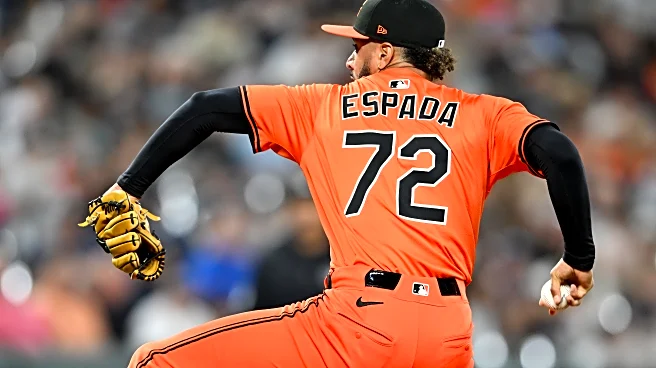
With three weeks left in the season, the Orioles would not be denied the opportunity to join the 2024 Marlins in baseball lore. All they needed was three new players, and you better believe they found enough waiver-wire relievers to do so. Boom: Carson Ragsdale (#68) on Sept. 14. Bam: José Castillo (#69) the next night. And finally, on Sept. 20, the day we’ve all been waiting for: right-hander José Espada worked three innings of relief in his first and only O’s appearance. There he was: player #70.
Seventy players in a single season. What a thing. It’s, uh, probably not something to celebrate. But the Orioles tied a major league record, and nobody can take that away from them.
….Until three days later, when the Atlanta Braves took it away from them by using their 71st player of the season. That player? Charlie Morton, who signed with his longtime team to pitch one final game before retirement.
And with that, the record slipped out of the Orioles’ hands. Where’s Houston Roth when you need him?