

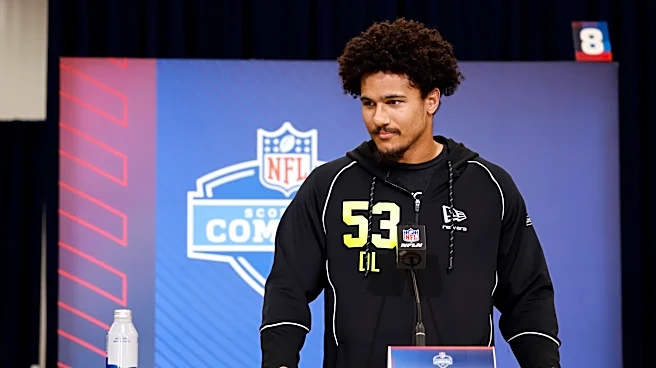
Our friends at Big Blue View, the SB Nation site covering the New York Giants, were ready to post an in-depth film review of right guard Josh Ezeudu’s performance in preseason Week 2 when the news of a trade hit.
The Giants struck a deal with the Kansas City Chiefs to acquire the third-round selection in the 2022 NFL Draft out of North Carolina. Now, let’s see what we can learn about Ezeudu from his play this preseason, a year after missing the entire 2025 campaign due to a calf injury.
Thank you to
Chris Pflum for sharing his write-up!
The Giants have long looked at Ezeudu as a utility lineman, using him at both left guard and left tackle. He played all over the offensive line at North Carolina, but he seems like a natural guard at the NFL level. So it was frustrating that the Giants constantly played Ezeudu out of position.
Part of that was due to happenstance, with his experience and athletic traits being enough to let the Giants call on him at tackle when their depth chart was depleted by injury. Later on, however, former head coach Brian Daboll’s staff insisted on keeping Ezeudu at tackle even when the depth chart was replenished.
But whatever the reason may be, of the 738 snaps Ezeudu played for the Giants from 2022 to 2024, 402 of them came at the left tackle position, while 317 came at left guard. Moreover, he was almost exclusively played at tackle in 2023 and 2024, with just 28 snaps at guard in 2024.
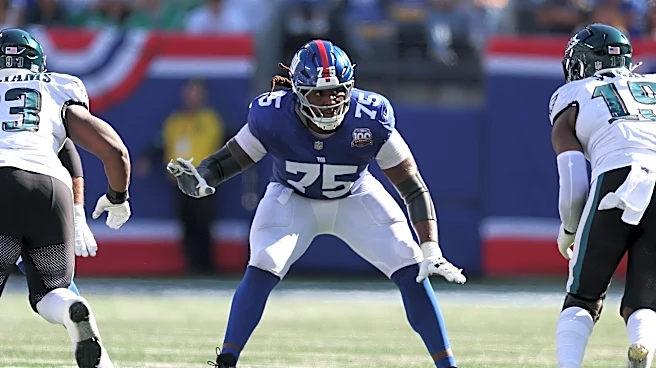
All of Ezeudu’s snaps in the first preseason game came at right tackle; however, he finally got his chance to play at guard after the team dealt guard Daniel Faalele to the Jacksonville Jaguars.
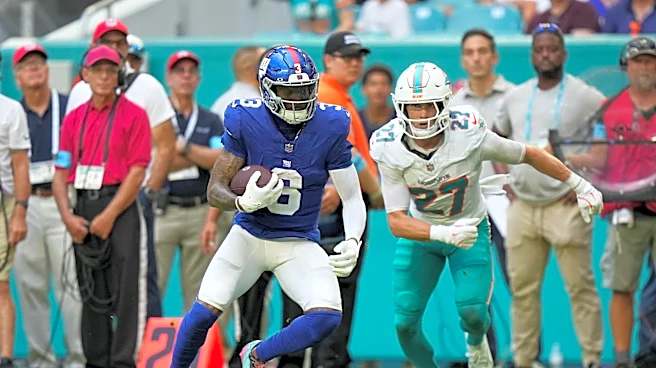
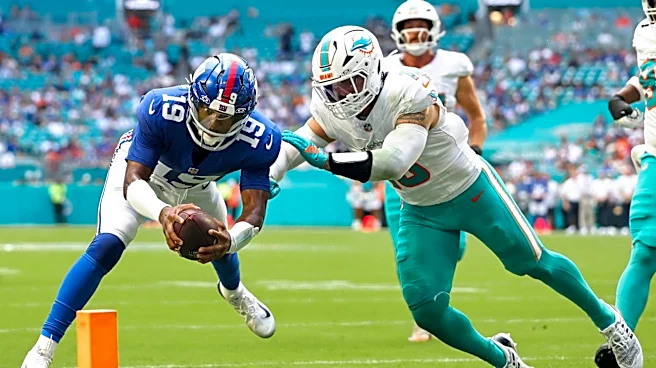
Ezeudu played 47 offensive snaps against the Miami Dolphins, splitting time between right guard and right tackle. His first 30 offensive snaps all came at right guard, so those are the ones we’re going to look at.
Run blocking
Ezeudu is very much not the 6-foot-8, 380-pound behemoth that Faalele is, or even the massively powerful 340-pounder that Evan Neal is. He has adequate size and power for a guard, but he tends to be better when allowed to use his athleticism rather than trying to distort the line of scrimmage and dig defenders out of gaps through main strength. Ezeudu’s near-tackle athleticism may have given the Giants too much reason to try him as an offensive tackle, but it allows him to easily flow laterally in zone concepts, as well as work up to the second level.

This is the first run of the game for Ezeudu, and you can see how easily he flows in sync with center Lucas Patrick on the guard/center double team, before working up to the second level to engage with 6-foot, 225-pound linebacker Kyle Louis.
And while Ezeudu might not have the power to routinely put defenders on skates and drive them off the ball, his athleticism does allow him to work angles and effectively out-position defenders.

Here we see Ezeudu make the reach block to double-team the nose tackle (aligned in the left A-gap) before the center abandons the block to cut off back-side pursuit. Ezeudu does a great job of establishing half-man leverage, as well as effectively positioning himself to seal off the inside of the running lane established by the pulling left guard. Ezeudu gets under the nose tackles’ pads, which, when combined with only having to block half a man, allows him to effectively stonewall the 320-pound tackle.
Ezeudu’s average play strength shows up when he can’t use his athleticism to establish leverage and positioning on defenders.

Even though outside zone plays to Ezeudu’s strengths here, the Miami defensive tackle is able to get initial penetration and establish leverage on Ezeudu. Ezeudu doesn’t quite have the strength to outfight the tackle or compensate for losing leverage, so even though he initially has position on the defender, the tackle fights through his block. There should be a running lane to the right of the center; however, the tackle gets under Ezeudu and closes the gap.
But to end this section on a more positive note, it’s important to point out that when Ezeudu is able to establish leverage, he’s versatile enough to be an asset in downhill runs as well as moving laterally in outside zone.

Here we see a straightforward power run through the left A-gap. The center works to the second level, leaving the left and right guards to establish the running lane. Ezeudu has to block the defensive tackle head-up. Ezeudu isn’t able to drive him off the ball outright, but he’s able to stalemate the defender and torque the tackle to keep him from making a play on the ball. He does a good job of matching the defender’s leverage, playing with a wide enough base to keep his balance, and showing great grip strength to steer the tackle while sustaining his block.
Pass protection
Ezeudu has always been a better pass protector than run blocker — though to be fair, he hasn’t been able to consistently develop at guard, and he might be further along in both disciplines had he gotten the opportunity.
That said, his agility and footwork do lend themselves to pass protection. And while Ezeudu might not quite have the traits to be a good tackle, he has more than enough quickness to mirror rushers at guard as well as enough strength to anchor.
Here’s a great look at Ezeudu’s quickness and agility in action.

The Dolphins execute a late shift, forcing a sudden change in the Giants’ blocking assignments. The defensive tackles also execute a twist, with the 1-technique slanting to attack Ezeudu in the right B-gap, while the 3-technique loops inside to attack the center through the A-gap. Ezeudu does a great job of passing off the 3-technique while picking up the 1-technique.
His quick feet let him slide inside, then redirect back outside to stay in front of the looping tackle, preventing quick, easy penetration.
Unfortunately, he doesn’t do a great job of anchoring against the rush and loses ground into the backfield. That said, his footwork is good enough that he’s able to lose slowly, using his feet to disperse some of the power while he widens his base to maintain balance. Ezeudu is able to bow up against the rush and buy quarterback Jameis Winston enough time to get the pass off.
Later in the game, we see the Giants field a very heavy front, using 22-personnel (a running back, a fullback, and two tight ends) only to run play-action.

It’s commonly asserted that play-action is built off of running the ball, but that’s not quite accurate. Instead, successful play-action demands good deception from the offense. The Giants set the stage with their heavy, condensed formation, which forces a base defense from the Dolphins and a heavier box.
Then, the offensive line has to sell the run through their blocking, while also transitioning to pass protection after the play-fake.
Here, Ezeudu does a great job getting in phase with his linemates as they fake the outside zone run. The fake is very successful, as we see the linebackers and even the defensive backs get sucked into run support before freezing and dropping back into coverage.
He uses his quickness and agility well to get in front of number 91, playing with good hip and pad level. As he transitions to pass protector, Ezeudu works his hands inside to win inside leverage and does an excellent job of staying parallel to the line of scrimmage and establishing a wide base. He’s able to stay in front of the defender, giving up almost no ground and establishing a deep pocket while Winston goes through his reads and eventually finds Devin Singletary for the short gain.
Final thoughts
If there’s one thing I really think stands out about Ezeudu’s game against the Dolphins, it’s the competitive toughness with which he plays. Whether he’s straining to sustain a run block, looking for work in pass protection, or hustling to pick up a defender in space, he gives great effort throughout the game.
That toughness gives him a chance, even when he doesn’t quite have the play strength to dominate his opponent, or the opposing lineman is able to establish positioning.