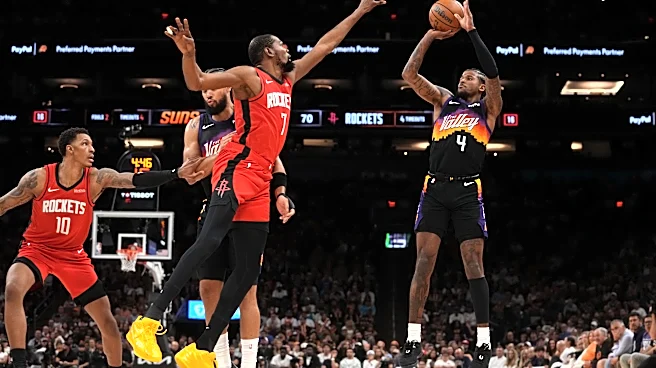








One of the Suns’ extension dominoes has already fallen. Dillon Brooks signed a three-year, $73 million extension earlier this month, a deal many would consider team-friendly given the impact he has already had on the culture of this team.
That deal benefits Phoenix in the short term and could pay dividends down the road as Brooks becomes part of the developmental force surrounding the younger players over the next three seasons.
There is still one extension sitting out there, though. That belongs to
newly acquired Miles Bridges, whom the Suns traded for from the Charlotte Hornets this offseason. Bridges is set to make $22.9 million this upcoming season and will become an unrestricted free agent next summer, although Phoenix will hold his Bird rights if the two sides don’t agree to an extension beforehand.
According to ESPN’s Brian Windhorst, it sounds like Bridges is willing to wait before signing a new deal.
“Miles Bridges did not extend his contract,” Windhorst observed on The Hoop Collective. “My understanding is he’s probably going to wait and try to extend it later. You may see him come in and really have a sizable role. I think they have not only an intent to pay him, but an intent to give him a big role.”
This is an interesting bit of news because, as we’ve previously discussed, there are essentially two timelines when it comes to Miles Bridges and a potential contract extension.
The first would come within the first six months of his acquisition, which takes us to January 13. In that scenario, the maximum Phoenix could offer would start at 120% of his previous salary, with 5% raises in each additional season, and no more than 4 total seasons, including the current year. That would make his new deal a three-year extension worth up to approximately $86.3 million.
The more likely scenario is that an extension comes after mid-January. At that point, Phoenix could offer him a standard veteran extension beginning at up to 140% of the final year of his current contract, with 8% annual raises. That could push the total value to approximately $143.2 million over four years.
Based on Windhorst’s comments, it also sounds like Phoenix intends to give Bridges a much larger role this season. That could mean a more Bridges-centric offense during the first few months as the Suns evaluate whether he can shoulder that responsibility and ultimately earn that kind of contract.
I’m not sure this is necessarily the best way to operate for a team that has done such a stellar job this offseason of retaining talent on what would generally be considered team-friendly deals. Brian Gregory has been masterful with the cap sheet during an era in which that kind of maneuvering has not only been helpful, but practically required for the Suns to remain competitive moving forward. If Phoenix were to sign Bridges to a four-year extension at the maximum value of $143.2 million, it would feel like a step backward.
It could also signal that the Suns are willing to move on from Jalen Green eventually, with his extension decision coming into focus when he becomes eligible on October 1. Why? Having Devin Booker, Miles Bridges, and Jalen Green eat up that much of the cap sheet may not be the most fiscally responsible way to operate over the next few seasons. If Bridges were to sign the maximum extension, he would make roughly $32 million next season. Booker and Green are already on the books for a combined $97 million, which would push that trio alone to approximately $129 million.
In the short term, that’s painful. Extrapolate it out several seasons, and it becomes increasingly difficult to manage. Granted, teams don’t always operate with that kind of long-range permanence in mind. Transactions happen and money gets moved. Bridges, Green, or even Booker could be traded during that window, creating additional flexibility. But committing that much money to all three would certainly make the cap sheet more complicated than it needs to be.
All of this comes back to the same premise. We have yet to see Miles Bridges on the court in this system, surrounded by these players, and therefore have no real understanding of what his value will be in either the short term or the long term. Perhaps that’s part of the reason no extension has been signed to this point. Phoenix wants to give Bridges a larger role and see exactly what he has, and quite frankly, what he doesn’t have, as a player on this team. From there, the Suns can make a more informed evaluation and potentially find another team-friendly contract that works for both sides.
Ultimately, time will tell where this ends up. The Suns don’t need to decide what Miles Bridges is worth today, and Bridges doesn’t appear eager to lock himself into a number before seeing what his role can become in Phoenix. Both sides have something to gain from patience. If the fit is as good as they hope, the answer will become clearer. If it isn’t, at least the Suns won’t have paid for a version of Bridges that only existed on paper.