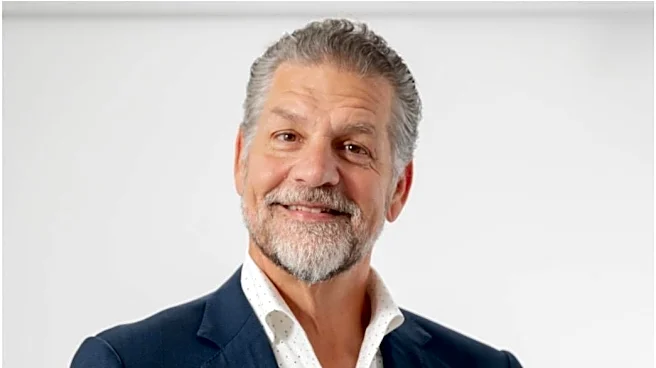



For Mike Golic Sr., football has never been simply a game—it has been a thread woven through nearly every chapter of his life. From his days wearing the gold helmet at Notre Dame to a decade in the NFL, followed by a broadcasting career that made his voice familiar to sports fans across the country, Golic has spent a lifetime around the game.
Now, his journey has brought him back to where so much of it began.
This season, Golic stepped into the radio booth as a color commentator for Notre Dame football
while also returning to ESPN Radio alongside his son, Mike Golic Jr.
I recently had the opportunity to sit down with Golic to talk about seeing Notre Dame football from an entirely new perspective, the Fighting Irish’s 3–0 start, the strengths that could shape this season, what he appreciates about his own Notre Dame experience all these years later, working alongside his son and how his approach to health and wellness has evolved along the way.
***
You’ve experienced Notre Dame football as a player, an alumnus and a parent, and now you’re experiencing it from the radio booth. What has surprised you most about seeing the program from this new perspective?
Yeah, it’s weird. All of a sudden, I have to be on during a game, right?
I first got there in 1975, when my brother Bob was a freshman. I was 12 years old, sitting in the stands. Then I was there with my brother Greg, running out of the tunnel. As you mentioned, then being a parent, watching two boys run out of the tunnel and my daughter swim.
And now I just have season tickets to the game—but now I’m put to work. While watching a game, I used to be able to go out and get something to eat. Now I have to watch the whole game.
But I love it. This was like a bucket-list thing for me. I jumped at the opportunity when they asked me to do this. Notre Dame has been such a part of my life and my family’s life. We own a home there as well, so it is like being at home, quite honestly. We love the place.
Who in the Golic family planted the seed that launched the family’s Notre Dame tradition?
That was my brother Bob, again, in 1975. It’s about a four-and-a-half-hour drive from our house in Cleveland, and Bob was a big recruit. All the big schools wanted him.
I think it was the combination of Notre Dame being what it was, but also the academic side. My parents were very strict with us about academics through grade school and high school, so that was a very important selling point to my parents when Bob got recruited, when Greg got recruited and when I got recruited.
Bob really kicked it off. Then I got to see Notre Dame as a 12- to 15-year-old—the Joe Montanas and the Ross Browners of the world—and I’m like, wow.
When my brother Greg went there, a year ahead of me, I got to see it as more of my peers going there, guys I could play with or against. I got to see it from a couple of different perspectives.
As long as I got the offer, I was all in. On Thanksgiving of my senior year in high school, I got the offer, and that was it.
Notre Dame is 3–0, but we’re still early in the season. From what you’ve seen up close, what is it about this team that makes you think it could be special—and what do the Irish still need to prove?
As a former defensive player, I love that side of the ball and what Chris Ash, the defensive coordinator, has going on with that defense. They’re so deep between the line, the linebackers and the secondary.
They have basically the best, or co-best, player in all of college football in Leonard Moore. If you want to put him with Jeremiah Smith, the wide receiver at Ohio State, that’s absolutely fine. But he’s one of the best, if not the best. They’re so deep and talented.
They have a legitimate Heisman candidate in CJ Carr and a running attack that’s starting to gain traction. It was always going to be tough to follow up last year, when you had two running backs—Jeremiyah Love and Jadarian Price—both go in the first round.
That’s tough to follow up on, but they have a great stable of running backs. I think four or five running backs, including a couple of true freshmen.
Right now, they do a good job, as the game rolls on, of really leaning on you with that offensive line and those backs. That’s the part where I think people have high expectations because of the running attack the last few years, and I think that part of their game is starting to catch up.
Do you think the offensive line has been off to a little bit of a slow start, or is it simply a matter of the players learning to work together?
It’s the part of the team that has to gel the most. While you have experienced guys, Anthonie Knapp, who played his first couple of years at left tackle, kicked down to left guard. You have Guerby Lambert, who played last year at right guard, going out to right tackle. You have a first-time starter this season, Will Black, at left tackle.
You have some old pieces in new places and new faces making their first starts, so there is a gelling moment they have to go through.
Joe Rudolph is an excellent, excellent offensive line coach. I think as the season goes on, you’ll see more and more improvement in the running game.
You played at Notre Dame and then spent 10 years in the NFL. When you watch today’s Notre Dame players, what do you notice from a former player’s perspective that the average fan might not see?
I see players who, whether they’re going to the NFL or not, are always very fundamentally sound. These last few years, Marcus Freeman has done such a great job recruiting. He’s getting incredible athletes, so you’re getting incredible athletes going from Notre Dame into the NFL.
I think Notre Dame was second or third in the number of players in the NFL from one school. It’s what recruits want. Recruits want to go to a great school, have a chance at a national championship and get prepared for the NFL. Notre Dame is certainly one of the schools that does that.
But let’s be honest: A high majority of not only Notre Dame players, but all college football players, aren’t going to the NFL. Two percent make it to the NFL. The rest have to go on with the real world and real life, and Notre Dame prepares you.
Notre Dame’s motto is “four for 40.” You go there for four years for the next 40 years or more of your life, and you’re prepared. You also can have great connections if pro football isn’t in your future.
You’ve had such a long career in sports and broadcasting, but Notre Dame keeps finding its way back into your life. What does it mean to you, at this point in your life, to be part of Notre Dame football again every Saturday?
My two brothers went there. I went there. My wife and her sister went to Saint Mary’s. Her sister’s two girls go to Saint Mary’s. My three kids went to Notre Dame.
It’s in our blood.
Notre Dame, to us, is family. Like I said, we have a house there. It’s a great meeting spot for everybody to get together. You meet people when you’re there and after you’re there, and you continue to stay in touch with them.
The word I use is family. I have my family, but we all have our Notre Dame family as well, which I’m sure you know well. It’s really second to none.
You’re also back at ESPN, this time hosting a show with your son. After everything you’ve done in broadcasting, what is different about getting to experience this chapter of your career alongside Mike Jr.?
After the long career at ESPN—the last three years of which I did a show with my son Mike and Trey Wingo—Mike and I have done a show together for a couple of different places over the last couple of years.
So that’s nothing new, but it’s also the best part of my broadcasting time: working with my son.
I understand the years with Greeny during Mike and Mike, we were fortunate enough to get a lot of accolades, and things went really well. But to be able to work with one of your kids, flip on the microphone and do a show with him. I’ll never take it for granted.
The one thing I do enjoy, though, is that for so many years I had to do a four-hour morning show starting at 6 a.m. Now it’s 10 to 12 Eastern. It’s two hours, and I get to sleep in, which I do enjoy.
As a former NFL player, you’ve spent most of your life thinking about health and performance in one way or another. How has your definition of “being healthy” changed as you’ve gotten older, and has wearing Stelo taught you anything about your own habits that genuinely surprised you?
Oh my gosh. I was diagnosed with type 2 diabetes in my early 40s. I’m 63 now. My father had it as well.
Back then, 20-some years ago, I pricked my finger to do a blood test to find out what my glucose levels were. I would work out, eat and sleep, and I didn’t know how that affected my glucose levels.
Now, with Stelo—and you can get all the information at Stelo.com—it’s an over-the-counter, small health wearable that does a great job of charting what your numbers are. Especially after you eat, you can find out what your numbers are after you work out and after you sleep.
It’s a very small health wearable, and it charts all these things for you. Now you have the information: I slept this long; I worked out at this point of the day; I worked out this hard; I did this type of workout. How are my numbers compared with that? I ate this at a certain time of day, and I ate that at another time of day. How does it affect my numbers?
The information highway that Stelo provides is absolutely amazing. You can chart it all and find out how your daily schedule should go. It has been an absolute lifesaver for me, helping me chart all these numbers compared with all the things I’m doing. It really lays out my day and how I should approach and attack each day.
And it really isn’t just for those with type 2 diabetes. It’s for anybody who wants to check their glucose level. That’s your energy. Learning how to keep those levels at the right level is huge, and that’s exactly what Stelo provides.
***
Before our conversation ended, Golic also answered several questions submitted by Notre Dame fans, sharing some favorite memories from his playing days and revealing which familiar South Bend establishment might have earned his NIL endorsement.
What was your favorite game at Notre Dame?
My favorite game was my sophomore year. We went to play Pitt. Dan Marino was the quarterback, and at some point all five members of their offensive line ended up in the NFL. I ended up playing against them in the NFL.
My sophomore year, they were 7–0 and number one in the country, and we beat them on their turf.
I remember we came back to Notre Dame and got on the buses from the airport. Instead of taking us right back to where they were going to drop us off, the buses went down Notre Dame Avenue.
Notre Dame Avenue was lined with students who ended up jumping through the windows of the bus. It was a great celebratory moment.
Unfortunately, during my years there, we had very few celebratory moments, but that was one of them. That’s one I’ll never forget.
What is your favorite Notre Dame memory away from football?
I wrestled as well, so I loved wrestling. Unfortunately, they dropped the wrestling program two years after I graduated. My brother Bob wrestled there as well.
I wrestled there for a couple of years, and I thoroughly enjoyed it. I love wrestling easily as much as football. I absolutely love the sport.
Which residence hall did you live in?
I lived in Dillon, right next to South Dining Hall. I loved it.
Did you have any unusual pregame rituals or superstitions?
I never did, which is probably more odd—probably more rare than not.
I think it’s more relevant in basketball, baseball and hockey, where you play way more games. In college, you play 12 games. In the NFL, I played 16 games.
I didn’t really have a ritual. The only ritual I had, more in the NFL, was that we had to be there two hours before the game. I made sure I got there two hours before the game. I was not one who liked to hang around a long time before a game.
If NIL opportunities had existed during your playing days, which company or restaurant would you have wanted to represent?
I think my senior year, after I turned 21, I would have aligned with the Linebacker. I loved the Linebacker. Maybe that, or maybe Senior Bar as well.
***
For Golic, this latest chapter may come with a microphone instead of shoulder pads, but his connection to Notre Dame remains unchanged. The University has been part of his life as a young fan, a player, an alumnus and a father—and now it has welcomed him back as one of the voices of Fighting Irish football.
As Golic put it, Notre Dame is “in our blood.” After nearly five decades of memories, relationships and Saturdays in South Bend, one thing is unmistakably clear: Mike Golic Sr. is still Irish—and, once again, he is right where he belongs.
This interview was arranged in partnership with Stelo.
Cheers & GO IRISH!!