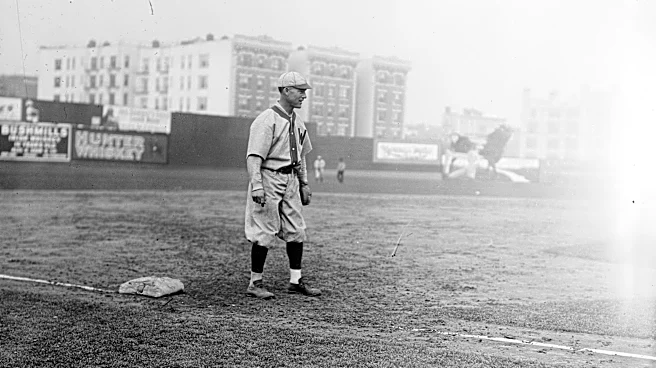




The nascent years of the Yankees franchise — then known as the New York Highlanders — were a veritable Wild West. Fortunes fluctuated frenetically as teammates, manager, and even owner clashed daily. The behavior of certain involved parties would make even the most controversial issues nowadays appear tame. Perhaps no player associated with the franchise embodied this volatility more than shortstop and later manager Kid Elberfeld.
Norman Arthur “Kid” Elberfeld Born: April 13, 1875 (Pomeroy, OH) Died:
January 13, 1944 (Chattanooga, TN) Yankees Tenure: 1903-09
Norman Arthur “Kid” Elberfeld was born in Pomeroy, OH, on April 13, 1875, the tenth of eleven children to German immigrants Philip Elberfeld and Katherine Eiselstein. He played mainly hockey and baseball in his youth, suiting up at every position except pitcher. After captaining several Cincinnati-area local teams, he got his first chance in professional baseball with the Dallas Navigators of the Class C Texas Association.
A leg injury ended his tenure with the team in May, but he managed to land with the Richmond Bluebirds of the Class B Atlantic League, with whom he would bat .306 with 46 stolen bases in 138 games in 1897. These performances caught the eye of the Phillies, who purchased his contract that fall. His MLB debut was delayed by several months, Elberfeld injuring his knee when he fell in a bathtub, but he finally made it to the bigs on May 30, 1898, in the first game of a doubleheader against the Louisville Colonels, collecting a pair of doubles and a hit-by-pitch while also committing a pair of errors at third.
An attitude that was equal parts petulant and lackadaisical defined his career as a major league fielder, Philadelphia sportswriters writing that he “might as well learn now that Philadelphia ballcranks will not stand for his minor league methods. What we want [are] ball players, not toughs.” He made just 14 appearances for the Phillies, batting .237 with no home runs and seven RBIs before his contract was sold to the Detroit Tigers, then a minor league club playing in the Class A Western League.
Elberfeld rebounded in 1899, batting .308 with 23 stolen bases to earn another shot in the majors. However, a back injury, poor play and an even worse attitude limited him to just 41 appearances with the Reds before they got fed up and sold him back to Detroit in 1900. He would play two-and-a-half years with the Tigers including their debut season in MLB in 1901. By the end of 1902, there was a deal in place for the New York Giants to purchase Elberfeld from the Tigers, but in the interest of maintaining peace between the AL and NL, Elberfeld remained in Detroit, now under the direction of new manager and future Yankees GM Ed Barrow. Barrow quickly grew tired of Elberfeld’s antics, fining and suspending him for “loaferish conduct” amid suspicion that Elberfeld was trying to force a trade to the St. Louis Browns, Barrow instead trading him to the New York Highlanders.
Soon after his arrival in New York, Elberfeld was given the nickname “the Tabasco Kid” by sportswriter Sam Crane on account of his being “the dirtiest, scrappiest, most pestiferous, most rantankerous, most rambunctious ball player that ever stood on spikes.” He was notorious for his hard-nosed play on the field and ill-temper off it, at one point getting charged with disorderly conduct for throwing either a bottle or a knife at a hotel waiter not long after his trade to the Highlanders.
Despite his frequent feuds with teammates including Hal Chase, Jimmy Williams, Wid Conroy, and Ira Thomas, Elberfeld played his best baseball in his first years with the Highlanders, leading all AL shortstops with a .275 batting average between 1904 and 1906. He had a pair of infamous run-ins with umpire Silk O’Loughlin in 1906, first threatening him with the bat before initiating an actual brawl in the second incident that required police intervention, which the New York Times called “one of the most disgraceful scenes ever witnessed on a baseball field.” This disdain for umpires would characterize his baseball career, Elberfeld on another occasion throwing mud into an umpire’s mouth during a confrontation.
His standing on the Highlanders began to seriously degrade in 1907, owner Frank Farrell suspending him in July for “indifferent work in the field and at the bat,” as Elberfeld again sought to force a trade, this time to the Washington Senators, whom he harbored aspirations of managing. As it happens, that opportunity to manage would come with the team that was close to pushing him out the door. Farrell lifted the suspension in mid-August and even offered a contract extension on improved terms. The following year, Elberfeld suffered a season-ending injury on May 1st, and after a poor stretch of play in June, manager Clark Griffith was forced to resign and Elberfeld was handed the reins.
That decision could not have a more disastrous result. Starting his tenure ten games back of first place, the Highlanders went 27-71 under Elberfeld’s direction to finish in dead last with a 51-103 record, 39.5 games back of first place. His .276 winning percentage remains the worst in franchise history. That catastrophe of a managerial appointment was summed up in the words of one of his unnamed players:
“We are … playing under the direction of a crazy man. It won’t take Elberfeld more than two weeks to make us the most demoralized ball team that the American League has ever known. He thinks he is a manager, but he can’t convince any one but himself that he has the first qualification for the place. It’s a joke.”
Elberfeld was replaced by George Stallings as manager in 1909, but still had a contract to play for the team. In 106 games, he batted .237 with 26 RBIs and 23 stolen bases, allowing Stallings to sell him to Washington at the conclusion of the campaign. He played two injury-filled years in the nation’s capital, followed by a season each with Montgomery and Chattanooga of the Class A Southern Association, and a final season in the majors with Brooklyn in 1914. The next four seasons saw him return to various minor league clubs in the Southern Association, and his final appearance in professional baseball was as a 61-year-old pinch hitter for the Fulton Eagles of the Class D Kitty League in 1936.

Elberfeld dedicated his post-playing days to coaching and instructing in various youth baseball leagues in Tennessee, Arkansas, Mississippi, Texas, Alabama, Georgia, and Louisiana. He passed away from pneumonia in Chattanooga on January 13, 1944, at the age of 68. Though notorious for his confrontational-going-on-violent personality during his playing days, he left behind arguably a greater legacy as a mentor for a generation of young ballplayers.
References
Kid Elberfeld. Baseball-Reference.
Kid Elberfeld. Baseball Almanac.
Simpkins, Terry “Kid Elberfeld.” SABR.
“ELBERFELD IS SET DOWN BY FARRELL; Owner of Yankees Suspends Sulky Player Indefinitely and Without Pay. CONROY TO PLAY SHORT Hilltop Club Drops Two Miserably Played Games to Cleveland — Chicago Loses Fourth Straight.” The New York Times. July 27, 1907.
See more of the “Yankees Birthday of the Day” series here