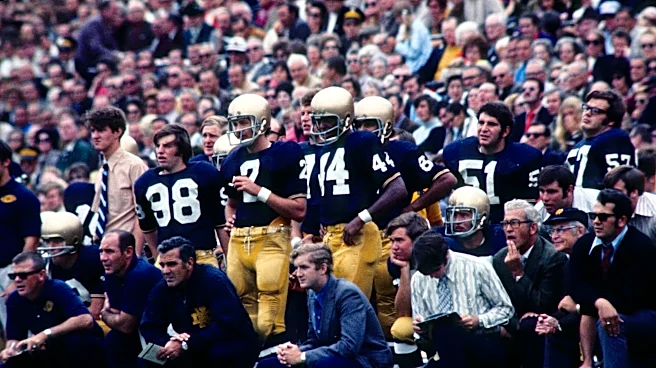


On October 16, 1971, Notre Dame was undefeated, Richard Nixon was president, Rod Stewart’s “Maggie May” was near the top of the charts, and I was exactly ten days away from entering the world.
Clearly, everyone was waiting for me.
In the meantime, Notre Dame had a football game to play, and if you were one of the 59,075 fans inside Notre Dame Stadium that Saturday afternoon, you probably came hoping to see something that had been missing through the first four games of the season: an Irish offense
ready to explode. Instead, you saw a defense that simply refused to let anyone score.
Notre Dame entered the game against North Carolina 4-0 and riding a defense that had become the backbone of Ara Parseghian’s team. The Irish had shut out Miami 17-0 the previous week, and opponents hadn’t scored against Notre Dame in ten consecutive quarters.
North Carolina wasn’t simply another team passing through South Bend, either. The Tar Heels came to town with a 4-1 record and would eventually finish the season 9-3 and win the ACC championship. They had a good football team and an offense capable of moving the ball.
Notre Dame’s defense just wasn’t particularly interested in letting them do it.
There was another storyline hanging over Notre Dame Stadium that afternoon. Joe Theismann had moved on, and sophomore Cliff Brown was making his first start of the season at quarterback. With USC looming the following week, Irish fans were anxious to see whether Brown could finally get the offense moving. One contemporary account described the crowd as coming to see whether Brown could “buckle into Joe’s shoes.”
Instead, they got more of the same grind-it-out football they had seen during the first month of the season. Notre Dame could move the ball, but finishing drives was another matter. The Irish drove deep into North Carolina territory on each of their first three possessions and came away without a touchdown.
Fortunately, they had Bob Thomas.
Thomas kicked field goals of 28, 27 and 24 yards, accounting for all of Notre Dame’s early scoring and tying the school record for field goals in a game, which Gus Dorais had set against Texas in 1913. It wasn’t exactly the offensive explosion fans had hoped to see, but with Notre Dame leading 9-0, it was more than enough for a defense that wasn’t giving North Carolina much of anything.
One of the game’s most remarkable defensive sequences came courtesy of Clarence Ellis. North Carolina had noticed a tendency in Notre Dame’s kickoff coverage: when the returner headed toward the middle of the field, the Irish coverage team converged. So the Tar Heels devised a little surprise.
Lewis Jolley took the kickoff and headed toward the middle before stopping and lateraling the ball to Earle Bethea along the sideline. Suddenly, Bethea had a wall of blockers in front of him, and Clarence Ellis was about the only thing standing between North Carolina and a potentially huge play.
Somehow, Ellis fought his way through the blockers and brought Bethea down at the Notre Dame 43. North Carolina coach Bill Dooley would later describe Ellis’s effort as “unbelievable.”
Ellis wasn’t finished. On North Carolina’s very next play, he intercepted quarterback Paul Miller.
The defining moment of the afternoon, however, came in the third quarter. Notre Dame still led 9-0 when Larry Cieszkowski fumbled and North Carolina recovered at the Irish 33. Two pass plays later, the Tar Heels had first-and-goal at the Notre Dame four, and suddenly that long scoreless streak was in serious jeopardy.
North Carolina tried three running plays, but the Irish defense refused to give ground. Facing fourth down, the Tar Heels finally decided to take the points and sent Ken Craven onto the field for a field-goal attempt.
Apparently, Notre Dame’s defense wasn’t interested in allowing three points, either.
Mike Kadish crashed through the right side of the North Carolina line and blocked the kick. After beginning the possession at the Notre Dame 33 and eventually reaching first-and-goal at the four, the Tar Heels had come away with nothing.
The shutout was still alive, and the Notre Dame students were starting to believe this defense might be capable of just about anything. According to a contemporary account of the game, some students celebrated the stop by yelling, “We can’t lose this year, ’cause nobody’s gonna score on us.”
Ah, the optimism of college football fans.
Some things haven’t changed much in 55 years.
Dooley later pointed to that goal-line stand as the turning point of the game. North Carolina had the momentum and an opportunity to make it a two-point game, but Notre Dame’s defense slammed the door.
“We had momentum in the third quarter with a first down at their four,” Dooley said. “But Notre Dame came up with that great stand and the momentum switched.”
Then he offered perhaps the greatest compliment Parseghian’s defense could have received: “Notre Dame is the best defensive team I’ve ever seen.”
While the defense was dominating, a little Notre Dame history was being made on the other side of the ball as well. Early in the game, All-American receiver Tom Gatewood made the 139th reception of his Irish career, passing Jim Seymour to become Notre Dame’s career leader in receptions.
Gatewood wasn’t finished, either. In the fourth quarter, Brown finally found him for a four-yard touchdown pass, giving Notre Dame the touchdown it had been searching for all afternoon and extending the lead to 16-0.
That was more than enough.
North Carolina never scored, Notre Dame had its second consecutive shutout, and opponents had now gone 14 straight quarters without putting a point on the board against the Irish defense. Notre Dame was 5-0 at the halfway point of the season, and thoughts of a national championship were beginning to creep into the conversation.
That’s one of the things I love most about digging through old newspapers for Throwback Thursday. We know what happened next, but the people sitting in Notre Dame Stadium that afternoon didn’t. We get to read their words and, for a moment, experience the season the way they did, when every possibility was still out there.
In fact, the optimism heading into the following week’s game against USC is almost charming to read today. One contemporary account suggested that the Trojans were losing to everybody and “couldn’t possibly stop the Irish express.”
Oh, to have the confidence of an undefeated college football fan in October.
I know the feeling.
And somewhere in all of this, I was ten days away from making my own debut. I obviously don’t remember Notre Dame’s 16-0 victory over North Carolina, but there’s something fun about knowing exactly where the Irish were just before I arrived: undefeated, halfway through the season, dreaming about a national championship and fielding a defense that had convinced students nobody was ever going to score on them again.
Fifty-five years later, Notre Dame and North Carolina are preparing to meet again. The uniforms have changed, the players have changed and college football has changed in ways those fans in 1971 probably couldn’t have imagined.
But that October optimism?
I don’t think that’s changed at all.
Go Irish! ☘️
(Research gathered from The Scholastic: 1971 Notre Dame Football Review, The Observer, and The South Bend Tribune.)