




On Thursday, Sunderland welcome Polish side Jagiellonia Białystok to Wearside for our fifth Europa League match of the season. Ahead of the game, I’ve had a look at what you need to know about our opponents and where they come from!
A Bit About Białystok
Białystok is located in north-eastern Poland, near both the Lithuanian and Belarusian borders. It can be reached by train from the Polish capital, Warsaw, in under two hours.
The existence of Białystok as a settlement dates back to 1437, at which point it belonged to the
Grand Duchy of Lithuania.
At the start of the 19th century, the city was sold to Prussia before being passed on to the Russian Empire a few years later. In 1812, Napoleon’s army entered Białystok on its way to invade Moscow.
Białystok soon experienced an industrial revolution facilitated by cheap land and its location. Its textile industry was its biggest asset at this time.
During the First World War, Russian rule of Białystok ended. In 1918, it was briefly declared part of the Belarusian National Republic; however, it was taken by Poland less than a year later, following Polish independence in November 1918.
The city changed hands several times during the Second World War, and throughout this period it was severely damaged. 80% of all the city’s buildings had been destroyed, and its population fell from 100,000 to fewer than 50,000. After the war, it was passed to the new Polish People’s Republic.

By 1956, the population had returned to 100,000, and its university was first established in 1968.
The Third (and current) Polish Republic was established in 1989 after the collapse of the Soviet Union, and a process of decommunisation began shortly afterwards. Białystok became a major transit and trade hub for goods arriving from Russia and Belarus.
Its population nowadays is just under 300,000, making it the tenth most populated city in Poland. Visitors to the city today can enjoy its large number of green spaces and parks, as well as its numerous churches, museums and palaces.

Jagiellonia Białystok: What You Need to Know
History
Jagiellonia Białystok was founded in 1920 by soldiers from the 42nd Infantry Regiment of the Polish Army.
The term Jagiellonia, by which the club is often referred to, refers to the Jagiellonian Dynasty, which ruled Poland for over two centuries between 1386 and 1596.
Just before the start of the Second World War, Jagiellonia were forced to fold and withdraw from the league as a result of financial problems. It wasn’t until 1955 that a newly formed club started using the name Jagiellonia again.
Jagiellonia have spent a lot of their history playing outside the Polish top flight. Their first season in the Ekstraklasa came in 1987, which saw tens of thousands of fans from across the region travelling to watch Jagiellonia for the first time.
After three seasons in the top flight, Jagiellonia were eventually relegated and fell all the way down to the Polish fourth division.
Their return to the Ekstraklasa came in 2007, and Jagiellonia have remained there since.
May 2010 saw Jagiellonia win their first major honour, lifting the Polish Cup after beating Pogoń Szczecin 1-0.
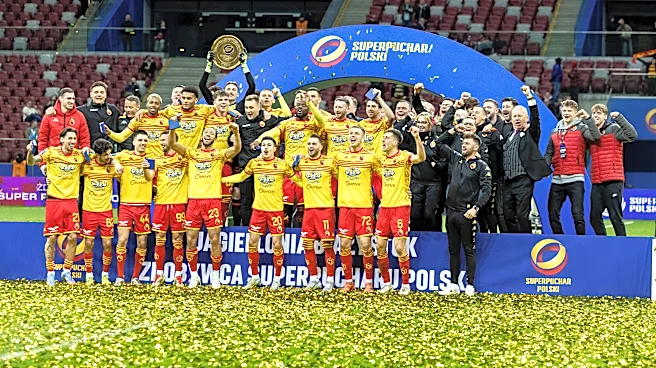
Subsequently, Jagiellonia beat league champions Lech Poznań 1-0 in the Polish Super Cup, another trophy they won for the first time in their history.
Their rise continued in the following years. After finishing third in 2015 and second in both 2017 and 2018, Jagiellonia finally won their first-ever league title in 2024, just about edging the title on goal difference. They also won the Super Cup again later that year.

Between 2010 and 2019, Jagiellonia often played in European qualifiers but were unable to qualify for the actual tournament. This changed in the 2024-25 season, in which they participated in the Conference League.
Jagiellonia reached the quarter-finals in their first full season in Europe, losing 3-1 on aggregate against Real Betis. They participated in the Conference League again in the 2025-26 season, this time reaching the play-off round before losing 5-4 after extra time against Fiorentina.
Adrian Siemieniec is Jagiellonia’s manager and recently surpassed 100 games in charge of our opponents, despite being just 34 years old. He became the youngest manager in the league when he took over aged just 31 and has overseen the club in all of their European fixtures and two major honours.

This Season So Far
This season is Jagiellonia’s first in the Europa League, having beaten Rangers and Georgian side Iberia 1999 to qualify.
In their four league-phase games so far, they have beaten Ararat Armenia and lost to Olympiacos, Anderlecht and Levski Sofia. With games against Crystal Palace and Lyon to come, their Europa League campaign isn’t going to get any easier, and they need to pick up points soon if they are to progress.
Jagiellonia have started their league season in reasonable form, sitting mid-table with seven wins and seven defeats in fourteen games. One of their defeats was a 2-1 loss away to our previous Polish Europa League opponents, Lech Poznań, back in September.
Jagiellonia’s Fans (or Lack Of)
As a result of crowd trouble at Jagiellonia’s last Europa League match away to Levski Sofia, no away fans will be allowed to attend the Stadium of Light to support their team.
UEFA had originally enforced a suspended ban on Jagiellonia’s fans following crowd disturbances at a Conference League qualifier last summer. However, further crowd disruption and the throwing of objects a couple of weeks ago in Bulgaria led to a full ban on selling tickets for one Europa League away game.
Jagiellonia were also fined €20,000 as part of their punishment.

Chorten Arena
Jagiellonia’s home matches take place at the Chorten Arena. Originally called the Stadion Miejski, its name changed in 2024 for sponsorship purposes.
The stadium was originally built in 1971 but underwent major redevelopment in the late 2000s and early 2010s. Its current capacity is just over 22,000, making it the tenth biggest in the country.
Before its redevelopment, the stadium hosted the Polish national team on one occasion, in a friendly against Bulgaria in 1988. Poland won the game 3-2.

A Familiar Face
Sunderland and Jagiellonia have had one player in common over the years: Max Stryjek. Despite being on the books for six years between 2013 and 2019, Stryjek never made a senior appearance in an official match for Sunderland before departing permanently for Eastleigh after loan spells at Boston United and Accrington Stanley.
Stryjek joined Jagiellonia ahead of the 2024-25 season and made his debut in a Europa League qualifying match away to Ajax in August 2024.
The match ended 3-0 to Ajax, with Brian Brobbey scoring the final goal. Bertrand Traoré and Jordan Henderson also started for Ajax that day.
The goalkeeper now plays for Kilmarnock in the Scottish Premiership, who he joined last summer after making five competitive appearances in Poland.

What Can Sunderland Expect?
On paper, Sunderland’s Premier League quality should be enough to see us through to victory on Thursday night.
However, as our last European game against Dinamo Zagreb showed us, as well as our away game against fellow Polish side Lech Poznań, there are no easy games in this competition. Another defensively solid performance and a win would do our European dreams and good form the world.