
Ahead of Missouri’s arrival in Starkville, coach Chris Jans’ scouting report likely framed Trent Burns as a stretch five keen to fire away from deep and occasionally finish around the rim.
It probably didn’t budget space for the redshirt freshman’s arsenal of low-post moves.
But only five minutes elapsed before Burns rolled to the right block, buried Sergej Macura, caught an entry pass, quickly pivoted and gently lofted a hook shot that found bottom.
It wasn’t an outlier.
A minute later, Burns dropped
in another after Jayden Stone drove and passed to him in the lane. Sixty seconds later, he ducked in, sealed off Jamarion Davis-Fleming, used a shoulder fake, and put another up over his left shoulder. As the half wound down, Burns added two more hook shots to his tally.
Mimicking vintage low-block operators is the latest plot twist in a two-week stretch where Burns has blossomed for the Tigers. The timing couldn’t be better.
Coach Dennis Gates and his staff have steadily optimized a seven-man rotation, but Shawn Phillips Jr. was the only true post player in that core. While Burns has averaged 5.3 points and 4.0 rebounds over the past four games, playing almost 17 minutes per game has provided vital flexibility with Jevon Porter indefinitely sidelined by a bruised quad.
Modest as that might seem, Burns’ emergence has coincided with the Tigers squad that has, for now, shed the maddening inconsistency that has defined much of this season. Since February, they’ve played like the No. 16 team in the country, per BartTorvik.com. Along the way, they’ve likely secured a spot in the field of 68, and sweeping their final two games could secure a double-bye at the SEC Tournament.
Need proof of Burns’ impact? Look at the Tigers’ scoring margin when he’s on the floor.
Entering its crucial matchup against Vanderbilt, MU was minus-34 in the 63 minutes Burns had played. That night, the Tigers outscored the Commodores by 19 points in the 17:51 he logged in an 81-80 upset. After Saturday’s 88-64 romp over the Bulldogs, the Tigers are now in the black when he’s on the court.
Curiously, Burns’ surge barely registers in his individual efficiency metrics. He’s posted a minus-33.3 net rating over the past two weeks, per Synergy Sports play-type data. Below, you can see a plot tracing how his efficiency has ebbed and flowed this season.
The easy takeaway when a player posts a strong on-off impact but a lousy individual net rating: He’s running a good lineup. That’s often the case with someone like Burns, who only has 17 percent usage on offense and serves as a backline anchor on defense. That creates modest sample sizes that skew metrics.
It’s especially volatile on defense. Synergy says Burns has allowed 1.333 points per possession over the past four games. Fair enough. But if he’s truly that much of a liability, why would MU expand his minutes?
Sussing out that answer required an old-school step: turn on the film. I rewatched every second Burns played over the past two weeks. The tape added context and reminded me that developmental bigs rarely progress in a straight line.
Synergy is invaluable, but defensive metrics get murky with centers. Teams are posting up less than ever. Pick-and-roll coverages, switches, and help rotations blur who owns a possession. The numbers tell a story, but with Burns, they don’t tell the whole one.
For example, Synergy’s database says he directly guarded a dozen plays over the past four games. Reviewing film shows Burns was involved in 36 possessions, and MU allowed only 0.814 points on those trips. That is on par with a top 20 defense nationally. Through that prism, it is obvious why Gates upped Burns’ minutes.
A prime example is the backup Burns offers as a help defender. The job description is simple: take up a position around the restricted area and use an immense frame to deter rim attempts. Watching it on film is benign. Burns moves to stay level with the lowest player on the floor, does not help up the lane, and uses his 7-foot-5 frame to wall up.
In some of these snippets, the presence of Burns forces some drivers to halt drives short, rush their shot, or alter their release angle. He is not credited with a block and will not be tagged as the primary defender. But his presence and positioning alter outcomes in and around the cup.
Burns also exerts a similar influence on some post-ups. When he can force an opposing big man to post up one step off the block, he can absorb the initial contact from a power dribble and react to counter moves such as hook shots or drop steps by maintaining verticality.
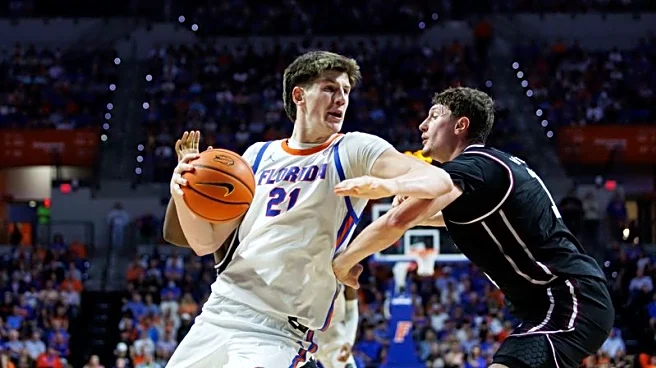
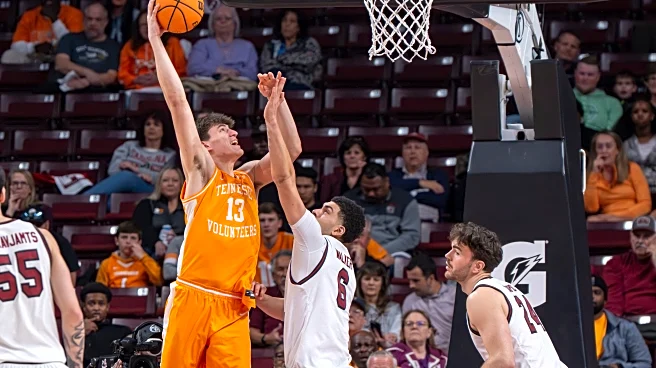
It is hard to tell with his frame, but Burns has filled in his upper legs and core enough that he is not as easily dislodged. However, we have not seen him against a truly brawny big man like Florida’s Reuben Chinyelu. Still, versus smaller post players who rely on power, he is holding up better. As you can see, against a big man like Tennessee’s J.P. Estrella, his understanding of positioning can be off-putting for finesse finishers.
Unsurprisingly, the chief question Burns confronted coming out of high school was how he could handle situations where offenses pulled him into space. The film from his time on the EYBL circuit was not always flattering, but that was the result of playing in pick-and-roll coverages that had him play at the level, hedge, or occasionally switch onto a quicker guard.
MU’s default coverage is hard hedging, but the Tigers make a rational change to drop coverage once Burns checks in. As you can see in the clips above, he can move well enough laterally to stay in front of a dribbler while a fellow Tiger recovers. Burns also seems to grasp how much cushion he can grant and still use his wingspan to contest pull-ups.
He also flashed some quick hands, especially against Tennessee, to create deflections or steals when pulled into on-ball situations away from the paint. Should we expect those to be routine? No. But part of the appeal in adding a jumbo wing like Trent Pierce and a bigger five in Trent Burns is the length that allows the Tigers to apply perimeter pressure without over-committing and getting leveraged.
Yet Mizzou’s upset of the Volunteers last week also exposed areas where Burns can improve.
Early in the second half, Tennessee coach Rick Barnes made a simple play-calling adjustment. Instead of running ball screens in the middle of the floor, they shifted to open-side ball screens. Why change the location? Because it eliminated a help defender pinching in to tag Felix Okpara when he rolled to the rim.
At times, Burns might have paused a tick too long before recovering back to the lane. A couple of possessions also saw him sit slightly lower, creating a seam for Ja’Kobi Gillespie to thread pocket passes. Not every lead guard is skilled at fitting the ball through those slim windows, and it is easier for a big man to high point a lob than snare a bounce pass on the move. UT’s targeting of Burns was so effective that Gates swapped in Phillips.
Yet when we call up Burns’ player profile in Synergy, we see him credited with guarding precisely zero pick-and-rolls, roll men, or cutters. That play-type data shows he guarded only three isolations across 17 games. Meanwhile, the records show he guarded 12 spot-ups and allowed 1.333 points per possession.
Chopping up film helps us reconcile squishy tagging protocols with what we’re witnessing in real time. It doesn’t entirely absolve Burns of some mistakes, but it helps us sketch a more detailed picture of his recent impact.
Outlining Burns’ influence on the offensive end isn’t quite so involved.
You can drop his touches into three buckets: cuts, post-ups and spot-ups. And because Burns is rarely a focal point of a set, we can avoid getting hung up on schematic minutiae to describe how his scoring opportunities come about.
Take cutting, for example. Against Vanderbilt, the Tigers deployed a modified ram set where Mark Mitchell received a down screen on the block, sprinted to the elbow, caught an entry pass, and turned to hit Burns on a high-low. On other occasions, Burns is simply a safety valve in the middle of the lane for a driver or for Mitchell out of short rolls.
There are two important takeaways from these snippets. First, Burns actively hunts for space. He’s not simply loitering in the dunker spot. Second, he catches high and finishes high. He doesn’t bring the ball down for a rhythm dribble or to execute a counter, minimizing the chances of a turnover. That’s a slight contrast to Phillips, who might have more vertical pop and strength, but still has a habit of exposing the ball to smaller guards and active hands.
But fundamentally, Burns’ game is firmly rooted in spacing the floor.
For example, his most common touch on the EYBL circuit was firing out of pick-and-pops. After that, it was spot-up jumpers. In both cases, he was firing from the top of the arc or deep in the corner. But outside of a stellar month, he only connected at a 23.3 percent clip. Before Burns was sidelined last season with a foot injury, we noted that his jumper needed to find some stability to make the upside play worthwhile.
Well, the wait is ongoing.
Burns is just 1 of 12 on 3-pointers fired off the catch this season. And on film, the misses aren’t particularly close. Now, some of those struggles might be tied to a lack of playing time and translating that shot to the collegiate level. However, that’s also tempered by what we saw in a larger sample two summers ago.
Sorting out shooting mechanics, though, is tricky. Burns’ size means he doesn’t need much lift on jumpers. But his height, elevated release point, and release velocity mean he can probably use a lower release angle. But how many coaches have needed to tweak that for a 7-foot-5 big? And what level of live reps cements any gains made in a practice gym?
It’s why seeing Burns go to work on the block against Mississippi State was encouraging. He’s never been a mauler on the post. But his footwork is proficient enough that he can create room for the hook shots you see below or a slight fallaway jumper, both of which are practically impossible to alter when they leave his hand.
If Burns’ proficiency on the block holds up for the remainder of the season, it’s more than another avenue to boosting his production. It could, theoretically, prevent defenses from ignoring him and using his defender as a roving deterrent against an MU offense predicated on applying rim pressure.
Converting Burns’ tantalizing progress into durable improvement also has important implications beyond whether the Tigers can improve their seed line.
Pairing a productive Burns with five-star freshman Toni Bryant would allow Gates to balance upside and long-term stability after long-time target Tristan Reed committed to Mississippi State last fall. It might also save MU some of its budget once the transfer portal opens, because this year’s potential pool of big men ($) appears shallow. Assuming Burns keeps this up, MU might have the flexibility to allocate dollars to shore up other areas of the roster.
Even before Burns suited up for the Tigers, projections and historical data made it clear his time horizon was longer than that of other members of his class. Mix in some injury luck that delayed his start to this campaign, and it was easy to be skeptical that he’d make an impression.
But if this display inside The Hump was an indication, it might be time to recalibrate our expectations.