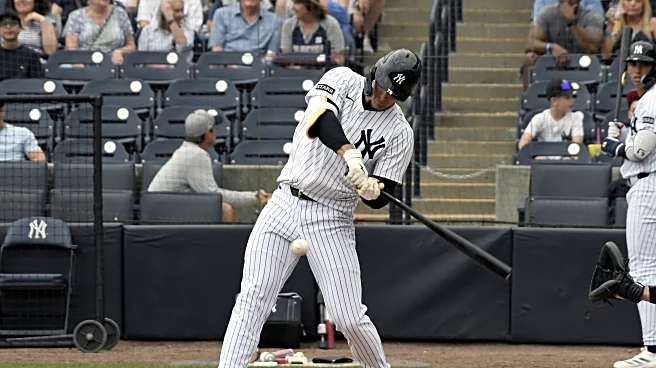

As pitchers and catchers report and teams prepare for the start of spring training, not many teams around Major League Baseball project to have a more powerful outfield than the New York Yankees in 2026.
Three-time MVP Aaron Judge will continue to anchor the lineup in right field, coming off another unbelievable season: .331/.457/.688, 53 home runs, 114 RBI, .357 ISO, 18.3/23.6 BB/K%. Judge posted a wRC+ over 200 for the third time in four years, and he’ll enter the upcoming season as the most feared slugger in the sport.
The other two outfield spots were in question entering the offseason, but the Yankees were able to bring back both Trent Grisham and Cody Bellinger; Grisham accepted the qualifying offer and will make $22 million in the Bronx this season, and Bellinger re-signed on a five-year, $162.5 million contract. Judge, Bellinger, and Grisham combined for 116 home runs in 2025, and after much commotion and uncertainty, all three will be returning to their starting outfield roles next season.
This was probably the best (realistic) outcome the Yankees could have hoped for, but it’s not great news for Spencer Jones, the team’s first-round pick from the 2022 MLB Draft who’s still looking for his shot in the big leagues. Jones is behind not only those three outfielders on the depth chart, but also Jasson Domínguez, who played 123 games with the Bombers last season. Despite decent offensive production, Domínguez has still not been able to secure a full-time role with those three sluggers occupying the outfield and Giancarlo Stanton firmly locked into the DH spot.
Domínguez is not even guaranteed a roster spot to open the season, which leaves Jones firmly stuck in the minor leagues, where he hit 35 home runs and stole 29 bases in 2025. Jones spent his age-24 season between Double-A and Triple-A, and while his power/speed numbers were overwhelming, he also struck out 35.4 percent of the time between the two levels. That’s an astronomical strikeout rate, and it actually came down a tick from 2024 when he struck out 36.8 percent of the time in Double-A with only half as many home runs as he hit last year. He’s one of the most toolsy prospects in baseball, but this is exactly why Jones is so polarizing around the league; there’s hit-tool risk, and then there’s whatever this is.
Many prospect analysts are firmly out on Jones because of these bright red flags, but the Yankees view him so highly because whatever this is can sometimes look incredibly special. In 49 games at Double-A last season, Jones hit 16 home runs (just one shy of his total the year prior in 73 fewer games) and stole ten bases. His walk rate jumped from 9.9 percent to 15.4 percent, his ISO went from .193 to .320, and his wRC+ ballooned to 185. In his first 114 plate appearances after his promotion to Triple-A, Jones was hitting .375/.439/.844 with 13 home runs, 10 steals, a 219 wRC+, and just a 24-percent strikeout rate. He hit the IL shortly after with a back injury and was a shell of himself the rest of the way upon return, but optimistically speaking you can make a legitimate case that the drop-off was largely due to the lingering injury.
That’s been exactly the case with Jones throughout his professional career. However you feel about him, he’s given you every reason to continue feeling that way. If he can produce anything even close to what he was doing around the end of July against big-league pitching, he should be a superstar. However, MLB pitchers are a massive step up from their minor-league counterparts, and it’s entirely possible that Jones’ hit tool is too weak for him to ever become a fixture in a big-league lineup. Jones possesses arguably the widest range of outcomes of any prospect in baseball, and that’s why most professional rankings have him in the back end of their Top 100 if he’s even included at all.
The Yankees, who don’t currently have a spot for him, seem completely unwilling to sell him at that price. Other teams have been understandably unwilling to buy him at theirs. If you believe Jon Heyman’s report, the Yankees would only consider trading Jones for a player like Paul Skenes. That simply is not happening. If there was ever a time to trade him it would’ve been last year, when Jones’ value peaked at the exact same time as the trade deadline, but it didn’t happen. Which leads to the crossroads that the Yankees and Jones find themselves at entering the 2026 season.
There is no spot for Jones in the Yankees’ lineup. Multiple injuries would need to occur for him to get a chance, and a player with a profile like his could take a long time to ramp up in his first extended look against MLB pitching. A team hunting for a pennant might not be able to provide that runway if it means eating a 40 percent strikeout rate during a long adjustment period. Jones will turn 25 in mid-May, however, and if he’s healthy and productive he needs to get a chance this year. So something’s gotta give.
The Yankees might be higher on Jones than any other organization in baseball. After they turned another 24-year-old 6-foot-7 outfielder with immense power and a scary hit tool into the greatest hitter of his generation, we can’t exactly fault them for that, but it does make trading Jones especially difficult. They’re unwilling to move him for a rental, and other teams are unwilling to invest significantly in a player who swings and misses as often as Jones does. It feels like they can’t trade him and they can’t keep him either; they can’t clear the runway for him and they can’t keep him trapped in the minors forever.
If the market for Jones around the league is lower than we think, it makes more sense for the Yankees to keep him. The argument for it is simple. At some point, they need to open Schrodinger’s box. If there’s a dead cat inside, they have enough alternative options that they can bury him in the backyard and drive over to PetSmart without it severely derailing their short-term or long-term plans. If the cat is happy and healthy, one of the best lineups in the American League could add another star player on a rookie contract or team-friendly extension for the foreseeable future. If they trade him for less than he’s worth, they could end up getting scratched for a decade.
If a deal emerges that the Yankees feel is fair value though, it might be in the best interest of the player and the organization for them to take it. Jones may be the type of player who sticks around for a while, but will require patience and a lot of trial-and-error on his journey. That journey may be better suited for a team without immediate World Series aspirations and a market less daunting than New York. If they do choose to keep him, it’s difficult but not impossible to envision a path to a full-time role.
Trent Grisham surprised everybody by accepting the qualifying offer this year, but he’ll reach a deal in free agency eventually and it likely won’t be with the Yankees. Dominguez doesn’t have the defensive ability to man center field in the Bronx long-term, which could open a path for the speedy, lengthy Jones. A lot is riding on how he handles Triple-A pitching in the first few months of the season. If he looks likes the Spencer Jones of last April-July, he could force the Yankees’ hand and make his MLB debut sometime this summer. If they give him a taste of the action similar to what Dominguez had last year, he could prove himself as a long-term option by holding his own and making ample contact against big-league pitching. It’d require a lot of patience from all parties involved, but if the Yankees believe in Jones to the extent that they’ve indicated and are willing to put their money where their mouth is (both figuratively and literally), he could still end up wearing pinstripes for years to come.