


1960
Chuck Comiskey made it public that White Sox
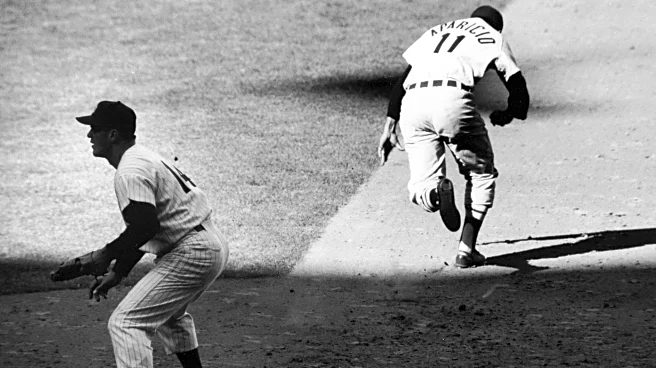
1963 It was the move that re-energized the franchise and led directly to back-to-back-to-back seasons of more than 90 wins in 1963, 1964 and 1965. White Sox GM Ed Short traded shortstop Luis Aparicio
and outfielder Al Smith to the Orioles for third baseman Pete Ward, outfielder Dave Nicholson, shortstop Ron Hansen and relief pitcher Hoyt Wilhelm.
Trading Aparicio was a shock, but contractual differences between him and the team and the bad feelings it produced made a deal necessary. He was so disappointed to be traded, he put a curse on the White Sox as he left town.
Ward supplied power for the next few seasons: In 1963 and 1964 he averaged 22 home runs, 89 RBIs and hit .290 before a accident (in which he was a passenger in a car leaving Chicago Stadium after a hockey game) severely impacted his career. He suffered whiplash and never felt comfortable at the plate ever again.
Nicholson, who struck out far too much, still managed 22 home runs and 70 RBIs in 1963. Hansen would become one of the best defensive shortstops in the league, and hit as many as 20 home runs in a season at a time when shortstops simply didn’t do that.
Wilhelm became the top relief pitcher of the 1960s. In his six years with the Sox, he won 41 games and saved 99 others while producing some astonishingly low ERAs considering he threw a knuckleball. His highest ERA between 1963 and 1968 was 2.64, and in every other season it was less than two. He became a Hall-of-Famer in 1985.
In a separate transaction on this same day, the White Sox sold the O’s pitcher Dean Stone, who would appear in 17 games for Baltimore in what turned out to be his very last MLB season.
1997
Thirteen years after shipping him off to the Yankees as a thrown-in to a trade for … Roy Smalley, the White Sox attempted to right past wrongs and signed Doug Drabek to a one-year, $1.3 million deal. The 34-year-old was coming off of two poor seasons in Houston, but wasn’t being looked at as anything but a lesser rotation arm. Drabek struggled even to deliver lesser-grade pitching, however, being gifted a 12-11 record in spite of a 5.74 ERA, thanks to a prodigious Chicago offense. His 0.4 WAR (presumably mostly grounded in sheer workload (31 starts/169 1⁄3 innings) did represent the last positive measure of his career, as in 1998 Drabek moved to Baltimore and flushed out of baseball with a -1.4 WAR.
All told, by swapping away Drabek carelessly, the White Sox missed out on 21.2 WAR through his 20s, which included a Cy Young win. (Think having him on that 1990 upstart club, given he went 22-6 with a 2.76 ERA and Cy, would have helped the White Sox catch Oakland for the AL West crown?)
2001
The White Sox acquired pitcher David Wells from Toronto, basically for pitcher Mike Sirotka. It was the second trade made with Toronto over nine weeks (Glover-Eyre trade, Nov. 7, 2000).
Over the coming weeks and months, Sirotka and the Blue Jays claimed the Sox knew that he had a bad arm and couldn’t pitch. Sox GM Ken Williams defended himself by saying that he told the Jays he thought Sirotka might be hurt and offered pitcher Jim Parque instead. Commissioner Bud Selig ruled in late March that the trade would stand. The whole episode became known as “Shouldergate.”
Wells, meanwhile, had few good moments with the Sox. He won on Opening Day in Cleveland after he said that fans in the stands got him angry by talking about his mother and how he was raised. But after that, because of a bad back, Wells barely pitched, winning only five games in 16 starts for the year.
He then caused a major controversy when he went on the radio and said that he didn’t think first baseman Frank Thomas was as badly hurt as he claimed. Thomas would play only 20 games that year after he tore a tricep muscle diving for a ground ball along the first-base line.