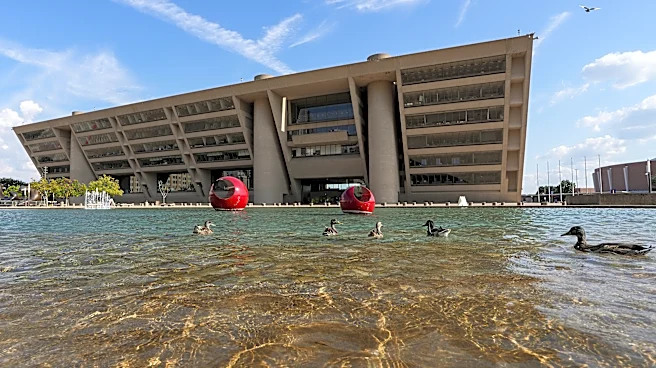








The season from hell is over. I could not be more relieved, as watching my favourite team organically tank their way to oblivion was getting more and more frustrating with every game.
Amid the blissful end of the season and the chaos of the Cooper Flagg-Kon Kneuppel Rookie of the Year debate, you might be forgiven for missing the news that the Mavericks are expected to submit a proposal for a new 50-acre entertainment district in Downtown Dallas.
While the new arena and the possibilities that it represents
sound encouraging for a franchise looking to reset its future direction and reestablish some credibility with its divided fanbase, considering the events of the past two seasons, I thought I’d take a moment to write about something that this project would impact – Dallas City Hall.
Based on the information shared in the article, The Mavericks and CEO Rick Welts intend to submit this proposal in response to an “Open Call for Concepts” that the City of Dallas launched earlier in the month – an initiative open to residents, architects, planners, developers and community groups to weigh in on whether the current City Hall should be repaired or the entire site and it’s context needs to be rethought entirely.
This follows the current efforts of the Dallas City Council to determine the future of City Hall as a matter of its repair & renovation, and the inherent costs therein brought up the feasibility of continuing to use the iconic 1978 building. Earlier in November, the City Council voted to explore relocating and selling the building, and the findings from those explorations were supposed to have been reviewed by the Council in February.
Issues such as the complexity of modernising the building’s AC system and leaky plumbing & flooding issues, as well as its ADA non-compliance, have been cited as some of the reasons why repairs are estimated to balloon up to $600 million over the next decade, although some reports estimate a much lower figure of $350 million.
Mayor Erik Johnson weighed in on the subject in November, telling CBS News, “I know we have issues because I work in the building every day with City Hall,” and “The building has some serious issues, and if those numbers are correct, that’s something we really have to think about.”
Naturally, some efforts have been organised to oppose the sale and demolition of City Hall. A movement called Save Dallas City Hall was launched with a petition that has 7,065 signatures to date. The website for the movement lays out the entire timeline for the City Council’s efforts to explore the retention and repair of the City Hall building, and the reading of that timeline lays things bare.
Based on those timelines, Mayor Johnson’s words ring out as a complete joke, with a tale of expanded cost projections ranging from a maximum of $121 million in June 2025 to $1.4 billion in February 2026, multiple closed-door meetings, and an opaque and rushed process to maximise the site and building for pure economic gain.
Conservation group Docomomo US has issued a statement in which they raised concerns about the process, stating, “Why is the process moving so fast and where is the public involvement in this process?”
Just a few weeks ago, Mavericks CEO Rick Welts mentioned the City had approached the Mavericks over a year ago about the availability of the City Hall site for the team’s new arena and entertainment district. He also reaffirmed the franchise’s commitment to remain in Dallas and said, “We love the idea of the downtown site” during a panel at the North Dallas Chamber of Commerce’s 72nd annual meeting, where he also spoke glowingly about City Manager Kimberly Bizor Tolbert and laid out the vision for what the new arena is going to be.
The Mavericks’ interest in this area is fairly straightforward. The City Hall site allows the Mavericks to stay in the downtown area, close enough to its current home at the American Airlines Center, and City Hall’s proximity to the Convention Center gives it easy access to a DART station which would theoretically make travel to the proposed arena district much easier.
The entire saga, though, reads as an embarrassing tale of corruption and greed, and the Mavericks’ involvement in this is just another misstep in a series of missteps since Mark Cuban’s sale of the team to the Adelson-Dumont family.
Full disclosure – I am not from Dallas, nor have I been a resident of the Metroplex at any point in my life. Being from Bangalore, India, I do not have an emotional connection to the city beyond my love for the Mavericks and my family who live there, as well as the MMB team, whom I’ve come to consider a good group of friends. As an Architect & Designer, my admiration is for the various Architectural landmarks that dot the Dallas-Fort Worth area, which I was fortunate enough to experience during my visit to Dallas in November 2024.
Dallas City Hall is a project worthy of preservation. Its brutalist expression, with the raw, exposed concrete and sharp geometric formality, as well as its position at the center of a large open plaza, mark it as an urban sculpture – a piece of theatricality and artistry that was needed at its time of completion in 1978 to revitalise the image of the city, still reeling from the assassination of President Kennedy fifteen years earlier.

The architect, I.M. Pei, when discussing his motivations for the design, stated:
“When you do a city hall, it has to convey an image of the people, and this has to represent the people of Dallas … The people I met – rich and poor, powerful and not so powerful – were all very proud of their city. They felt that Dallas was the greatest city there was, and I could not disappoint them.”
The building is very much in keeping with Pei’s distinctive hallmarks. Geometric precision, an innate understanding of proportion and scale, and a balanced composition of volumes. The horizontality of the building, in conjunction with its positioning within the plaza – something Pei himself persuaded the city to acquire an additional six acres for – makes it an icon, a marker that the city needs to treat with respect and reverence.
The Dallas-Fort Worth area does have quite the inventory of projects of architectural significance, from Frank Lloyd Wright’s Kalita Humphreys Theatre in Turtle Creek, to Louis Kahn’s Kimbell Art Center, Philip Johnson’s Thanksgiving Chapel, Tadao Ando’s Modern Art Museum, as well as Pei’s other projects in the city – the Morton Meyers Symphony Center and the Fountain Place tower. City Hall stands toe to toe with those icons and, in many ways, is far more important than any of them, considering the historical context for its conception and construction.
Downtown Dallas does come across as isolated and abandoned for the most part – it certainly did when I visited the site that November evening, when the only people in the area were stragglers and people waiting for some kind of transport, but that is not the fault of a singular project. It is reflective of bad urban planning and a focus on commercial development downtown in a city whose residents largely reside in the suburbs.
The building itself, and the problems that Mayor Johnson remarked on, aren’t necessarily its own fault. From various accounts, the maintenance of the building has been neglected and deferred, making this more of a civic failure. Council member Paula Blackmon, who is in favour of restoring the building, points out, “We’ve done more harm to it than good. We haven’t taken care of it, and it’s sad.”
Amongst the groundswell of support for the preservation and restoration are New York-based illustrator (and former Dallas resident) Rob Wilson, who has created a graphic of supersized circular glasses, part of I.M. Pei’s look, set on top of the building, with a slogan of I.M. Dallas.

Noted architect Steven Holl wrote an open letter to Mayor Johnson, urging him to look into the adaptive reuse of the building and maintain something that has significant cultural importance.
Going back to Mayor Johnson’s interview in early November, one of his observations was that “We can’t just take off the table the possibility of moving from City Hall because a famous architect designed the building”.
Well, Mayor Johnson – You’re right. No one is arguing that the building needs to be preserved and restored because it was designed by I.M. Pei. Pei was the conduit, the lightning rod. It’s not him that you’re showing respect to. It is the building itself.
City Hall was, from what I’ve read, a symbol of the city’s rebirth – a statement project that should have been the center of a rich & vibrant downtown area. In person, the building lives up to the hype – the rare project where the result matches the intent, and THAT makes it worthy of preservation and deserving of our respect.