



In my time covering and analyzing the NFL I’ve found interceptions (and discussions centered around them) to be incredibly fickle. They are one of the game’s most classic, frequently cited statistics but do not come with context, therefore they often miss the mark when attempting to provide proper quarterback assessment.
And now, Pro Football Focus has conducted a comprehensive study on the matter.
Analyst Mark Chichester recently wrote “The hidden story behind quarterback interceptions” at PFF.com,
and it’s fantastically insightful.
With an enormous sample — between the 2016-2025 seasons —Chichester found that 49% of Turnover-Worthy throws resulted in an interception. That’s an incredible discovery that, frankly, should change forever how we view quarterback interceptions.
(For those new to PFF’s Turnover-Worthy metric — long one of my absolute favorites in the football analysis industry — it’s simply a play, or in this case, a throw, that is deemed by multiple layers of PFF analysts to be “worthy” of a turnover. The actual result of the play is irrelevant.)
Chichester followed with findings on how frequently interceptions were the result on a play that featured a good throw:
Across that same 10-year sample, there have been 1,441 interceptions thrown on passes that were not deemed turnover-worthy. That’s one in three of all interceptions thrown in the league over that span. In those moments, the quarterback may have done little or nothing wrong, yet a turnover still lands in the interception column. That’s bad luck.
So, just above half of bad, should-be-an-interception throws became actual interceptions (good luck) and a good, should-not-be-an-interception throw (bad luck) accounted for one third of the interceptions over the past 10 seasons in the NFL. Striking.
For quite some time now, I’ve been an advocate of Turnover-Worthy Plays (and Big-Time Throws) when evaluating quarterbacks and utilizing those metrics for better analysis than touchdowns and interceptions for reasons I hope now are fairly obvious.
In his piece, Chichester introduced “Net Luck” which he defined as:
(Turnover-worthy interceptions avoided versus league-average conversion) − (non-turnover-worthy interceptions incurred versus league average)
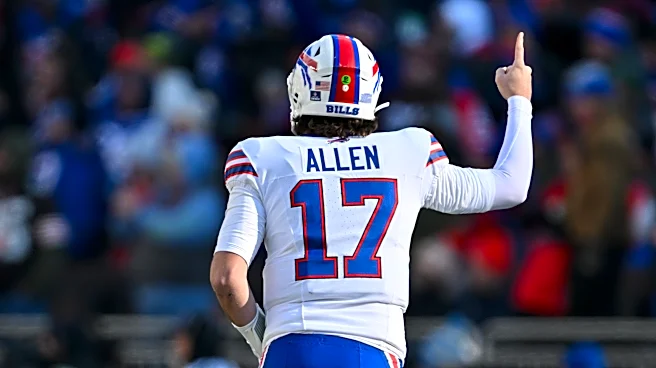
Unsurprisingly, in Chichester’s research, Josh Allen’s last two seasons represent two of the three largest swings in interception luck from the previous season.
Remember back in 2023, Allen started in that Monday Night Football loss to the Jets with three interceptions and finished with 18 of them in the regular season.
Of course, Allen immediately followed with six interceptions on 483 attempts in his MVP-winning 2024, a key part of one of the finest ball-security seasons a team has had in NFL history. That represented a (positive) swing of 59.8% in TWP-to-interception conversion rate (how often a TWP turned into an interception), quite easily the largest of its kind in Chichester’s 10-year sample.
Last year, the pendulum swung back. Allen went from that rather low 16.7% TWP-to-interception conversion rate all the way up to 75%. That difference of 58.3% (negative this time) was the second-largest negative swing in the study.
To hammer home his point in all of this, through the granular lens of Allen’s 2023 to 2024 to 2025, Chichester wrote:
The underlying quarterback remained largely the same across all three seasons. The interception outcomes did not.
Allen tied for the fifth-highest rate of most dropped interceptions and most interceptions that were the result of a receiver drop in his career to date.
I urge you to read the entirety of Chichester’s piece — it’s illuminating and loaded with fantastic nuggets on quarterbacks across the league. But this snippet felt like the mic drop:
The luckiest quarterbacks in one year almost always drift back toward league average the next. So do the unluckiest ones. There is little evidence that quarterbacks possess a repeatable skill for consistently avoiding interceptions once the ball has already been put in harm’s way.
Sure, Allen could be more or less risky with throws or this upcoming season. Yet he is essentially who he is as a quarterback as a 30 year old entering Year 9 in the NFL.
And this study clearly indicates Allen is in line for a relatively low interception total in 2026.