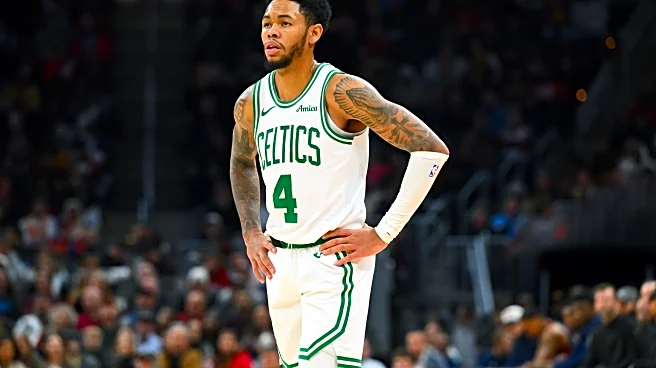

When the Celtics moved Jrue Holiday for Anfernee Simons last summer, it was easy to view the trade through a financial lens. Boston needed flexibility. Simons offered shooting, youth, and a smaller expiring
deal.
It wasn’t a perfect match, but there was enough upside to let it play out and see how he fit within Joe Mazzulla’s system alongside Boston’s stars.
Twenty-five games into the season, we’ve gotten a meaningful look at it, albeit in a much smaller role. Currently, he’s averaging 13PPG in 23.7 minutes — lower than any of his previous four seasons with the Trail Blazers.
In Portland, Simons was the offensive engine. He logged heavy on-ball reps and operated with freedom as a primary creator. In Boston, that role no longer exists. He’s been asked to condense his game, make quicker decisions, and thrive with fewer touches.
Some #1 options can benefit from the move to a shrunken role on a better team, but it’s a difficult challenge to squeeze enough out of a skillset based around volume shooting and explosive scoring runs.
On paper, there’s been success in specific areas. His finishing has improved on lower volume, and he ranks in the 95th percentile in three-point attempts per 100 possessions while raising his efficiency. The spacing generated by Boston’s offense has afforded him cleaner looks than he’s had in years.
While some things are working, the relationship itself hasn’t clicked. Simons has accepted a bench role with professionalism, but that hasn’t translated into the level of scoring punch that’ll swing momentum. His presence isn’t killing them, but it’s not really much of a boost either.
When filtering out low-leverage minutes, that shows up clearly. The Celtics are essentially neutral with Simons on the floor (+0.4 Net Rating), compared to a +6.9 mark when he’s off. For a player brought in to juice the bench offense, the swing is hard to ignore.
In Boston, he isn’t afforded the same green light he’s grown accustomed to, and that adjustment has proven tricky. His touches have dropped sharply — from 65.1 per game in Portland to 41.7 — but the way he uses them hasn’t changed much. He still ranks first on the team in seconds per touch, and second in average dribbles per touch.

That disconnect matters. In a smaller role, they need his possessions to be decisive. Extending advantages and using his scoring ability to pick apart rotating defenses. Instead, Simons is often operating with the cadence of a primary creator in a role that wasn’t built for it. The result is efficiency that looks good, but doesn’t hit the right notes in terms of impact or cohesion.
The tension becomes clearer when you zoom into different lineup combinations.
Next to Jaylen Brown, Simons should theoretically benefit from Brown’s scoring gravity. There have been flashes, but the pairing tends to lean toward self-creation rather than quick attacks in the gaps. It’s two scorers operating in parallel instead of in concert.
Excluding low-leverage minutes, the numbers reflect that imbalance:
— Brown & Simons: –0.83 Net Rating
— Simons, no Brown: +1.89
— Brown, no Simons: +7.87
It’s not an indictment of either player on its own. But it does suggest that, so far, the fit has been more clunky than complementary. There is hope though, if Simons can shift his approach.
His best work this year has come on catch-and-shoot looks, where he’s converting 45.7% of his threes. In comparison, he’s shooting 29.9% on pull-ups from deep. If he settles deeper into an off-ball role, it could help offset a lot of the struggles next to a player that should only make his life easier.
There’s still a place for his creation ability, but they can pick his spots better. When Brown is on the bench it’s a good time to lean on his shotmaking. If they’re sharing the floor, Simons can’t let the ball stick too much.
On the other side of the floor, it has been about as expected for Simons.
To his credit, Simons has brought focus on the defensive end, showing he’s serious about improving. His frame and strength limit his overall influence, but Boston’s own lineup constraints haven’t helped. Early in the season, he spent significant time alongside Luka Garza, forming an untenable defensive pair (-8.5 Net Rating). Even with Simons’ commitment and effort at the point of attack, it was hard for Boston to protect both of them.
The pairing ultimately zapped Simons’ offensive impact as well.

Adding a more reliable defender into the equation has made a clear difference as Simons, as he and Queta share a +5.96 Net Rating. It allows him time to navigate screens and recover, along with the security of a capable rim protector patrolling behind him. Even small-ball lineups with Minott have been a more effective option.
Simons’ defensive limitations with Garza highlight why lineup composition is important to get the most from him. When paired with Queta’s shot blocking ability, he has the necessary support to succeed. It also enables him to thrive on offense with an effective screener and athletic roller at center.
The season is still young, and there’s room for growth. As he spends more time with the team, they may find the right combinations and style for positive results. Or it could be a place of discomfort that ultimately never clicks. His place in their future plans has never felt permanent, but if it’s not Boston, he still has reason to play his best basketball in a contract year.
Ultimately, Simons’ success here will depend on how much further he can embrace the framework the Celtics have in place, while continuing to mold his game to fit cleanly. If he can strike a more useful balance between pull-up and spot-up scoring, and he’s supported by preferable lineups, he and the team will be better off for it.
Simons has shown he can be efficient in Boston’s ecosystem. What he hasn’t shown yet is that his game consistently elevates the lineups he’s part of. That intersection between production and impact is a question the Celtics still haven’t answered.