
Special thanks to Roman Tomashoff of Locked on Huskies for joining me to discuss Washington’s roster on this week’s podcast:
A look at the Huskies’ scoreboard this season can be quite confusing – they’ve struggled against or lost to several weak teams while last week knocking off a top-ten team, they’ve flipped on its head the facile home/road narrative advanced in their first two years in the Big Ten, they have frequent late comeback efforts to win or make games look closer than they really were,
and seven of their nine FBS games have been one score decisions with a 4-3 record (the other two are wins, by 12 and 14 points).
But with a wealth of charting data this late in the season and a substantially similar roster and coaching staff last year to make granular comparisons, statistical analysis made short work of describing the Huskies – the regression engine finished in record time this season.
The Huskies’ twin-track defensive system keeps them in games against teams that predominantly play out of 11-personnel and don’t take advantage of shot opportunities because those offenses want to extend drives rather than build quick leads. With the UW defense and opposing offense mutually agreeing to keep the game in high-variance mode, the UW offense is in position to take advantage in the 4th quarter with their own explosive passing offense, with a particular connection that defenses can’t or won’t take as seriously as they should, then run out of time before they can respond.
Any other game script sets up UW in 2026 for an all-but-insurmountable struggle, because of massive big play vulnerabilities on defense and lack of robust offensive tools. It’s straightforward to understand why the defense is in the transitional place that they are this season: now finishing year 2 at UW, DC Walters’ preferred high pressure bear-front man-coverage system is in every conceivable way the complete opposite of the prevailing 2-4-5 cover-3 issued to every DC alongside the Subaru with a Sounders bumper sticker upon arriving in Seattle. It’ll at least be 2027 before Walters has the recruits in place to either complete the transition in earnest or make a decision to fully embrace a working hybrid approach instead of having it forced upon him.
The offensive reduction in versatility is not at all difficult to describe — it’s comprehensive across all metrics, with both fewer and less productive viable personnel at every position in the two-deep — but it is harder to understand. With the exceptions of the running back room, which has unfortunately seen a rash of terrible injuries, and offensive line depth, which as a predictable consequence of not retaining any of their absolutely vital backups from 2025 when they entered the portal last offseason were far less resilient in 2026, every unit should have been stronger, not weaker, due to incremental growth and program stability attracting more talent in Coach Fisch’s third year. In my roster database, UW had the fourth largest year-over-year growth in the conference in average roster talent between 2025 to 2026, and the three ahead of them were perpetual cellar-dwellers Illinois, Indiana, and Purdue who had far more headspace.
I spent quite a bit of time in our podcast conversation with Roman trying to determine if any of these puzzling offensive constraints were self-imposed … and if so, whether Fisch might suddenly choose to do something different on Saturday (don’t say he couldn’t, he started his current QB for the first time in 2024 as a true freshman on just such an occasion). Roman and I both think it’s unlikely, there’s too much inertia and too little to be gained at this point, though if there is a shakeup the wide receiver unit would be the most logical place.
Offense

In all six major metrics, as well as every down & distance situational category for run and pass, UW’s offense has declined appreciably, in many cases to the point of complete ineffectiveness. Each position in the two-deep is now filled by a player who’s grading out worse or producing less reliably on a per-play basis than his counterpart in 2025 (there are some individual players who moved from one position in the offense to another and now has better performance indices in and of himself, but no one who stayed put does, and no one moved into a role and bettered last year’s performer).
The most significant structural change to the offense in 2026 is that the run game has totally collapsed, making this a one-dimensional offense (arguably less than one, as they aren’t above water in passing efficiency and are completely reliant on explosive passing plays, furthermore their targets for explosive passing production are very narrow and predictable).
The run game collapse has come in two parts, which I’ll address separately. The larger part of it has to do with the fall by more than 15 percentage points in efficiency — a staggering amount, as these things go — on all downs, six percentage points on 1st down, and about 30 points on late downs (2nd & medium/long, all 3rd and 4th down situations). This is attributable to the injuries in the running back room and problems along the offensive line, which I’ll discuss below.
The second part of the run game collapse is the fall in explosiveness by nearly six percentage points — again, an enormous, almost unheard-of amount for this metric — which in turn explains the fall by -1.7 adjusted YPC as 2025’s yardage average was propped up by superexplosives rather than routine chunk yardage. The key producer of those superexplosives last year was #1 QB D. Williams keeping the ball on designed runs and read option plays against defenses completely unprepared for a running quarterback or, apparently, any offense devised in the last 40 years, as he had an incredible 25% explosiveness rate and 7.5 adjusted YPC on rushing plays (excluding sacks and scrambles on called passing plays, and garbage time).
For reasons I don’t fully understand, those plays are not being called anywhere near as frequently in 2026 — it’s only about a third as often — and in an astounding reversal, when they are being called Williams’ production numbers are so terrible that it would be better if these plays were removed from the playbook: he has a 31.3% success rate for 2.87 YPC with a 0% explosiveness rate. As Roman pointed out, Williams does have one explosive designed run this year, which I excluded as garbage time — 23 yards against Penn State on the last drive of their loss to the Nittany Lions — but all this does is reinforce the strangeness of the situation: Williams is obviously physically capable of executing these plays, but it’s just not happening. For a good deal of them it looks like the reason is that the defense is simply hip to the trick now, but there still are several where it should have worked but just … doesn’t.
As a related but separate matter, Williams remains dangerous as a scrambler on called passing plays, but there’s been a significant falloff in how dangerous and how high leverage these scrambles have been. In 2025, Williams had a scramble win rate of 37.97% – that is, out of 79 broken pockets during meaningful play, 30 of them he managed to turn into sufficient gains with his legs given the down & distance to count as a success in standard advanced stats formulas, while the remaining 49 were sacks, negative or insufficient yardage scrambles, or some other bad outcome.
Williams could scramble explosively, he had nine 15+ yarders and those tend to humiliate defenses, but what was far more important was the leverage effects: Williams’ scramble win rate didn’t fall at all on 3rd / 4th downs – that remained at 36.7%, meaning he was converting drives that were heading for punts due to a sack into continued possessions, and at a far higher than FBS-average rate for throwing the ball on 3rd downs. It’s impossible to overstate what game-changing leverage this created, and why my entire strategic analysis of that year’s team turned on stopping Williams.
In 2026, what remains the same about Williams’ scrambles is his ability to be explosive — he has nine 15+ yarders yet again, there’s nothing wrong with his legs — and that his 3rd / 4th down win rate is no different than his 1st / 2nd down win rate is. But what’s different is that his global win rate is simply much lower – down to 29%. That’s essentially the FBS median for any called passing play on 3rd & long, nothing special, and substantially below average for success rates on 3rd & short as well as every 2nd down situation and a major win for the defense on 1st down.
So while defenses need to be prepared to stop any scramble from going explosive, that’s about it for extra effort – the imperative has flipped around, defenses should be focused on covering the pass. It’s now the case that this team performs much better when passing from the pocket, as Roman told me was the plan all along, and the numbers support when pocket passer backup #7 QB E. Brown took over for a couple games due to a rib injury to Williams:

And due to a collapse in efficiency passing offense and a bizarre contraction of the wide receiver unit to one player, while the most productive returner has been relegated to constrant checkdowns and screens which has destroyed his efficiency with overtargeting, the offense is extremely predictable in its production. Every conference game that they’ve won, as well as three that they’ve pushed comeback attempts, have been completely dependent on explosive passes on late downs in the 4th quarter to one receiver: #8 WR Lawson.
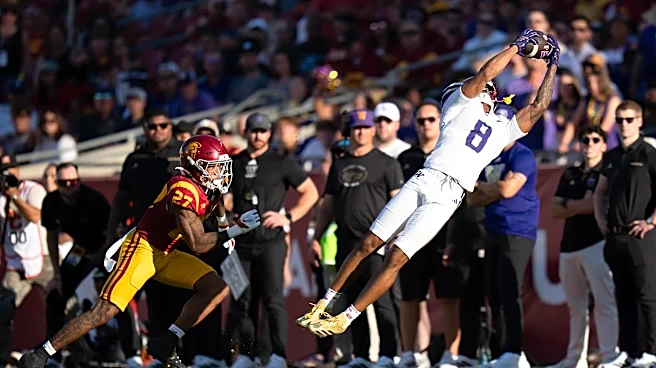
It is astonishing how clear the pattern is, and exactly when it hits in every game: 6 minutes remaining in the 3rd quarter. Prior to that point, Lawson makes up only 27.5% of the team’s passing production, but after that point he becomes responsible for 45.8%. Restricting the sample to “do-or-die” situations, late downs during the endgame — that is, 3rd & 4th downs plus 2nd & medium/long, in the bottom of the 3rd quarter and throughout the 4th — Lawson represents 71.1% (!) of the offense’s entire production. It took until week 12 for defenses to figure this out and start defending Lawson. Here’s a representative sample of this heroball offense:
Throughout the podcast, Roman suggested that it would be useful to re-examine the data I’d gathered about UW’s offense through the prism of the last 10 quarters of play, because it was his contention that the team was playing substantially different ball and much closer to how the plan for the season was meant to be. I promised Roman that I would do so.
During this second look, I figured out the reason for the 10-quarter cutoff – it would include the second-half comeback attempt against Penn State, but not the first-half dud. But even analyzing the final drive against PSU which I had previously excluded as garbage time, there’s really no difference in where their production did and didn’t come from or what their per-player efficiency was like against PSU or Michigan State – it’s mostly big throws to Lawson, sometimes #86 TE DeGraaf, and the occasional big run for the QB, with the run game going nowhere, an inconveniently timed interception under pressure, and essentially no above-replacement contributions from any other passing target. The sequence just happened to line up in two second-half drives against PSU such that they could score, whereas the same plays were happening but they weren’t lining up so they weren’t scoring in the first half. Meanwhile the MSU game fit exactly the same pattern as the rest of the season.
But the Indiana game did show substantial differences, and I’m glad Roman pointed me towards a separate analysis … though I don’t think I came to the same conclusion he was getting at. The Hoosiers’ DC Haynes pursued a very aggressive defensive front strategy, certainly the most aggressive UW faced since week 5 at USC and in many of the ways I would quantify defensive aggression (like early-down pressure rate and cover-0/1 frequency) it was the most aggressive UW saw all year. This defensive approach did have the effect of producing the highest negative or zero-value play rate per-dropback for Williams all season: four sacks, four more failed scrambles, four throwaways, and an interception, vs only two successful scrambles.
However, the approach was catastrophic for Indiana. The two successful scrambles were the biggest all year, combining for 100 yards and each converting a 3rd down. And while they did cap Lawson (except for a trick play), and #3 WR R. Williams was as unproductive as ever, all four of the other skill players who contributed had his best game of the season, exceeding his year-long average by +0.8 YPP (#17 RB Limar), +2.4 YPP (#34 RB Bonner and #2 WR Roebuck), and +6.4 (!) YPP (DeGraaf).
Roman’s takeaway from this was that UW was playing its best football of the season at the end. I interpret the data differently: I think Indiana’s all-or-nothing defensive choice backfired spectacularly, sacrificing coverage and containment and leaving themselves out of position and out-athleted when handling a mobile quarterback and skill players who, unlike most of the Big Ten opponents the Hoosiers have been squeezing out wins against this season, can make plays in space.
My takeaway from Indiana’s blunder is to do the opposite and follow MSU DC Rossi’s example (with the exception of the freshman cornerback due to injuries) and approach UW conservatively. I would suggest limiting the pass rush — since extra personnel aren’t needed to beat this line — and instead prevent the QB from escaping the pocket, daring UW to run the ball, keeping the resources back to defend yards after the catch and deep passes, especially Lawson and crucially during the endgame.
Wide Receivers

Roman suggested that Lawson is replacing the production and position of Denzel Boston in this year’s offense, though he hastened to add that he wasn’t comparing their talents. I think I know what he meant – they aren’t generating yards the same way. Boston was four inches taller and 25 lbs heavier, with the complete dominant physical receiver’s toolkit to win contested catches and muscle through tackles against smaller DBs for extra yards, and I don’t see that as much from the 6’0” Lawson who’s winning with speed and separation alone (and, I think, defenses not taking him to be as much of a threat, to their folly). That’s reflected in the difference in their per-target success rates: Boston was in 2025, as he was throughout his career, at just over 65%, while Lawson is about 10 points lower at 54.4%. However their adjusted YPT is close to the same, 9.9 for Boston and 9.5 for Lawson, which means Lawson is getting a higher yards per catch, he’s just not actually catching it as much – higher variance, more boom & bust.
Roebuck is the one returner from the four receivers in the main lineup last year, he had about 45 targets in 2025 which my predictive algorithm indicated was just about perfect for a slot receiver – as Roman and I discussed on this Summer’s podcast, avoiding overtargeting is crucial for smaller inside receivers to ensure they have room to run and since they’re not going to fight off PBUs or break tackles. I expressed concern that a lot of offenses take their most productive returning receiver and push his targets way past the point of diminishing returns, which would rob Roebuck of his sweet spot per-target numbers in 2025 of 67.4% efficiency and 9.4 YPT.
But that’s exactly what UW did, giving him a 75% increase — so far! — and driving down his 2026 numbers to 50.6% efficiency and 6.3 YPT, a loss of nearly a 17 percentage points and 3 yards on every target, taking a championship-caliber receiver and making him play below FBS medians.
From watching tape I still think Roebuck shows all the same talent — I particularly like his hands and quick reaction timing to catch unexpected or improvised throws — but this is not good utilization by the coaching staff. It’s the kind of thing that the staff could change tomorrow if they wanted, but talking to Roman made me think that’s unlikely. They have a long list of receivers who have ridden the bench all year (see Thomas’ offseason preview for the complete details and discussion, it approaches a dozen).
The two other wide receivers both have terrible success rates and production numbers, and far fewer targets, though #3 WR R. Williams still has so many that it constitutes a drag on the offense. He’s at 35.6% efficiency and 5.1 YPT, while #11 WR Clay is at 38.5% and 4.8 YPT. A few other receivers have a smattering of targets, not enough for quality individual analysis. I pressed Roman for an explanation on why they’re not getting more play and the likelihood they might replace one of the underperformers or relieve the overuse Roebuck is suffering for; he said it’s not injury related and this is simply Fisch’s preference. The cumulative per-target figures during meaningful play for all wideouts besides Lawson and Roebuck are 40.7% success and 5.15 YPT – badly underwater by even FCS standards, let alone FBS or Power conference medians.
Tight Ends

#86 TE DeGraaf is playing a somewhat different role in this year’s offense than in last year’s when his parter was Quinten Moore. This year there is officially a more even split in blocking and pass catching assignments between DeGraaf and #85 TE Naone; however, in production and effectiveness grades on my tally sheet, there’s really no contest. Naone is far more effective as a blocker, about a 72% blocking grade vs DeGraaf’s poor 54%, with DeGraaf constantly presenting a holding foul risk (and Big Ten refs are actually calling that this year).
Meanwhlie, DeGraaf is much more effective with the ball in his hands: a 70.4% success rate and 9.3 adjusted YPT, which are both excellent numbers, vs Naone’s good success success rate at 62% but below average YPT at 7.1. Naone is much more of a possession guy while DeGraaf is more dangerous split out and in open space; so much so that he’s one of only two pass-catchers (actually, skill players of any kind) who have clearly above replacement-value production on the 2026 team, and he should be getting targeted more often. My algorithm suggests it would be optimal to push DeGraaf’s targets up to five per game from about three per game as they are now, and to take those mostly from Naone and a bit from Roebuck. I asked Roman about this possibility and he said the staff seemed committed to splitting the targets evenly between the two tight ends.
Here’s a representative sample of successful called passing plays:
And unsuccessful passing plays:
Running Backs

Injuries have severely affected this unit. During Spring practices, presumed starter #4 RB J. Washington suffered a neck injury and was taken from the facility in an ambulance; Roman has told me he’s recovered quickly but he’s missed the season. The two mostly likely backs at that point would have been sophomore #21 RB Carr and Oregon transfer #17 RB Limar; both were injured very early in the season. Carr has been out for all of it; Limar didn’t return until after the bye in the week 9 game against Nebraska. For a while they turned to #22 RB Cooley, who has been unhealthy for a very long career and that unfortunately continued at the end of this season with a concussion, he hasn’t played the last two weeks and I’m not expecting him to play — or if he does, not very well — on Saturday.
For large stretches of the season the only back they had was true freshman #34 RB Bonner, a mid 4-star but not experienced with UW’s zone run scheme, and it showed. The line changed up to more of a gap scheme to accommodate him, although that had mixed results at best. With Limar’s return, even though the season-long figures put Bonner ahead in the carry count, the freshman has taken a backseat and Limar his getting the vast majority of the workload.
It’s unsurprising that Washington’s best available back was a 4th stringer from Oregon whose numbers are essentially identical as when he was at his previous school – a high efficiency rate at 60%, but low YPC at 4.48. Bonner remains getting the second-most carries in these most recent games; his numbers are a substantial step down regardless of the time period examined, he comes in at 42.2% efficiency and 3.76 YPC.
Besides the hit to efficiency — the top two backs last year were at 66.7% / 56.9% and 4.85 / 4.77 on 215 combined meaningful carries, Limar and Bonner have half as many combined carries and worse average production — the major change is in the backs’ utilization as pass-catchers. More than just checkdown receivers, RBs were major parts of the passing offense and filled the screen pass and wheel route role in 2025 that Roebuck is being wasted on in 2026. Last year, the top two backs combined for 50 targets and averaged 8.6 adjusted YPT – better than a couple main wide receivers. In 2026, every running back who’s played put together only have 20 targets, and are averaging under 4 YPT cumulatively.
Here’s a representative sample of successful designed run plays:
And unsucessful designed runs:
Offensive Line

The brief history of Coach Fisch’s tenure can be described through the offensive line unit: when he took over after Kaelin DeBoer left, the entire roster was devastated except for a tiny handful of absolute loyalists, and Fisch had to backfill in 2024 just to make his numbers with low-level players. Then in 2025 he had to perform another revision, which even in contemporary transfer-portal era football is uncommon – clearing out those backfill players and making a second wave of imports but with more consistently higher quality guys.
This should have been devastating to the offensive line, which thrives on stability, but through great good fortune, they wound up with an extensive group of playable o-line backups. They needed all of them, as the injury rate at UW has always been quite high (if I had to guess, I would say playing on the ice rink that is Alaska Airlines Field has something to do with it). The line wasn’t fantastic or anything, it graded out middling by Big Ten standards, but by all rights due to the circumstances it should have been close to the bottom.
It was therefore a great surprise that, while UW announced with glee and celebration their retention of all their returning OL starters (that is, the ones who needed constant rescuing by the backups) they allowed every one of the vital backups to hit the transfer portal, all of whom were picked up and have stayed healthy and productive all year for BYU, Arizona, and Wazzu in starting or important rotational roles. UW instead felt comfortable with a highly rated true freshman and prized recuiting battle win at left tackle, a talented project of a sophomore at guard, and as their only transfer and backup option at tackle, a Sam Houston transfer of poor quality prior play.
Thomas’ preview article laid out in precise detail exactly the scenario that would come to pass from this foolishness, and predicted with crystal clarity how UW’s OL starting lineup would decay from its initial point as reality set in and they found their functional depth wanting. One wonders where Thomas found such clarion inspiration.
The Huskies have the second worst negative play rate in the conference, beaten to this dubious distinction only by Michigan (the Wolverines fumble more often, as the key tiebreaker), at 16.38%, nearly one in six offensive snaps going backwards or giving the ball away. These comprise 29 sacks, 31 TFLs, 19 procedurals, six holding flags, and nine turnovers during meaningful play (they had 10 more negative plays during the second half against Iowa, but I excluded the entire second half as garbage time since they were getting blown out).
Defense

DC Walters’ compromise last year — when they had the depth of personnel to run the beat front and complete a rotation of all the necessary 1st and 2nd line defensive front players, but discovered it wasn’t worthwhile as their coverage talent was getting shredded in man and the front wasn’t generating any pressure — was to shelve his preferred defense and switch back to the same soft zone coverage out of a 2-4-5 that all his predecessors employed.
After an exodus of defensive line and linebacker depth — 15 departures, only five returners with serious play — and replacing them with eight freshmen, four transfers whose experience was mostly at lower levels, and a group of linebackers whose dominance was like SEC wins which is to say entirely hypothetical, it seemed obvious to outside observers that the target date for switching back to Walters’ preferred defense was going to be 2027, and that 2026 would be a transitional or experimental year.
That’s indeed what we’ve seen – an even surface, nickel defense on most downs, and instead of rotational depth in the same positions in the front, an alternate odd surface configuration for rushing downs or when the opponent goes to heavy personnel groups. By the end of the year, as certain key members of the odd-front configuration faced some nagging injuries and no replacements existed, they leaned into their comparably greater depth at linebacker and played a 4-3 instead in those rushing or heavy situations.
As it usually is, the conservative nickel defense, simply by keeping the play in front of them does a decent job at preventing efficiency gains from turning into chunk yardage. They’re especially effective against 11-personnel offenses trying to march the field as they get stronger in any long yardage situation, with over 62% success rates in 2nd or 3rd & long regardless of run or pass, and over 56% in 2nd or 3rd & medium passing.
However, they are very weak against well sequenced series. Their early down numbers are quite poor, only a 46% success rate on 1st down overall (even weaker against passing), under 35% success rates against the run in any short yardage situation or 2nd & medium, and extremely poor at defending 2nd & short pass attempts under 25% success.
On tape it is very clear why: they don’t have the bodies and have to solve problems with numbers. If offenses present run looks they don’t have anyone on the edge heavier than 240 lbs except one 260 lbs DE, so they have to put extra personnel in the box to do what other teams accomplish with fewer, heavier edge-setters (and what UW could do up until last year with 290 lbs DeShawn Lynch). Doing so means taking away from the back end, and they lack the athleticism and tackling ability to cover without extras in zone. There is a huge coverage and rush lane liability located at the 2nd-to-3rd level transition on the opposite of the nickel side, or if they’re in the 4-3 on either side, as the linebacker or safety in that hole is easily manipulated out of it.
The result is that 3.47% of all plays UW has defended this year have surrendered 30+ yards, and 1.53% have surrendered 40+ yards, which is 108th and 89th nationally (for context, top teams like Georgia, Miami, and Wake Forest surrender about one third those rates; median Power conference teams like Iowa and South Carolina about one half those rates). Every opponent, including FCS Eastern Washington (Oregon’s FCS opponent in 2027), has been able to count on at least two and usually several more supermassive explosive plays every game, both on the ground and through the air. Here are examples of the consistency with which the void in coverage and lane responsibility is exploited for big gains against UW’s poor tackling and back-end athleticism:
Defensive Line

The above roster listing is how personnel rep distribution has played out for most of the year, with a distinct package for the even-front players #90 DT E. Davis and #5 DT Colman-Brusa as interior linemen, and another one for the odd-front players with #18 NT McClendon and #98 NT Khan rotating at nose and #33 DT Conley and #12 DE George on either side.
But both Conley and George have been nicked up lately and appear as questionable on this week’s injury report, and increasingly the odd front has just been subsumed into the 4-3, with George (when he’s healthy, switching over to be a backup edge in the 4-down look and #58 DT Watts getting more rotational play behind Davis.
In terms of effectiveness, out of the two groups Davis and Conley had led their respective configurations in terms of penetration, though over the last three weeks the approach has shifted to mostly gap-filling.
Edges

Veteran #48 DE Lane is the closest thing to an anchor on the line at 260 lbs. At the beginning of the year he was clearly used as one of two defensive ends on a 4-down front, and came off the field for the bear front in the odd surface. They’ve been getting away from that in the last three weeks, and Lane has just been playing most reps, joined by #91 OLB Ward on the other side as a lighter pass rusher, and the freshman #11 DE Fruean rotating in.
I agreed with Roman’s take that Fruean has the frame to add weight and his motor and length are impressive enough to play as a freshman, I definitely understand why he’s displaced redshirt senior #99 OLB R. Davis as the rotation has consolidated, but right now Fruean is significantly underweight and can’t set the edge at all. He’s also a significant penalty risk as a young player, with three personal fouls, as many as Lane, in addition to two offsides flags, as many as Ward.
Linebackers

It puzzled me why UW fans were so loud about this group of four linebackers given that we’d seen very little of them actually playing together between injuries, redshirting, and transfers. In his preview Thomas called them a Rorschach test; as usual the skeptic sees the image most clearly. #9 LB Manu is getting the lion’s share of the reps in the middle of the defense, just about everything is funneled to him. #23 LB Rainey-Sale is the switch or rover backer who plays on- or off-ball, backs in to coverage, and plays all over the field – he’s Walters’ solution to personnel holes, and therefore the player offenses manipulate out of the way to get big plays.
Roman suggested that former starter #10 LB Alexander is still suffering lingering effects of his injury. He missed the week 7 game against Purdue and I haven’t seen him make as much of an impact since, with the other backup, #0 LB Al-Uqdah seemingly more present on the field despite getting fewer reps. Roman said that because Manu and Al-Uqdah share a body type it was expected that they wouldn’t both be used; I think that’s contrary to the suggestion at the beginning of the year and Al-Uqdah just isn’t as good as advertised; there’s little market for 5’ 10” linebackers and its remarkable that Manu has gotten as much run as he has.
Here’s a representative sample of successfully defended rushing plays:
And unsuccessfully defended rushes:
Secondary

In 2025, Walters tabbed then-redshirt freshman #2 CB R. Clark to be the all-important inside corner in his high-pressure man coverage system. Clark, a King County 4-star like Colman-Brusa, Fruean, and Rainey-Sale, officially retained the position throughout the year, it’s just that the position stopped being fielded.
Instead Walters capitulated to the reality in Seattle and fielded a third safety (whose position alongside the “down” and “post” safety in Walters’ defense was given the title by the creative local media, according to Roman, of the “third” safety) played by then-true freshman #4 DB Dillard-Allen while Clark increasingly rode the bench.
In 2026, the player who was at the post, or high, safety has departed and Dillard-Allen has switched to that spot, while former FCS transfer #7 DB McLaughlin continues his transformation into a quasi-linebacker by playing almost exclusively in the box (Roman’s diplomatic language regarding McLaughlin’s coverage and athleticism was impressive, I think he’s suited for an ambassadorship).
Dillard-Allen is responsible as the high safety for keeping plays from going explosive. That’s the team’s biggest defensive problem.
Clark returns to the nickel role, and although it’s different in 2026 as it’s not the exclusively man-coverage, high-pressure version Walters’ originally assigned him, what hasn’t changed is Clark getting his lunch eaten by a true freshman. This year it’s #24 DB J. Jones, ostensibly Clark’s backup but getting a near equivalent amount of reps, and during a September game when the outside corners were out, it was Jones tabbed to move over to play the high-stakes outside role instead of Clark. Roman and I both think Jones has outperformed Clark and I’d have pulled the trigger by now.
The two outside corners are #6 CB D. Robinson, a tall mid 4-star who was the backup to a couple of NFL guys last year I think has the raw talent to follow them if he ever learns to get his hips right in relation to the sideline, and #3 CB Karnley who’s smaller but started his career in Tucson and UW is the home for wayward Arizona corners. Roman said he felt that coverage breakdowns have been about 50/50 between the two of them. I pointed out that the tackling disparity is six-to-one, with Karnley having to make 30 tackles to Robinson’s five, despite Karnley playing about 20% fewer reps due to some missed injury time. Roman responded that tackle counts can’t be used as an accurate measure for anything on this team, and that was certainly a fair point.
Here’s a representative sample of successfully defended passing plays:
And unsuccessfully defended passes: