
I definitely can recall a time, back in the cooler days of spring, when I used to forget that Taylor Ward was in the lineup. Acquired last November for Grayson Rodriguez to Anaheim, I was pretty uninterested in Taylor Ward, and I felt bad for Rodriguez. In general, the trade felt to me hasty, a little wasteful, and cruel to a homegrown arm.
Well, that take has aged pretty badly, because Ward has quietly become a reliable leadoff man, and one of the most interesting hitters on the team. (If you were
wondering about Rodriguez, by the way, here.) The moral: I guess we should read the transaction wire more carefully.
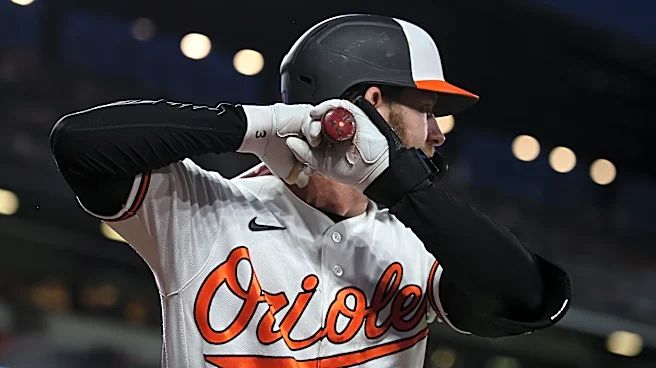
The raw numbers are solid without being flashy, brought down of late by an 0-for-14 skid. But a batting average hovering around .252 with an OBP north of .400, MLB-Top 3 walk totals, and a thoughtful approach at the plate has been a genuine asset at the top of a lineup that’s sorely lacked in consistency. In early May he set an O’s record with 40 walks through his first 40 games (topping the previous mark of 39 set by Albert Belle). The power, though, has been nearly absent—or at least diminished: after posting a career-high 36 home runs with the Angels a year ago, Ward has cleared the wall only twice this season. The homers have turned into doubles: 16, tied for fourth in the AL.
What’s changed for Ward at the plate?
Discipline metrics tell much of the story. The headlining number is Ward’s walk rate: 19.2%, a career high by a wide margin, and third among all 163 qualifying hitters in baseball, trailing only Mike Trout and the Athletics’ Nick Kurtz. A walk rate that extreme does not happen by accident, and the underlying swing data reveal a player who has fundamentally remade his approach.
Ward’s Swing% sits at 31.1%, a career low, meaning he is offering at far fewer pitches than at any point in his career. His O-Swing% (swings at pitches outside the zone) is 12%, the only time in nine seasons it has not exceeded 20%. His Z-Swing% (swings at pitches inside the zone) has fallen to 50.8%, another career low. In other words, Ward is not even chasing good pitches unless they are precisely what he is looking for. And when he does pull the trigger on pitches in the zone? He is making contact at a 90.8% clip — a career best.
The profile that emerges is of a hitter who is extraordinarily choosy but, when he has identified the pitch he wants, is not missing it. And he’s not selling out for power, either. Alongside a strikeout rate near its career low, his launch angle is at a career low, too, and his average exit velocity is unspectacular. Ward is taking walks. Or he’s finding the gap. He’s not swinging for the fences.
What explains the transformation? The change is intentional, as you’d guess. Ward himself cites three factors: offseason mechanical work to produce a line-drive approach, more intensive pregame prep on how pitchers plan to nibble outside the zone, and the new Automated Ball-Strike challenge system, which he says has encouraged umpires to stay closer to the true zone all season. Let’s dwell on that last point for a second.
The ABS system, new in 2026, uses Hawk-Eye cameras and a slightly hitter-friendly strike zone calibrated to each player’s height. One big implication is that pitches that clip the outer edge at the front of the plate and then dive out of the zone are no longer called strikes. And new hitting coach Dustin Lind has a documented track record of reducing chase rates wherever he has worked: he helped the Giants drop their chase rate from 31.2% to 24.2% between 2019 and 2021, and brought a similar philosophy to the Phillies in 2024.
One further downstream effect of Ward’s extreme selectivity is that it forces pitchers to throw strikes. When a hitter lays off breaking balls and borderline pitches with Ward’s consistency, opposing pitchers face an uncomfortable choice — walk him or attack him with fastballs. This season, fastballs have constituted 59.3% of the pitches Ward has seen, and he is hitting .309 against them. Ward’s choosiness, in other words, is producing, not just walks, but also an advantageous pitch mix. He is laying off the curveball, getting the heater, and doing something productive with it. (Now, can Colton Cowser do the same?)
So there you have it: Taylor Ward, a player we were all mostly uninterested in, showed up to town in his ninth big-league season, at age 32, with a brand-new skill set. Granted, he arrived in Baltimore with a reputation for power, and that power is somewhat dormant, unless you really like doubles. (For the record, I do like doubles.) Ward may or may not be a household name in Birdland, but he is on this team—and, in fact, batting leadoff most nights—and he has been one of the most quietly excellent hitters in the American League all season. Time to start paying attention.