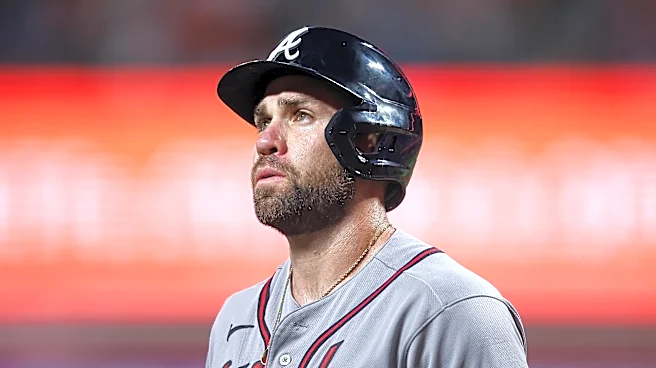




A serious bout of catcher injuries struck the Atlanta Braves during the first half of the season, and desperate times called for desperate measures. One of those measures, of the band-aid variety, ended up being Austin Wynns, who spent two weeks with the club in June and appeared in six games.
How Acquired
The Braves added Wynns in the middle of the season, while both Drake Baldwin and Sean Murphy were down with injuries. They sent cash considerations to the Angels in exchange for Wynns’ services, and designated
longtime third-string catcher Chadwick Tromp in a corresponding move. The reasoning was a bit weird, though it was all meant to be a temporary fix anyway: Sandy Leon was getting the bulk of playing time anyway, so the Braves opted to acquire a backup-to-Leon instead of using Tromp in that role for whatever reason.
One silly thing about the Wynns acquisition is that the Braves kind of prompted it with their own DFA of Jonah Heim earlier in the season. The Athletics, who acquired Wynns in a midseason trade in 2025, DFAed him three days after trading for Heim. He was released and signed with the Angels, but didn’t get promoted to their big league team. Three weeks later, the Braves traded cash considerations (which is what they received for Heim) to Anaheim for Wynns.
What were the expectations?
There weren’t any real expectations, to be blunt.
Coming into 2026, the 35-year-old Wynns had a career 74 wRC+ that featured a pretty sizable xwOBA overperformance (.282 wOBA, .265 xwOBA) in 783 career PAs spanning parts of six major league seasons. He had never topped 180 PAs in a single season, nor 1.0 fWAR. He came kind of close in 2025 riding a massive xwOBA overperformance (.365 wOBA, .295 xwOBA), though. He also wasn’t highly regarded defensively, with just one good defensive year (2023) behind the plate and some substantially below-average performance in other seasons.
He wasn’t doing much of anything in 2026, either — a -47 wRC+ (yes, a negative sign) in 43 PAs in Sacramento before getting released. Basically, the Braves acquired a guy who had 0.6 career fWAR in 826 PAs at the big league level.
While it’s not entirely clear what the Braves were thinking in swapping Tromp for Wynns, it was a fairly inconsequential shuffle to try and survive until Baldwin and Murphy returned.
2026 results
Wynns was only with the Braves for two weeks, acquired on June 3, recalled on June 4, and granted free agency on June 16, the day after Baldwin returned from the Injured List.
During his time in Atlanta, he appeared in six games and was 1-for-14 at the plate. He had just one single and no walks, leaving him with a sad .071/.071/.071 slash line that was somehow even worse than his -47 wRC+ with the Athletics. In what would be his final game with the team, he went 0-for-4 with three strikeouts against the Mets. It wasn’t much better behind the plate, where he allowed six stolen bases and didn’t throw a single runner out, and lost nearly a run of defensive value despite barely playing, even after accounting for the massive catcher positional adjustment. In total, he put up -0.3 fWAR in 14 PAs, which by far his worst stint-with-a-team-in-a-season of his career, small sample size and all.
At least the baseball gods threw him a bit of a bone: after he rejected the Braves’ outright assignment and became a free agent, he signed a minor league deal with the Rangers, spent a month playing in their minor league system, and then got promoted for a month on the big league roster. In 32 PAs in Arlington, he somehow managed a .312 wOBA with a .195 xwOBA, and his defense improved-ish. All in all, Wynns finished 2026 with -0.7 fWAR in 89 PAs, but it would’ve been worse without that stint in the Lone Star State. The Rangers outrighted him in August, and he once again elected free agency, and spent the tail end of the season in the minors with the Cubs.
It wasn’t a fun season for Wynns, as he tied his career-worst in fWAR, had a sub-100 PA season for just the third time, and had a career-worst wRC+ (2).
What went right?
Per Statcast, his defense was commensurate with being in the 73rd percentile in blocks above average? That’s about the only good thing you can say for his season, and it’s largely negated by the fact that he was below average in caught stealing above average, framing and pop time.
In somewhat fitting fashion, Wynns’ “best” game as a Brave was the beginning of their downfall — that 6-5, extra-inning loss to the White Sox. Wynns’ hit was a one-out single that put runners on the corners on with one out while the Braves already had a one-run lead. They didn’t end up scoring in the frame, in part due to a fielder’s choice that threw the runner trying to go home out, and, well, you know how that game and the rest of June went for the Braves.
What went wrong?
Not to be harsh, but, pretty much everything. He wasn’t expected to be a plus bat but one could have at least hoped he could’ve improved on his -47 wRC+ from earlier in the year. That’s how you get a career-worst year.
If you had to pick a specific game from his six as a Brave, well, the day after that horrible loss to the White Sox, Wynns really faceplanted. He flew out with the bases loaded and two out in the second. Then he flew out with the go-ahead run on second and two out in the fourth. Then, after the leadoff man reached in the seventh and Wynns represented the tying run, he lined out. He didn’t get another chance in that game, as Eli White pinch-hit for him and drew a walk in the ninth, representing the tying run, but the Braves lost that game, 2-1.
2027 Outlook
With Wynns set to turn 36 in December, it seems quite possible this is the end of the road for his major league career. He may get another chance with a team if they pick up a rash of catcher injuries, but it’s hard to imagine that would be the Braves again. There are also enough catchers out there on the waiver wire that a guy who neither hits nor fields the catcher position particularly well doesn’t seem like anyone’s first choice, but… the Braves did deliberately acquire him last year, so you never know.