
The Ivy League gives us more data points than any other league in non-conference play to learn about teams. It also gives us the fewest data points within league play for the teams to separate themselves.
So now that every Ivy League team is done with its non-conference slate, let’s take a step back and evaluate where they all are heading into Monday’s openers. Sorted by KenPom order.
Yale
The Bulldogs went 11-2 in non-conference play and are easily the favorites to represent the conference in the NCAA Tournament come mid-March for the third consecutive season. This group ranks just as high in the metrics as it did last year to open up conference play, when it ran through the league at 13-1 to earn a 13-seed.
Despite losing the greatest senior class in Yale history, featuring John Poulakidas and Bez Mbeng as top billing, James Jones’ team has improved immensely on the offensive side of the ball, ranking as the 20th most efficient unit — opponent adjusted — in the country, per KenPom. Ivy Player of the Year favorite Nick Townsend is averaging 17 points, 7.5 rebounds, and 4.3 assists per game. Only three other players in the country are averaging 17/7/4: Cameron Boozer, Joshua Jefferson and Quion Williams. But it’s not just him, as Jordan Brathwaite and Riley Fox have taken big sophomore leaps to add depth to the bench around stalwarts Casey Simmons, Samson Aletan, Isaac Celiscar and Trevor Mullin.
Mullin may not be the player that Mbeng was, but he probably doesn’t need to be in order for this team to win the Ivy League. He’s done a good job limiting mistakes, getting to the line and hitting threes. When you’re surrounded by as much shooting as he is, along with Aletan’s athleticism, Celiscar’s slashing and Townsend’s ridiculous skillset, it’s all Yale needs.
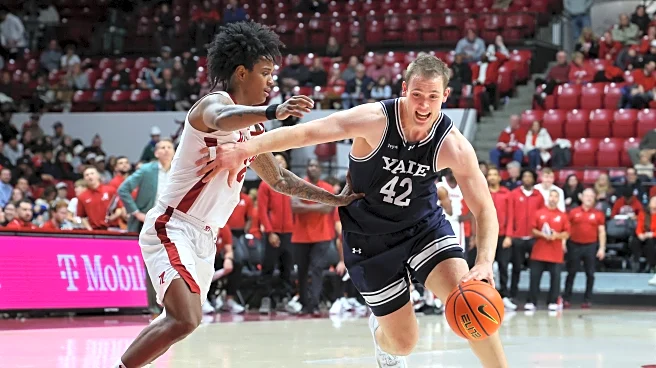
Yale’s only two losses came to Rhode Island and Alabama. It boasts a win over Akron — one of the other top mid-major teams in the country — as well as road wins over Navy, Quinnipiac and Vermont, all of whom could very well end up as their conference’s representative in March.
It feels crazy to say after Yale won the conference by four games last season, but it’s possible that the gap is just as wide, if not wider, this season.
Columbia
Kevin Hovde’s Columbia Lions are the biggest surprise in the Ivy League right now, finishing non-conference play 11-3 after a blowout win over a non-Division I opponent. Columbia climbed all the way up to 120th in KenPom but has dropped down to 136th heading into league play.
Hovde has the Lions playing like a Florida team, complete with dominant two-way rebounding splits, and size that will bother anybody in the conference. Even after starting big man Zine Eddine Bedri went down with an injury — Hovde said he’d be out “for a while” on Nov. 26 following their win at Fairfield — Mason Ritter, Ryan Soulis and Blair Thompson have filled in admirably.
The backcourt of Kenny Noland and Miles Franklin has been excellent as well, but it’s important to remember that Columbia was 11-2 at this time last year as well. Now, it did lose its superstar, Geronimo Rubio De La Rosa, for part of Ivy League play, but it didn’t win an Ivy game that he played in, regardless. While Columbia still has many of the same players, I think it’s fair to give Hovde the benefit of the doubt after all of his success at different stops as an assistant — including Columbia under Kyle Smith.
Cornell
Entering his second Ivy League conference schedule as Cornell’s head coach, Jon Jaques is ready for whatever.
“Last year, we changed so much between the first Ivy game and the 14th,” Jaques told Mid-Major Madness in a phone interview on Sunday. “So I think this year, I’m much more flexible and ready for that. Obviously, we have a certain identity. We play a certain way, and that’s not going to change, but [we’re] definitely comfortable pivoting if we need to.”
His Big Red team sits at 7-6 after non-conference play, with returning stud Cooper Noard averaging 19.2 points per game. His fellow Chicagoland native, Jake Fiegen, missed the first part of the season but has made up for lost time with 14.2 points per game over his last nine. Between Cornell’s top three scorers, Noard, Fiegen, and Adam Hinton, you’re getting 40% from deep from all three.
While there’s no Nazir Williams, AK Okereke or Guy Ragland Jr.-types on this team for playmaking purposes, the potency of the top three scorers has continued to keep the offense humming through non-conference play. Cornell averaged 90 points per game over the last seven Ivy contests last season — including Ivy Madness — with the only two losses in that span coming by single digits to Yale. This season, the Big Red are averaging 88.8 points per game against Division-I opponents, which ranks fourth among all mid-major teams in the country. The combination of pace and efficiency makes for a really difficult matchup for any group.
Every question mark comes on the other side of the ball.
“Defensively, we need to improve,” Jaques said. “There’s room for growth in how we can compete. I love how physically we play. It’s non-negotiable for us, so just figuring out how to use that to our advantage and get stops, speed people up on defense, that’d be helpful.”
With a matchup against Columbia looming to open conference play, the Big Red will be tested immediately.
Harvard
The Crimson haven’t qualified for Ivy Madness since the 2019-20 season, but that could very well change this year. Harvard enters conference play at 7-7 coming off an impressive road win against Colgate to end the month of December.
Robert Hinton already has two 30+ point games this season, but the best sign for the team is that it has been able to win games on nights where Hinton isn’t pouring in a ton of points. Chandler Piggé remains one of the most rock solid and underappreciated players in the conference, shouldering a bigger playmaking load this year and leading the team in assists. Meanwhile, Tey Barbour has taken a sophomore leap and is shooting 43% from beyond the arc on high volume.
Harvard does however, have one of the shallowest benches in college basketball right now. Tommy Amaker is relying a ton on his top six of Hinton, Barbour, Piggé, Ben Eisendrath, Thomas Batties and Austin Hunt. It’s one of the better top sixes in the league without a doubt, but for the Crimson to take that next step, somebody else will need to step up. Could it be one of the freshmen, Frankie Mannino, Ryan Sullivan or Kenan Parrish?
A favorable schedule to open Ivy play, with four of the first five games being played at home, awaits, but that just means that just three of the final nine games will be played in Cambridge. Can Harvard get off to a fast start? Or will it need to snag some late road wins to make up ground in order to make it to Ithaca?
Penn
The Quakers made waves early in the season by defeating former head coach Steve Donahue and Saint Joseph’s en route to an appearance in the Big 5 Championship Game against non-Philadelphia school Villanova. In their first season under Fran McCaffery, the Quakers finished non-conference play 7-6, despite Ethan Roberts missing the entire month of December.
That stretch allowed the Quakers to grow around them, including AJ Levine, who played some of his best basketball in late December, TJ Power and Cam Thrower.
“It’s an opportunity for other people to step up and be aggressive in their role,” McCaffery said after Penn lost to George Mason on Dec. 28. “I think it’s been good for Cam, It puts more pressure on TJ and Michael (Zanoni), but it also puts more pressure on our five spot, and I think Augie (Gerhart) and Dalton (Scantlebury) have been terrific.”
Penn is hopeful that Roberts comes back soon, but injuries in the Ivy League can be a slippery slope, as there are so few regular-season games. Additionally, Thrower and Scantlebury missed the New Year’s Eve tilt with NJIT.
Power has been a revelation, playing like the player that many expected him to be coming out of high school with 14.6 points and 7.9 rebounds per game, but it’s Levine and Zanoni who might be the ceiling raisers for this group.
Zanoni has scored 23 points in back-to-back games and is shooting 41% from beyond the arc. When he’s hot, he can get absolutely nuclear, but he’s worked on adding a little more off the bounce.
Meanwhile, Levine has responded incredibly well to being benched in the first half against George Mason with three of his best halves since then.
“I know what (McCaffery) wants from me,” Levine said after the NJIT game. “I know that when I’m not doing it, I understand why I’m not in the game. I just need to keep doing what he wants.”
For McCaffery, games like the Ivy opener against Princeton are why he decided to come back to Penn.
“That was always one of the most incredible atmospheres you’d ever play in front of,” he said. “And it always had a great impact on your ability to win a championship.”
Brown
The 0-4 start came before Brown was fully healthy. David Rochester and Landon Lewis didn’t play until after that, and the Bears have won six of their last nine games — albeit two of those wins are non-Division I. Only Columbia has a higher-ranked defense than Brown coming into league play, as the development of N’famara Dabo and Jeremiah Jenkins has created a great unit.
However, Lewis hasn’t quite taken the offensive leap that one might have hoped. He’s averaging fewer points and rebounds on 11% lower from the field than last season, but his two highest scoring games of the season came at the end of non-conference play.
It’s a sneaky big game on opening day of Ivy play, as Brown takes on Yale in Providence. The Bears certainly won’t be expected to win, but if they can make life difficult for the incredible Bulldog offense, it could stand to legitimize the defense for games down the road. Hopefully, sharpshooting freshman Brady Loughlin will be available, as he missed the last game.
Dartmouth
The Big Green has had some really good and some really bad in non-conference play. It’s definitely among the biggest “Jekyll-and-Hyde” teams in the northeast at the moment. Blowout road wins over Saint Peter’s and Holy Cross, a comfortable home win over Boston University? Those are all great. But blowout losses to Marist and Sacred Heart aren’t great, and allowing 55 points in the second half to Bryant isn’t good either.
For as much as Dartmouth returns from last year’s team that made Ivy Madness for the first time since the inception of the tournament, this team isn’t as extreme in some of its strengths, while also maintaining some of the weaknesses.
Sophomore guard Kareem Thomas has been one of the top breakout players in the conference this year, averaging 18.5 points per game, but he’s not much of a playmaker, and it puts more pressure on those who are when one of the main handlers isn’t. I’m looking forward to seeing whether Thomas can continue being as efficient as he has during conference play with teams starting to be able to scout him out better.
Princeton
The Tigers immediately lost eight games in a row after Dalen Davis got hurt in November, but many of the games came down to the wire. Only one of those games had a margin of more than five points. Against Vermont on Tuesday, Princeton finally got one to go its way, winning in overtime 75-69 to end the losing streak. The Tigers led by 13 in the second half, nearly blowing the game but dominating the overtime period.
“It wasn’t like ‘oh boy, it’s happening again,’” said Jack Stanton, who had 19 points. “It was like ‘we’re sick and tired of this, we’re getting it done this time. It’s not happening again.’”
Princeton has already played two teams twice this season, facing both Temple and Vermont in late December after playing them in the ESPN Events Invitational. For an underclassman-heavy team, getting those extra reps in simulating a conference-style scouting report can be valuable.
“It’s okay to be mad about (losing the first game),” Mitch Henderson said. “But what are you going to do about it? We’re young enough to now start to understand how hard it is to win and how hard you have to compete to be involved in a game like this.”