

The NBA G League is full of talent, littered with former collegiate stars and former lottery picks. But it’s not just a league full of flops who were never good enough for the NBA. It’s a launching point for the careers of future NBA champions and a place where struggling NBA players can find their feet and become contributors on an NBA roster once more.
No G League arena knows that story better than the Mississauga Sports and Entertainment Centre. Champions and Raptors of old such as Pascal Siakam,
Fred VanVleet, Norman Powell and Chris Boucher once plied their trade on the hardwood at the venue formerly known as the Hershey Centre, before a name change and a changing of the guard saw JaKobe Walter, Gradey Dick, AJ Lawson come through the doors during the era of the Paramount Fine Foods Centre in recent years.
The Raptors have always been at the forefront of using the G League to find contributors and develop their own draft picks, and that should mean something to fans in Mississauga. A lot of folks in other places may scoff at the G League but it is a chapter in the stories of some of Raptors fans’ favourite players and, at the bare minimum, a footnote in the 2019 championship.
While fans may know those stories, there are G League alumni littered around the NBA, many of them NBA champions who either got their start in the G or earned their way back to the NBA.
The G League as a Launching Point for Champions
The 2019 Raptors championship team featured two players whose stories are integral to the tale that is 2010s NBA basketball, and both of them got their start in the G and were even teammates at one point in Reno, Nevada, for the Bighorns in the 2010-11 season.
Danny Green
The three-time NBA champion with the Spurs, Raptors and bubble-era Lakers was drafted by Cleveland 46th overall in 2009 after an NCAA championship at UNC, but after 20 games in a rookie year in which he struggled, the Cavs cut him loose, allowing him to move on to San Antonio, where they also waived him. He landed in Nevada with the Reno Bighorns, the former G League affiliate of the Sacramento Kings.
Green balled out in 16 games for Reno, leading the team in scoring with 20 points a night, as well as 7.5 rebounds per game. Arguably most importantly, he shot 43.4 per cent from deep, which was the skill that got him to the NBA and made him valuable there. He just needed a platform to show it.
Jeremy Lin
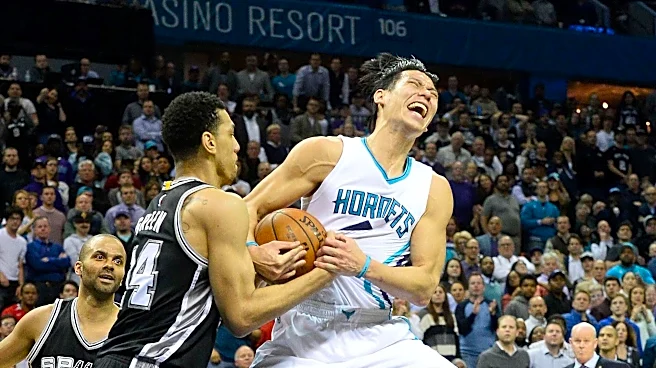
Jeremy Lin was Green’s teammate in Reno, albeit not for long. Lin began his NBA career in Golden State after going undrafted, a tough place to come by playing time as he sat third on the point guard depth chart behind Monta Ellis and some guy named Steph Curry.
Lin spent a lot of time down in the G League with Reno, who had an affiliation with Golden State at the time. He played well and earned himself an opportunity in China during the NBA lockout before returning to North America with the Knicks the following season, and everyone knows how that went for him.

That Reno Bighorns team was a launching point for Lin and Green, but it also had a roster any basketball sicko would love. Steve Novak and Hassan Whiteside suited up for the Bighorns, as did Patrick Ewing Jr, son of the Hall of Fame Knicks big man.
Alex Caruso
Another multi-time NBA champion, with the Lakers and Thunder, actually began his career with the Oklahoma City Blue, the G League affiliate of the OKC Thunder. His lone season with Oklahoma’s G League club led him to a Summer League invite with the Lakers and a Summer League championship alongside Lonzo Ball, Josh Hart and Kyle Kuzma.
Caruso earned himself a two-way contract, which made him the first two-way signee in Lakers history. While on a two-way, he continued to play in the G League with the South Bay Lakers until his talent became so undeniable that he eventually earned himself a regular rotation spot. He’s gone on to win two championships and sign $123 million worth of NBA contracts.
Reviving a Career in the G League
While for Lin, Green and Caruso, the G League was where they got their first really meaningful opportunities in professional basketball, for others it has been a platform to resurrect a career that once looked dead in the water. Certain players take longer to find their role and carve out their basketball niche, and the G League can provide an opportunity away from the bright lights of the NBA.
Gary Payton II
Gary Payton II, son of the Hall of Fame SuperSonics legend, had actually played for the Lakers, Bucks and Wizards before finding his way to the Raptors 905 in January 2021.
With the 905, Gary carved out a role for himself that should be familiar to anyone familiar with the Payton family name: defensive stopper. He won the league’s Defensive Player of the Year Award, joining Chris Boucher as the only other player to win the award as a member of the 905. Finding his role in professional basketball during his lone season with the 905 opened an opportunity for him to join the Golden State Warriors, where he won a championship in 2022 and has been an NBA player ever since.
Raptors 905 centre Jamarion Sharp won the 2026 Defensive Player of the Year Award in the G League as a member of the Texas Legends. Who’s to say he can’t follow in the footsteps of Payton II and carve out a defensive role for himself in the NBA?
While many fans write off the G League as a land of misfit toys and failed prospects, it is anything but that. You are highly unlikely to find future NBA All-Stars in the G League, with the exception of draft picks getting sent down for extra reps, but fans of G League teams ought to be on the lookout for the next elite-level role player like Caruso or Green, because they just might be playing in a G League gym this season.