

Before we flip the page to the Steelers’ next opponents — our preview of the New England Patriots matchup is out Friday — we here at Read & React wanted to take one last look at the film from Week 1, and take stock of any interesting trends or tidbits we felt worth sharing. We haven’t decided if we’ll do a film room each week in-season, or toggle between that and doing what we have in the past in discussing the trending Steelers narratives in the media at large.
At least for this week, we’ve opted
for the former, as we couldn’t bring ourselves to add another article with hand-wringing about the Joey Porter Jr. contract situation, attempts to interpret the various Aaron Rodgers and Mike McCarthey soundbites throughout the week, nor give any in-depth takes on former coach Mike Tomlin as an in-studio analyst — though I think he had more ups than downs, and I hope NBC doesn’t try to over-sanitize his personality; we don’t need more Jason Garrett types!
So with that in mind, let’s dive into the tape with what Ryland and Ryan found noteworthy about Week 1’s performance.
Defense

RB: So much was made about how creative and at times complicated Patrick Graham’s Steelers defense would be in 2026, but to start off the season, Pittsburgh’s new coordinator kept things fairly simple.
There were some twists rushing the passer, a healthy dose of coverage rotations, and some of Graham’s signature creepers at the line of scrimmage. But overall, Pittsburgh’s game plan was fairly straightforward by NFL standards.
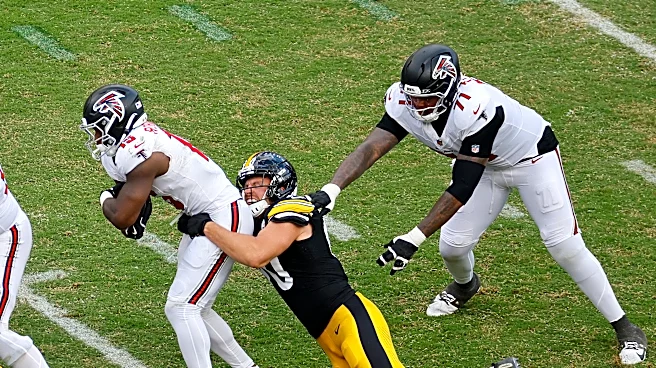
Pittsburgh blitzed at a league-low 7.7%, primarily relying on a four-man rush. According to Next Gen Stats, the Steelers played zone coverage exclusively when the Falcons dropped back to pass — though it should be noted, as Graham did in a later press conference, that some of those reps used match concepts, which have similarities to man coverage. And while some off-ball linebacker snaps for Nick Herbig were a new wrinkle in the Steelers’ three-outside linebacker package, there wasn’t much in the realm of exotic formations or schematics.
Why were things so simple? My guess would be that the Steelers rightfully recognized their defense is clearly more talented than the Cooper Rush-led Falcons offense, and saw no need to complicate things. Despite Pittsburgh rarely blitzing, the Steelers managed a 15.4% sack rate, the league’s second-best mark in Week 1.
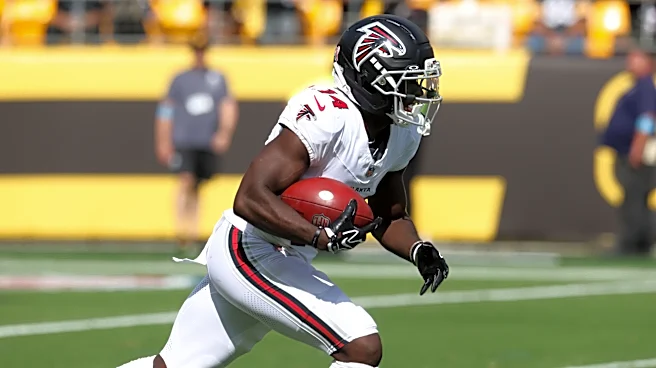
Elite running back Bijan Robinson was a problem, as expected, with 90 receiving yards and plenty of missed tackles in the process. Despite this, he was held to a manageable four yards per carry in the run game. And Atlanta’s next-leading receiver, the talented Drake London, was held to 29 yards as Rush completed just 12/22 passes for 143 yards.
Altogether, a lack of uber-confusing concepts likely helped the defensive players simply line up and make plays. Keeping things simple can be a detriment when a team lacks enough talent, but we’ve also seen plenty of elite defenses, like last year’s Texans or the Legion of Boom-era Seahawks, suffocate opposing offenses when the right collection of players can master a straightforward scheme.
For the Steelers on Sunday, that resulted in arguably the best game of inside linebacker Payton Wilson’s career.
For much of the summer, I projected my hope that a Year 3 breakout from the talented Wilson would be possible under Graham’s guidance. That campaign got off to a good start in Week 1. I’m not sure if I’ve ever seen Wilson look so fast and confident on the football field. He logged 13 total tackles, including two for loss, and looked both quick and decisive in coverage. And while he’s still not a thumper defending the run, the game looks like it has slowed down for him, with Wilson seeing success knifing through blocks near the line of scrimmage to make plays.
Wilson’s play, as well as high-end performances from T.J. Watt, Cam Heyward and Alex Highsmith, were probably the biggest individual storylines for the Steelers defense.
However, I was also impressed by the contributions of some newcomers on the defense.
Both safety Jaquan Brisker and cornerback Jamel Dean were solid in coverage (Brisker recorded a nice interception on an overthrow in zone; Dean got run by when flat-footed on one play but otherwise looked fine), but both made their biggest impacts as tacklers.
Dean looked like a heat-seeking missile at times and managed to force a fumble on Robinson.
Brisker was fearless when filling holes in the run game. Even if he didn’t always make a clean tackle, he clearly affected a number of plays.
One of the hits on Robinson was a true bone-crusher, too.
Besides taking advantage of misfires and poor reads from Rush, Graham’s zone-heavy scheme (with a heavy dose of cover 4) allowed the team’s aggressive defensive backs to keep the game in front of them and crash down when needed.
A more underrated contributor was new defensive lineman Sebastian Joseph-Day, who logged just 18 snaps in a rotational role but still managed to stand out on several reps. His power is a real asset, and having a player of his caliber outside the main starting lineup speaks to the team’s overall depth at the position.
We’ll end with the Steelers’ biggest name on defense, T.J. Watt, who looked like his prime self once again against Atlanta with two sacks, a pick-six and another tackle for loss. Attentive watchers would’ve noticed Watt saw a number of rushes from the right side of the defense — he’s been almost exclusively a left-side rusher for much of his career — showing some of the “Watt moving around the formation” hype could finally be coming true under the defense’s new coordinator.
Did Watt look especially different coming from the right side? Did defenses look unusually perplexed? Not exactly, but his first rep from the blind side resulted in a sack, which means the idea resulted in some success. It’s also a good sign for the Steelers continuing to matchup hunt and mix and match the team’s arsenal of pass rushers down the road.
What’s exciting about Graham as the defensive coordinator is that it’s difficult to know what he’ll bring to the table next week. He’s made a career of being adaptable to the players he has and the opponents he faces, something he made clear to the media in Tuesday’s press conference.
“My philosophy is what’s best for that week, usually … what we think is best to beat the opponent and make sure our guys are able to play fast,” Graham said when asked about the team’s zone-heaviness in Week 1.
Graham had a similar response when asked about the lack of blitzing. “I mean, I’m going to tell you, we’re going to try to do what’s best for the game that week,” he said. One game we might have ‘blitz zero’ 20 times in a game. The next week might not blitz one time. We might ‘drop eight’ 20 times. I can’t tell you.”
“If it’s physical, if we’re running around, attacking the ball, I think everybody in this town would appreciate that because that’s Steeler football, in my opinion — part of the identity of Steeler football, defensive football. … How we play, more than what we do, is important to me,” he continued.
That philosophy was clear in Sunday’s win. Much tougher offenses await later in the season, but it was as good a start as could be expected for the Patrick Graham era of Steelers defense.
Offense

RP: While Ryland’s given us plenty of reasons to be intrigued by the defense, unfortunately the Pittsburgh offense is here to pour some cold water on the proceedings. That isn’t to say there can’t be improvement as the season progresses. It’s only been one week, after all, and the Steelers are both learning a new system and trying to shake off the offseason rust. But the Steelers can’t continue to play offense like they did on Sunday and expect to win many games. Pittsburgh converted just three of its third-down attempts into first downs, and failed two fourth-down attempts, though one was a botched operation on a field goal, not a genuine attempt to go for it.
While there will be time to discuss the passing game in further detail in the future, the topic of Pittsburgh’s passing difficulties has already been discussed on BTSC, and it’s clear the Steelers had some bad luck with some pass interference — including both some questionable OPI calls and some missed DPI calls — and also left plenty of meat on the bone with inopportune drops and failures to win contested catches. McCarthy also took a lot of the blame upon himself for calling a “herky-jerky game”and failing to get any of the Steelers’ playmakers in a rhythm.
The passing game was certainly frustrating, but what gave me the most concern was the rushing game.
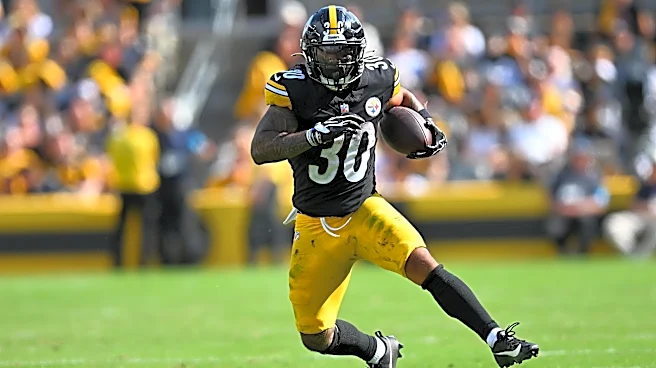
Excluding kneel-downs at the end of the game, the Steelers ran the ball 18 times for just 61 yards. Jaylen Warren had a decent day and looked like one of the Steelers’ more explosive playmakers on offense, but he also had a fumble and had just as many runs gain less than four yards (5) as he did runs that exceeded that mark. Rico Dowdle had an especially tough go of things. After picking up six yards on his first carry, he had just one carry that exceeded three yards the rest of the day.
I wanted to diagnose what the root of Pittsburgh’s issues were and see if there were any schematic or personnel patterns that might explain why the sledding was so tough for the Steelers’ ground game. What I found was that it didn’t really matter whether the Steelers had 11 personnel or multiple tight ends on the field. They were out of sync regardless, though they were particularly bad running out of shotgun.
Some other tidbits I found:
- Of the Steelers’ 18 rushing attempts, 11 came on first down. All other attempts, excluding kneel-downs, were attempted on second down. The Steelers threw the ball on 16 first-down plays.
- The Steelers attempted 42 passes and just 18 rushing attempts.
- Steelers runs to the left (9 attempts): 3.1 YPC (Warren 3.5 YPC, Dowdle 2.3 YPC)
- Steelers runs to the right (5 attempts): 3.2 YPC (Warren 7.0 YPC, Dowdle 0.6 YPC)
- Steelers runs up the middle (4 attempts): 4.3 YPC (Warren 5.5 YPC, Dowdle 3.0 YPC)
- Steelers in 11P: With Washington at tight end (6 attempts, 3.0 YPC); With Freiermuth at tight end (2 attempts, 0.0 YPC)
- Warren’s stat line was buoyed by three late runs (an 8-yarder, 17-yarder, and 9-yarder) that totaled 34 yards (74% of his output)
Even before throwing on the tape, it’s easy to see why McCarthy was critical of himself. Offenses he’s called, especially with Rodgers at quarterback, have always skewed pass-heavy, but the imbalance of run-versus-pass in this game was stark. It also didn’t set the offense up for easy third-down attempts. If we include the two third-down plays that were wiped out due to pass interference — one on the offense and one on the defense — the Steelers’ average distance to go on third down was 7.7 yards.
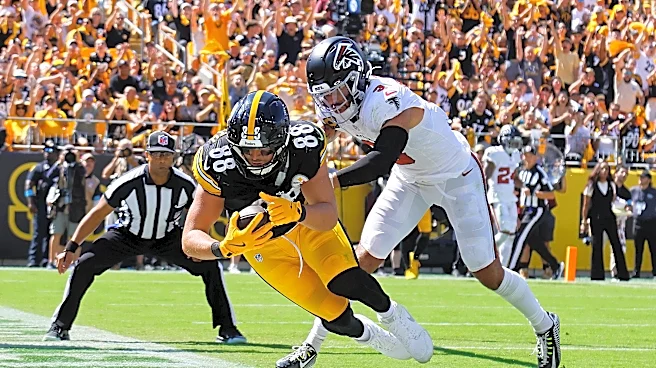
McCarthy also could have called more play-action, considering how well it worked for the Steelers. Even with the inconsistencies running the ball, Rodgers completed 6-of-8 play-action pass attempts for 65. The two incomplete passes were both instances where the Steelers left points on the board. One was a pass to Metcalf in the end zone, where the defensive back did grab his arm before the ball arrived, but Metcalf still managed to get both hands on the ball. The second was on a bootleg to the left, where Rodgers missed Jaylen Warren wide on a pass the running back would have walked in for six with a better ball.
Now you might be saying to yourself, “But Ryan, you said you weren’t going to be talking about the passing game. Yet here you are talking about play action.”
To which I say, touché. I guess I was running some play fakes of my own just now. But more importantly, I think it’s an interesting part of understanding how this offense could work together better in the weeks ahead, that is, if the Steelers can iron out some of the kinks. As you’ll see in some of the following plays, the Steelers run game wasn’t scaring the Falcons defense much, but the Steelers were still efficient with play action despite that. Imagine how dangerous that could be if the Steelers develop a threatening run game.
So what went wrong? I don’t think it’s as simple as blaming this on any one player. To have a functioning and effective running attack, the offensive line, tight ends, fullbacks, and even the wide receivers need to work in sync as blockers. The ball carrier must also make the right reads and hit the holes provided to them with the proper timing and intensity. Often, it only takes one weak link to doom a designed run. I thought the Steelers’ struggles in this game, more often than not, fell on the blockers rather than the backs, though Warren and Dowdle can certainly stand to improve on this game.
In particular, I thought left tackle Troy Fautanu and right guard Spencer Anderson had some difficult reps as run blockers in this game.
While there were some decent reps from Fautanu on other plays, his issues with leverage on Sunday jumped out to me in a game where the Steelers attempted disproportionately fewer rushing attempts. I watched Fautanu a lot on film last year, and there are games where he kicks butt as a run blocker. He’s not a player who lacks the necessary power to move defenders. But when he does have struggles, it’s on reps where his technique gets sloppy, and he loses his leverage.
Sunday was just one of those games for Fautanu. In the clip above, he doesn’t even do anything egregiously wrong. I think you could ask him to move his defender off his spot with a little more power, but Fautanu wins his rep if not for Warren tripping on the offensive tackle’s leg. If Warren is able to keep his feet, plant, and accelerate out of that cut, all he needs to do is make the linebacker (53) miss, and the Steelers have a positive gain instead of a stop at the line of scrimmage.
It certainly wasn’t Fautanu’s best performance, but Anderson was the player that left me with the most concern. Coming out of college, the knock on Anderson’s draft profile was a lack of pop to his blocks, and a tendency to find himself leaning and off balance. All of those flaws were on display against Atlanta, though as you’ll see in these clips, he isn’t the only one losing on some of these reps.
Overall, the unit just rarely looked fully in sync.
As for the running backs, I think we all are familiar with Warren and his skill set. He remains the team’s best running back, both with the ball in his hands and as a pass blocker. That said, I’m not ready to throw in the towel on Dowdle as the RB2 just yet. While I don’t think Dowdle has the same burst and decisiveness as Warren, I lean toward the line’s performance as the biggest factor in his poor Week 1 stat line. Of course, that doesn’t mean I don’t think there are plays he needs to execute better, like in the following clip.
Still, even with this showing against the Falcons, I do think this is a team that can get better. While I don’t think Dylan Cook particularly contributed to the team’s running woes, I do think getting Iheanachor into the lineup would be a net positive for this unit. He has obvious power and plus-mobility that we got glimpses of in the preseason.
Beyond that, I’d keep an eye on Anderson. He’s a cool story as a former seventh-round pick who’s climbed to a starting position, but he needs to show some improvement if he wants to keep the job. The Steelers have plenty of options should his struggles continue. They could always kick Dylan Cook inside if they believe he is still one of their best five linemen, plus they have veterans they could call on like Brock Hoffman and Ryan McCollum. I don’t believe rookie Gennings Dunker is quite ready to start, but I felt similarly about McCormick as a rookie, and he responded well to being thrown into the fire. Dunker was often compared to McCormick during the draft cycle, for what it’s worth.
Will the Steelers be able to get the run game right in Week 2 against New England? Come back Friday for our New England preview.
Join in on Steelers R&R by sharing your takes on this week’s topics. Feel free to pitch future questions in the comment section or on Twitter/X: tag @_Ryland_B or @ArmchairScout21, or email us at steelersreadnreact@gmail.com.