

We’re off schedule, but the position breakdown series marches on. Quarterbacks and running backs are in the books. This week we take a hard look at the group that has held the Iowa passing game hostage for the better part of 15 years and ask the question we ask every summer: is this the year the wide receiver room finally becomes an actual weapon?
Setting the Stage
Marvin McNutt caught 82 balls for 1,315 yards and 12 touchdowns in 2011. That’s the school single-season receiving yardage record. No Iowa wide receiver
has come within 500 yards of it since. Ihmir Smith-Marsette got to 722 in 2019. Nico Ragaini finished a whole four-year career with 842. Nobody else has cleared 800 in a season during the Kirk Ferentz second decade. It’s been fifteen years of WR production drought in Iowa City.
The issue has been a combination of recruiting, scheme and injury but the result is the same: Iowa has gotten almost nothing in the receiving game outside of the tight end position for a very long time.
The 2026 season again comes with hope and promise as the WR room brings an interesting mix of returning experience, a pair of legitimate FCS stars, an SMU portal add and a healthy (for now) freshman class. It also comes in without Kaden Wetjen, the punt-return artist who was more valuable on special teams than any pass-catcher on the roster in 2025, or either of Iowa’s top two WRs in receiving yards from a season ago.
The question isn’t whether this room has talent. The question is whether Tim Lester’s third year of scheme install and a new starting quarterback can finally turn talent into targets.
Who We Lost
- Kaden Wetjen — Drafted in the 4th round by the Pittsburgh Steelers Wetjen’s 2025 role blended slot receiver duties with return specialist. Iowa loses both modest pass-catching production (151 yards and 1 TD) and, more importantly, the field-position weapon in the same offseason.
- Jacob Gill — 24 catches, 278 yards led all Iowa receivers in 2025. He wasn’t a superstar but he was dependable and now he’s out of eligibility.
- Seth Anderson — Tied for the team lead with two receiving touchdowns a season ago. He’s one of the candidates for what-if players at Iowa with his injury history.
- Sam Phillips — Philips was a senior portal add from 2025 who’s out of eligibility. Like Gill, he wasn’t a superstar and his physical stature will be easily replaced, but he was second among Iowa WRs in production last year with 261 receiving yards and a team-high 16.3 yards per reception.
- Terrence Smith — Redshirt freshman quietly removed from the roster in mid-July. No explanation from the program as of yet. An odd story line to follow, especially if the Iowa WRs struggle in 2026.
Add it up and Iowa lost close to 50 combined receptions and half of its 2025 receiving-touchdown output. This isn’t a total gut of the room, but the top of the depth chart is being rewritten.
Who’s Back
Reece Vander Zee (Jr., 6-4, 220) is the X. The Rock Rapids native missed the first half of 2025 with a foot injury and still finished with 15 catches, 219 yards, and 2 touchdowns. Healthy from the jump this fall for the first time in his career, he’s the biggest-body outside threat Iowa has had at the position in years. He’s the leader among the returning receivers and is a good bet to lead the team in TD receptions in 2026.
Dayton Howard (Sr., 6-5, 215) is heading into his senior season looking to deliver on the promise of his physical stature. Originally from Kansas City, Howard finished 2025 with just 8 catches for 91 yards and a touchdown. Howard has been the guy the coaching staff wants to see take a leap for two years now. This is his last chance to do it and he’s playing behind Vander Zee, who also has that big body and has been more productive with it. If not for the newcomers, he may have been vying for a starting role this year, but entering fall camp it seems unlikely he wins the job opposite RVZ.
KJ Parker (Jr., 5-10, 191) is the offensive breakout candidate everyone left the spring talking about. The Bellwood, Illinois product got significant first-team reps at the April open practice with several WRs held out, and made the most of them. Ferentz’s read on him after that session: “KJ’s at that point — he’s got a good energy to him. He’s got some ability, certainly, and goes hard, and is fearless out there.”
Parker had all of three receptions for 18 yards in 2025. His 2026 production floor is a lot higher than that suggests. Look for him to get into the rotation at either the Z or the in the slot.
Jarriett Buie (Jr., 6-2, 198) is another one of those high potential guys that hasn’t hit his ceiling yet. He was building into a rotation piece in 2024 (9 catches, 94 yards) before an injury torpedoed his 2025. If healthy, he’s another 6-foot-plus body in a room that suddenly has size at every spot on the depth chart. As it stands, he’s likely a rotation piece that’s a backup opposite of RVZ/Howard.
Alex Eichmann (Sr., 6-2, 210), Jackson Naeve (Jr., 6-0, 195), and Apollo Payne (So., 6-3, 214) round out the returning depth. All three project as special teams contributors with a very limited path to spot rotation.
Newcomers
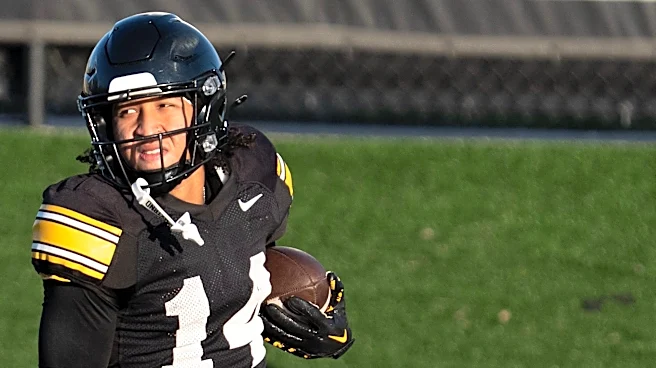
The headline addition is Tony Diaz (So., 5-10, 184), the redshirt-sophomore FCS star from UT Rio Grande Valley. His 2025 line at UTRGV: 68 catches, 875 yards, 11 touchdowns. That’s a full-time No. 1 receiver stat line at the FCS level, earned in his first year of college football after redshirting in 2024. Phil Steele named him a first-team FCS Freshman All-American. The AP put him on their honorable mention list.
Having topped 100 yards in four different games a year ago, Diaz is the most productive receiver in the room already and has done nothing but turn heads and build hype since committing to Iowa back in January.
Head coach Kirk Ferentz on the addition: “Receivers’ first job is to catch the ball, and he likes to catch balls. No matter where they’re at, he’ll find a way to catch it. He runs well, and he’s just got a great attitude.”
The internal reviews out of spring practice were louder. Reece Vander Zee on Diaz: “The dude is impressive. He goes up and gets the ball wherever it’s at. He’s fast.” Dayton Howard: “Probably the twitchiest I’ve ever seen, for sure. His ball skills are amazing. If it’s in the air, it’s his every single time.” Diaz got first-team reps immediately in the spring and did not let anyone take them back.
If anyone is going to be the legit WR1 in this offense, it looks like it will be the Boogeyman. If he is as advertised, Iowa opponents should beware of what the Hawkeyes could do with an actual passing game.
Evan James (Jr. 5-10, 210) is another promising transfer prospect who may not get the attention of Diaz, but in any other year would have had Iowa fans buzzing. James led Furman with 65 receptions, 796 receiving yards and eight total touchdowns (7 receiving) a season ago. He’s got a similar frame to Diaz, but is a bit thicker. How Tim Lester opts to use him will be interesting. He feels like a guy who could take a lot of the Kaden Wetjen touches on jet motion or screens and projects as the likely starter opposite RVZ on the outside with Diaz in the slot, though the two transfers could swap spots.
Lance Beeghley (Jr., 6-2, 197) came in from SMU in the same portal cycle and while he is from a larger school, he projects to have a smaller role than the two small-school guys. Beeghley was a rotation piece with the Mustangs and projects as a size-and-blocking depth piece for Iowa. Not the same ceiling as Diaz or James, but he has more height and has two years left.
The freshman class brought in four WRs. Xavier Stinson (Fr., 6-2, 202) from Port St. Lucie was the highest-rated of the group and the most likely candidate to see time as a true freshman. Brody Schaffer (Fr., 6-1, 195), Diondre Smith (Fr., 5-10, 160), and Isaiah Oliver (Fr., 5-11, 199) round out the class. All four project as what would have been redshirts before the five in five change. Don’t expect much impact outside of special teams roles given the depth (I can’t believe I just typed that about an Iowa offense) in front of them.
Projected Depth Chart
Key Questions for Fall Camp
- Does Tony Diaz translate to the Big Ten? FCS production doesn’t always scale up. The film says his hands and route running should. Iowa’s coaching staff has spent years bringing in lower level G6 and FCS transfers with mixed results. Diaz is the most-hyped one of the batch and the praise from Ferentz, the staff and the rest of the roster has been borderline absurd. It’s hard not to be bought in on that alone, but the jump from UTRGV to the Big Ten is going to be noticeable.
- Can Reece Vander Zee stay healthy? The foot injury has been a lingering issue for two years. When he’s on the field, he’s a legitimate outside-the-numbers threat and one of Lester’s best options in the redzone. When he’s not, the ceiling on this offense drops noticeably and the play-calling becomes limited.
- How much of KJ Parker’s spring is real? Spring hype is a hazardous thing to bet on. Parker’s tape from the open practice was incredible — the contested catches were the kind of plays Iowa fans have not seen from a WR in years. But we need to see it in September in live action, if he can even crack the rotation. If he can’t, will that be a good thing or a bad thing?
- Who wins the punt-return job? Wetjen leaves a massive hole on special teams that isn’t going to be filled internally. Whoever wins the job takes on one of the most important individual roles on the entire 2026 roster.
- Can Tim Lester actually target this position? Iowa’s WRs got 40 combined targets in some games last year. The offense’s identity was Gronowski + the run game. This year requires a different formula. Lester’s play-calling philosophy is the variable that turns what we think is a talented room into an actual weapon and potentially clears the stink off the Iowa offense’s name around the country.
The Bottom Line
This is the deepest, most talented Iowa WR room since McNutt was catching everything in sight fifteen years ago. Whether that translates to actual production depends on three things: Vander Zee’s health, Diaz’s transition, and whether the quarterback battle produces a starter who can consistently push the ball outside the numbers and vertically downfield.
The talent floor is legitimately higher than it has been in a decade. The ceiling is 2,000+ combined receiving yards from a WR room and Iowa’s first 700-yard receiver since 2019. The realistic outcome is probably closer to 1,500 combined yards, one 600-yard leader, and an offense that finally has more than two credible pass-catching threats.
Even the middle of that range would be enough to change the shape of Iowa’s offense. Go Hawks.