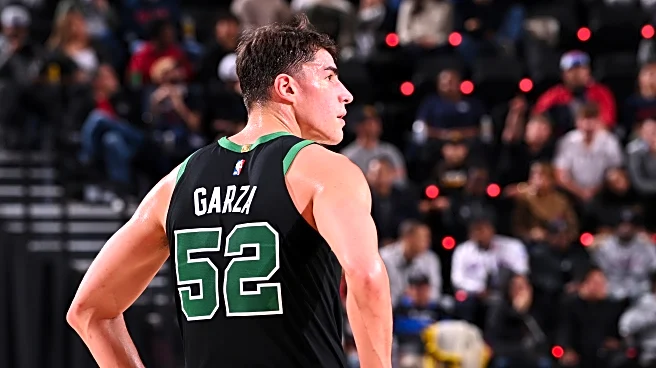



Before Luka Garza ever logged a minute in a Celtics jersey, he told us exactly what he was going to do.
In new environments, words are currency, and selflessness is always the safest investment whether the speaker means it or not. So, when he spoke in his first after practice interview as a Celtic and said, “My number one role you know playing with Jaylen [Brown] or Payton [Pritchard] or Anfernee [Simons] is to get them open,” on its own, the line could easily be dismissed as the right thing said at
the right time.
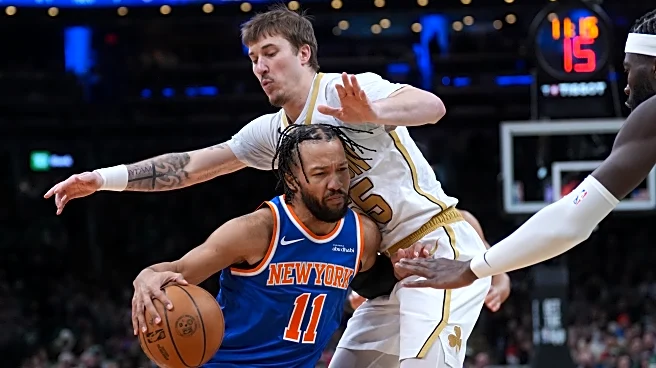
But when you see him do things like this…
You quickly realize he meant every word.
Garza has without a doubt been one of the best screeners in the NBA this season.

The numbers support the claim. His 6.82 screen assists per 75 possessions, and screening talent grade ranks fourth in the NBA. His Roll Man Impact, a measure of points added per 75 possessions on court from roll/pop and slip scoring ranks first. On possessions where Garza is the roll man the Celtics average 1.6 points per possession which is also in the 100th percentile.
After 15 straight days without seeing the floor, Garza returned to action against the Toronto Raptors on December 20, 2025. Since that game, Garza ranks third in screen assists (4.6) and screen assist points (10.6) per game. In both categories he trails only Jusuf Nurkic and Rudy Gobert. Nurkic leads the NBA with five screen assists per in this span, and Gobert is right behind him with 4.8, but the kicker is they both average over 30 minutes per game.
Garza? Just 21.4.
It’s also worth noting that Neemias Queta (fourth) and former Celtic big Luke Kornet (ninth) are also in the top 10.
Now I surely don’t know how many screens every big man in the league has set since December 20th, but I may have an idea of how many Garza has.
Starting with the Raptors game and ending with the Celtics’ most recent loss to the Indiana Pacers, I rewatched all 505 offensive possessions with him on the floor and landed on 482 screens. Here is the game-by-game outlook.

Working off that 482-screen total, Garza is averaging 40.1 screens per game over his last twelve outings, a staggering display of consistency and relentless activity.
To show more of the nuance involved in his efforts, let’s jump into looking at just about every type of screen he sets and why it works.
In the after-practice interview I referenced earlier, Garza said something interesting about the Celtics offense. He was asked about how Boston would be playing with pace going into the season and he said “Just trying to get into the actions early so you can get looks early and if they’re not there then you go to the second action or the third action. It’s just everything you do is with a fast pace.”
The Celtics have thrived in early offense this season, and the screening in those actions has been imperative.
Veer Screens
After a missed or sometimes made shot by the opponent, the Celtics are usually looking to set one of three types of screens to get a look early. The first one is a “Veer” screen as explained below.
As Garza stated earlier, the Celtics can get into actions after the initial Veer screen if it doesn’t get them a shot.
Wide Action
“Wide” action is the second of such early offense screens. A big will usually run wide to set a screen for someone on the wing, and they’ll look to work back towards the top of the key and create something.
Flare Screens
Last but not least, in the early offense screening series is the “Flare” screen. This and the pin down screen are the Celtics favorite off-ball screens to set.
Although they are used for early offense, Flares are more of a staple in the Celtics’ set offense. Both of the plays below show the versatility of this screen and the IQ of Garza. Here Garza helps Derrick White again by spontaneously setting a Flare.
Here they run “Chest” action to perfection which helps Garza get a bucket.
On ball screens
Now to the most common of screens, which is the on-ball screen. The Celtics rank second in the NBA in pick-and-roll handler frequency, running the action on 19 percent of their possessions. Despite that high pick-and-roll and pick-and-pop volume, they sit third in the league in points per possession (0.95) on those plays, a level of efficiency that hinges on precise, physical screening. It also seems like being able to establish a wide base when screening works well for the green team.
Garza’s combination of motor, IQ, and strength make him such a factor as a screener as detailed below.
Twist Screens
Mentioned Garza “twisting” screens briefly in the last portion, and his nonstop motor makes this easy. If a defender dodges his first screen by going over or under the screen, he just twists his body and sets the screen on the other side.
Gortat screens
Next screen is one made famous by former Polish NBA big man Marcin Gortat. The “Gortat” screen is when the screener seals/screens his own man so the ball handler can get a clear lane to the rim.
Garza, being a strong and intelligent screener, knows when to pull this trick out his sleeve and do it legally.
SLOB Plays
One key trait that helps championship teams win is consistency, and for some time now, 90 percent of Boston’s SLOB plays have started the exact same way.
SLOB, an acronym for sideline out of bounds, is a situation that every team has set plays for. The Celtics have different actions for when they get the ball in, but before the pass it’s consistent.
Exit Screens
Next, we have “Exit” Screens. Exit screens are when a screen is set for someone to cut to the corner. Boston has gotten more creative with the screen using it as a variation of their Spain Pick and roll as you’ll see below.
Handoffs
Garza has also been useful on plays where he’s the handoff passer. His IQ and quickness against slower bigs shows up big time and can create automatic drop coverage if they are too far behind.
Roll Impact
Towards the very beginning of this article there was stat called Roll Man Impact on Garza’s screening profile.

I’m not sure if he will stay number one in this stat for the entire season, but I can show you for sure how he’s impacting the squad positively.
Lastly, screening well, and doing it relentlessly, is among the most selfless jobs in basketball. It doesn’t show up in regular box scores, yet it fuels everything an offense becomes. This entire piece has focused on Luka Garza helping others get open. The question now becomes: what about him?
Garza seems genuinely fulfilled by the work of screening if it’s what winning demands. The irony, and the benefit, is that in creating opportunities for others, he simultaneously opens up his own offensive game.
As he continued to elaborate on how his number one role would be getting the scorers open, he said “When I get into an action with them [Brown, Pritchard, and Simons] it’s to get them open because in return that creates opportunities for me whether that’s on the roll, or the pop, or obviously even on the glass.”
Based on what we’ve seen on that front this season, he was absolutely right.
Luka Garza arrived promising space. The numbers back it up. The film confirms it. And the irony is that in committing so fully to opening the floor for others, Garza has quietly carved out a pathway for himself. The Celtics don’t need him to be something he’s not. They need him to keep doing exactly what he said he would do: get them open.
Subscribe to my Youtube for more in depth analysis : https://www.youtube.com/@niknba
Follow me on twitter : https://x.com/NIKNBAYT