



It’s easy to look back on Sunderland’s 87-88 season as a positive one all told, and ultimately it was – but it wasn’t all plain sailing.
Last week, I wrote about Sunderland’s 2-0 win over Brentford as Denis Smith’s team looked to cement its place at the top of the Third Division – a victory that came against all of the odds with the vast majority of the first team laid low with the flu.
After the game, the players were knackered – but faced two away games against relegation candidates in the next seven
days; firstly against Bristol Rovers at Twerton Park, and then against Aldershot at the Recreation Ground.
These were two games that Sunderland were very much expected to win – however, as we all know, things like that don’t always go to plan.
The Bristol Rovers game resulted in a heavy 4-0 defeat – the worst loss of the season and the only time Sunderland conceded more than three in a game all season. The game had been ignited early on after a poorly timed tackle from Gordon Armstrong broke the ankle of Rovers player/assistant manager Kenny Hibbitt, ending the former Wolver player’s playing career. Armstrong saw yellow, Rovers were furious, and it made for a high-octane affair that Smith described as ‘Bristol Rovers’ cup final’. It was one in which Sunderland were very much second best.
And naturally that did little to ease the growing discontent that Sunderland supporters were feeling.
In the letters page of the Sports Echo, Clive Lee – a regular contributor to local letters pages at the time – said:
Although we have led the Third Division for some time, over the past few months a great deal of complacency has crept into Sunderland’s performances…
The Bristol Rovers defeat must jolt the players out of the dream of promotion and face realituy that we are nowehre near home and dry. Teams are breathing right down our necks and waiting for slip ups.
There are a lot of gaps clearly to be seen in midfield which urgently need sorting out. Denis Smith should make up his mind either to give John Cornforth full games or go out and buy a quality midfielder. I would ive the lad his chance at least.
Also the forward line lacks fire power. A striker must be signed soon if we are to make promotion more positive.
Another contributor, T Race, echoed the need to get another midfielder in, and said:
The results of recent games have actually been better than the performances of the team and the time to strengthen the team is now. I was however pleased to read the manager did not sign Johnny Byrne from QPR foer £250,000. Sunderland cannot afford to put all of their eggs in one basket.
If perhaps Andy Dibble and Imre Varadi were signed, this would improve the forward line and the defence, and not cost the sum mentioned. Another possibility is the signing of Marco Gabbiadini’s younger brother from York. Marco has said he’s bigger and better than him. One Gabbiadini is great – two could be even better.
Smith had been linked with Byrne – who was playing top flight football in London – however wouldn’t pay the £250,000 asking price; preferring instead to target ‘three players’ he wanted to bring into the club.

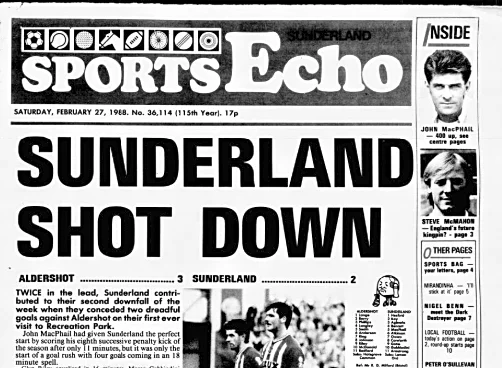
On the back page of the Echo on the day the lads played Aldershot was the story of a prospective new signing – Smith wanted to land Fulham’s striker Leroy Rosenior (father of current Chelsea boss Liam).
Twenty three year old Leroy had scored 19 division three goals already this season, and Smith had offered a sizeable fee plus Keith Bertschin in part exchange – however top flight Watford were said to have beaten Sunderland’s offer. The manager was keen to offload Bertschin, who a year after signing for the club hadn’t moved to the north east.
Smith was also fielding accusations that, after the 4-0 reverse in the West Country, the Sunderland players had wrecked the away dressing room.
These are very serious accusations which I take great exception to.
A suspended ceiling came toppling down and we were very fortunate indeed that only Reuben Agboola received grazes to his body.
I will be discussing the matter with my board of directors next week, when I expect we release an official statement.
On the field, things didn’t get much better down at Aldershot, with the lads going down 3-2 – the winning goal scored by ex Sunderland player Steve Berry.
Clive Lee had got his wish – John Cornforth was given a start in the centre of midfield, replacing the suspended Steve Doyle after his red card at Fulham, while Marco Gabbiadini returned to the team in place of Bertschin.

And, Sunderland were twice in the lead as they looked to bounce back from the midweek horror show. First of all, John MacPhail had converted from the spot for the eighth successive time after Gates’ shot had been handled by defender Colin Smith in the 11th minute – and almost immediately, Sunderland should have been two up, when Gabbiadini, through on goal, shot straight at keeper Tony Lange.
Sunderland’s fragile confidence showed, though, and on 16 minutes Aldershot were level, Glyn Riley firing into the roof the net from close range after a corner reached him unmarked at the back post.
Shortly afterwards, though, the lads were ahead again, Gabbiadini stealing possession as Tommy Langley dithered, and firing into the goal from a tight angle.
The teams were trading blow for blow, however, and almost immediately Aldershot were level again. Hesford had made an excllent save and captain Gary Bennett made an acrobatic clearance as the rest of the Sunderland defence stood flat footed – however Langley, who’d conceded possession for Gabbiadini’s goal moments earlier – fired towards goal, the linesman flagging the ball had just crossed the line.
Less than 30 minutes gone, and the game was 2-2 – and unsurprisingly both teams had opportunities to score again before the break. Berry flashed a shot wide for the home team, while Gabbiadini went close to a second, and Owers headed wide when it was easier to score.
Just after the bream though, Aldershot took the lead – and it was Steve Berry, who hadn’t enjoyed the best of times at Roker, who scored with a drive from the edge of the box that beat Hesford all the way.
For the rest of the second half, Sunderland had a lot of possession but failed to make a breakthrough – the final ball often letting the side down. Owers forced a good save from Lange with a well struck shot after a corner was cleared, but the breakthrough wasn’t forthcoming. Whether tiredness played its part after illness and three tough games in seven days, who’s to say. Maybe that was a convenient excuse.
But Sunderland dropped down to second, and what looked like a certain promotion a couple of months ago seemed an increasingly uncertain proposition.