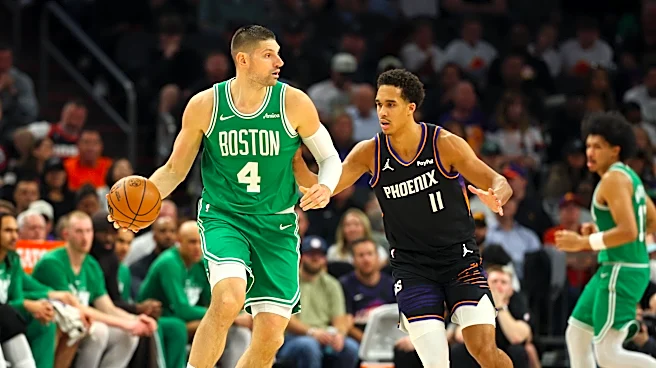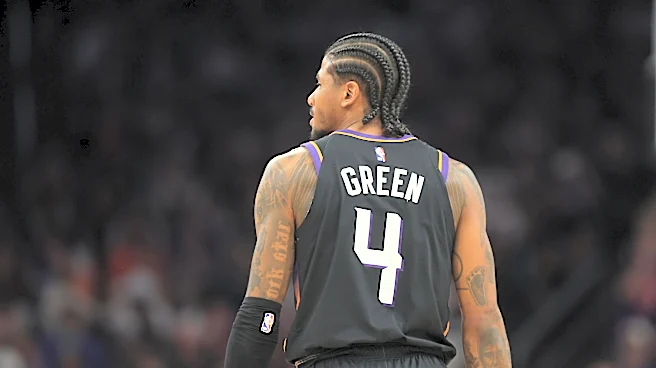






I was never a fan of the Jalen Green trade, and this past season illustrated the problems I anticipated. The Suns were exceeding all expectations while Green was out with injury, but then fell to earth when he returned. If it felt like they were worse after he came back, you’d be right. The team was 17-15 (.531) when he didn’t play, and 28-22 (.560) when he did. When you consider Booker’s injuries, the Suns were 24-13 (.648) when Booker played, and Jalen Green didn’t.
To put it in perspective: taking
Jalen Green out of the picture, and a little better health by Booker, could have put the Suns in a position to compete for the 4th seed in the West. This would have given them a real shot at making the second round instead of getting splattered by the Thunder in a four-game sweep.
On the surface, this doesn’t seem to make much sense: why would the Suns be worse with their second or third-best player on the court? The short answer is that when he’s on the court, it forces the Suns to play lineups that are very sub-optimal. When he’s sitting on the bench, that’s $36.3 million in wasted salary. This puts the Suns in a position where there is no good answer other than to move him for a player who can play as a power forward.
Thinking through the lineup permutations, if the Suns play a lineup of Booker and Green in the backcourt, plus a “normal” frontcourt rotation with a small forward (Brooks) and a power forward, then they don’t have a true point guard running the offense, and Booker is being used sub-optimally. Booker’s best play has always been next to a point guard, whether Rubio, Chris Paul, or Collin Gillespie.
If the Suns play Gillespie, Green, and Booker, it puts Booker at small forward (he’s not a small forward) and then forces the Suns to either play Brooks at power forward (where he’s outmatched size-wise) or sit him (which puts your second or third best player on the bench). Again, this forces the Suns to either play people out of position or put their best players on the bench.
You theoretically could put Green on the bench as a super-Sixth Man, but that’s $36.3 million in salary coming off the pine, while the Suns also have great guards competing for those same bench minutes in Jordan Goodwin and Grayson Allen. Both of whom have far smaller salaries, meaning that the Suns spend less money (and less salary cap) on them when they’re sitting on the bench. When Green is on the bench, he has the same on-court value as Bradley Beal’s cap space dead money. This is just another form of inefficiency.
When you dive further into the statistics, you see the same observations playing out.
The table below shows the net +/- per 48 differential for all the main Suns players at the end of the season. What jumps out is how middling Green’s effect on the court was, and how playing a real power forward, even a journeyman like Isaiah Livers, improved the team immensely compared to throwing small forwards like Brooks, Dunn, or O’Neale at the problem. Note that the Suns’ small forwards all played significant minutes at power forward, and all had negative differentials in part due to playing out of position.
Again, the solution to the problem is blindingly obvious: trade Green for a decent power forward, and you end up with a balanced rotation, while taking minutes away from the player who’s become the “pigeon” on defense (O’Neale), and probably should never have been playing power forward in the first place.
When you look at net ratings for various lineups on the Suns, you see the same pattern emerging. Lineups with Booker and Gillespie had a +7.0 net rating, and Booker/Green was a +4.1. Interestingly, Gillespie/Fleming lineups had a +8.7 rating, and Booker/Fleming lineups were a +10.4. The conclusion that satisfies Occam’s Razor here is that the Suns are best when playing a balanced lineup, and that Jalen Green’s presence on the roster directly interferes with this necessity.
This is not calling Green a bad player (though his shooting efficiency is pretty lackluster) or a bad teammate. It’s simply to say that he’s a bad fit because he only plays one position, and it’s the same position as the Suns’ best player (Booker). With Green on the roster, the Suns are faced with the choice between playing lineups with a relatively low ceiling (a little over .500 winning percentage) or sitting their second-best player and his $36.3 million salary.
Note that the Suns had the worst point differntial of any team in the NBA after Jalen Green came back from injury as well.

We all know that the “Moneyball” era of the NBA is here: like layups and three pointers as the only shots teams want to take. Every little advantage is crucial. Winning is all about maximizing the efficiency of your shots, your possessions, your lineups, cap space, and anywhere else that contributes to winning. There is no conceivable way to maximize the value of Jalen Green while he’s on the same team as Devin Booker. This inefficiency and wasted cap space on a player that doesn’t help on the court dooms the Suns to mediocrity until he or Booker is gone.
Suns fans were howling for Jordan Ott to give Rasheer Fleming some playing time in the playoffs as OKC mercilessly exploited the Suns’ lack of size. However, the reason Fleming didn’t get any was due to the conundrum created by Green’s presence on the roster. His presence makes even less sense than that when John Gambodoro is saying the Suns’ top two priorities this offseason are re-signing Gillespie and Goodwin.
If the Suns want to take the next step to being a team competing for home court advantage in the playoffs, rather than just a play-in team that gets unceremoniously annihilated in the first round, they must move Jalen Green elsewhere, preferably for a power forward. The logic is inescapable, and the quantitative evidence backs up the eye test.