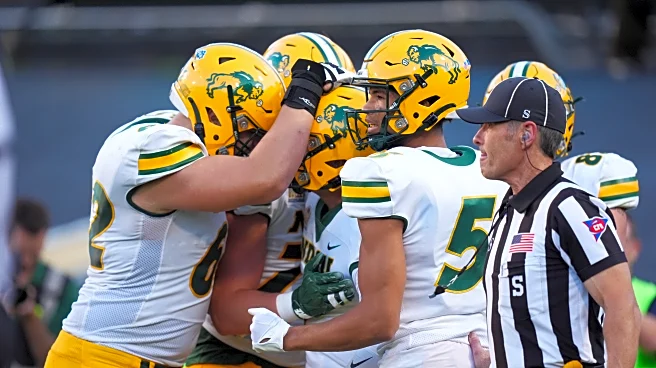


The sun is dawning on a new era in the FCS, one that will look drastically different simply because one team will no longer be around. At long last, after years of clamoring from every fanbase (even their own) to leave, it has finally happened. North Dakota State is gone. The Bison are on the fast track to the FBS and the Mountain West but only do so after dominating the subdivision for the last 15 years. Winners of ten national championships, countless playoff games and more hardware that can fit
into any one trophy case, NDSU is leaving. Them doing so changes the very fabric of what we’ve come to know about FCS football.
What exactly will that mean moving forward?
Beginning with a more localized look into their previous conference, there might not be the complete 180 power shift that many expect and that is because the Bison’s longtime rival is still around. South Dakota State, despite a down year last year, still looms large and should be an immediate contender to win a bulk of the league titles in the years to come. The Jacks have built a program modeled largely around what NDSU did and, because of that, have made themselves a perennial top-tier FCS unit. It’s not a stretch to imagine that they will be near or at the top of the MVFC essentially every season.
Other squads, however, should reap some of the benefits as well. Youngstown State, for instance, returns Walter Payton Award winning quarterback Beau Brungard this season and should be right in the mix too. North Dakota and South Dakota, both playoff teams from a year ago also, have brighter paths to the top of the league now as well. Then there’s Illinois State… the team that actually knocked NDSU from its lofty perch last winter… and made an improbable run to the big game. The Redbirds have an argument to be right there as well. No more trips to Fargo for all these teams means more parity for the conference and its remaining members. If anything the race for a league title should actually be tighter now.
Expanding it out the national scale, the big question that immediately comes to mind is who will take over the mantle as the team to beat year in and year out? As of right now, it seems like the answer is overwhelmingly Montana State. While others like the aforementioned SDSU and Montana still loom large in that upper echelon, the Bobcats look to be clear favorites to run things at least for the immediate future. MSU returns practically all of its key players from its national championship run last season and really the only team that’s been able to consistently thwart them in recent years has been North Dakota State. With that hurdle now gone, it’s safe to imagine that Brent Vigen and company could hold the crown for a while.
Where things really get interesting, though, will be for the teams at that tier right below. The Tarleton States and UC Davis of the world suddenly see realistic paths to host more playoff games. It was almost always a forgone conclusion come December that one side of the postseason bracket would run right through the Fargodome because NDSU almost always claimed the #1 or #2 seed. Someone like Montana State, Montana or South Dakota State usually claimed the other. Now, though, the possibility of someone else making a run to homefield advantage is greater.
The playoffs as a whole should, in many ways, be a lot more exciting to the average fan. Last year when Illinois State shockingly bounced the Bison in the second round, the bracket opened wide up on that side. Villanova ended up hosting the semifinals for the first time in a decade and a half because of it and the Redbirds made their first appearance in the national championship in ten years. Things like that will likely become a lot more commonplace with North Dakota State no longer in the picture and that is inherently a good thing as far as viewership is concerned.
The one real drawback of the Bison departure, however, is that the FCS has unquestionably gotten weaker in terms of overall talent at the top. NDSU was the bluest of bluebloods and take with them one of the richest histories the subdivision has ever seen. It is a big blow in a long line of them that has seen others like James Madison, Appalachian State and Georgia Southern all leave for the FBS. It’s a trend that in some ways is troubling for the overall health of that level of Division I football and it begs the question, how long until other powers like the Montana schools and South Dakota State follow suit?
Right now there are a lot of unknowns of what this sans-Bison era of the FCS will bring but some things are for sure. Some new teams will be on our TV screens late in the year and no longer will squads have to worry about the big bad bullies in Fargo hoisting more trophies at the end. Whether or not it is an overall positive or negative can (and will be) debated at length. As for now, though, the FCS and its fans embark on a new future that feels quite a bit more open than it has in a long, long time.