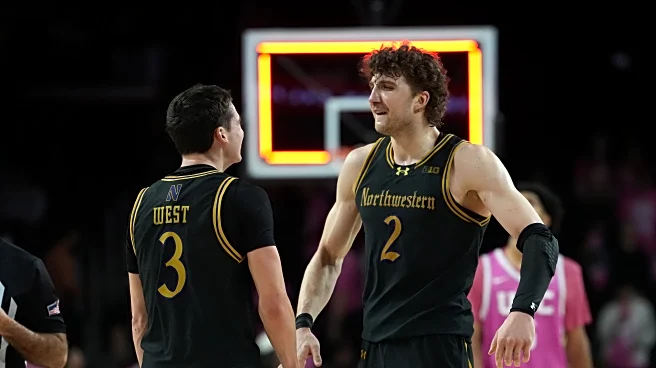

Northwestern (9-11, 1-8 B1G) is tied for second to last in the Big Ten. However, after picking up its first conference win of the season out west against USC, the ’Cats will have a major opportunity against Penn
State (9-11, 0-9 B1G) — who sits last place in the Big Ten — to channel their west coast momentum into another win.
Here are three keys to victory for Northwestern against the Nittany Lions:
Get the ball inside
Against Penn State, the most favorable offensive one-on-one matchups will come inside for Northwestern. The ‘Cats bigs are their most capable isolation scorers, while the Nittany Lions’ bigs are some of their worst defenders.
On the Northwestern side of the ball, need I even say the obvious? Nick Martinelli is one of the best scorers in college basketball. Averaging a whopping 23.4 points per game, the senior is first in the Big Ten in points per game, and fourth in all of college basketball. A lot of Martinelli’s points come in isolated high post situations. He’ll catch the ball on an elbow, get to his left hand with a spin move and finish with a hook shot; with his long arms and sneaky physicality, it’s unguardable. On top of that action, Martinelli is extremely scrappy moving without the basketball, positioning himself for passes in the post or second-chance opportunities off the glass. If you’re guarding Martinelli, you have to be locked on him for the entire possession.
Despite the criticism he gets for other aspects of his game, Arrinten Page is also a premier isolation scorer. Page has a splashy midrange jump shot that allows him to bait defenders with a lengthy jab step and get to the basket. With his jab, Page is consistently able to get a step in isolated post opportunities, though he sometimes struggles with decision-making against when help comes defensively.
Both of Penn State’s primary post defenders are vulnerable. Of players that have played at least 500 possessions for the Nittany Lions this season, Penn State’s starting forwards Josh Reed and Ivan Juric are ranked fifth and seventh, respectively, of seven qualifying players.
Reed and Juric aren’t physical enough, or fast enough, to keep up with Page and Martinelli in the post. The ‘Cats should look to attack these mismatches, getting Page and Martinelli high-post opportunities often. Out of these sets, Northwestern’s forwards can get downhill, or find open shooters after forcing defensive help.
Splash some threes
Penn State cannot defend the perimeter. The Nittany Lions rank dead last in the Big Ten in opponent threes made per game and opponent three-point percentage, allowing an average of 9.8 made threes per game on 36.9% three-point shooting.
The problem for the Nittany Lions on the perimeter is two-fold: they’re too slow AND they don’t rotate well defensively.
Check out this play from its 71-60 loss against UCLA:
Trent Perry, one of UCLA’s quicker guards, is dribbling the ball at the top of the key. When the Tyler Bilodeau ball screens comes, Reed, the Nittany Lions forward, stunts Perry as he comes around the screen, working together with Dominick Steward on a double-team. However, the only reason Penn State feels the need to stunt Perry is because it knows that neither Reed nor Stewart have the speed to defend Perry if he uses separation from the screen to drive to the basket.
However, slower teams can defend the perimeter if they’re smart rotationally. On this play, and a lot of the time, Penn State is not.
Seeing the Reed-Stewart double-team on Perry, Bilodeau slips his screen and pops open on the right wing for a three. Knowing the plan is to stunt double Perry off on-ball screens, Juric, the ball side post-defender, has to be ready to rotate and defend Bilodeau whether he rolls to the basket or pops out to the perimeter off of his screen. Instead, Juric is late rotationally, and Bilodeau, one of the Big Ten’s best three-point shooters, makes him pay.
Though Northwestern is not a great three-point shooting team, against Penn State, its shooters have to be ready for open looks on the perimeter off of rotational mishaps from the Nittany Lions. Penn State will either choose to switch ball-screens or flash double teams; the ‘Cats will have open looks from outside all night long. Expect Chris Collins to have his shooters ready to get hot.
Don’t let Eli Rice get hot
Statistically, Kayden Mingo and Freddie Dilione V have been Penn State’s best scorers this season. However, it’s been Eli Rice lately. The Nittany Lions’ streaky, southpaw spot-up shooter has been the team’s most dangerous threat.
After averaging just 5.7 points per game in the first month and a half of the season, Rice turned the corner after draining five threes in the Lions’ 90-67 win over North Carolina Central. From that game onwards, Rice has averaged 12.1 points per game on 43.5% three-point shooting.
The sophomore from Tennessee is a hot and cold player, however. Last Thursday he barely saw the floor, scoring just three points in twelve minutes. Yet, he bounced back on Monday with his best game of the season, turning in a career high of 20 points against Ohio State on 6-of-11 perimeter splits. Depending on how you look at it, Rice’s streaky shooting can make him even more scary.
For Collins and the ‘Cats, it will be critical to keep Rice off the perimeter. Rice is a pure spot-up shooter, so Northwestern should feel okay about guarding him tight and forcing him to play inside the arc. This Nittany Lions offense is not an explosive one, but when Rice gets hot, the floor opens up. Don’t let the lefty get hot.