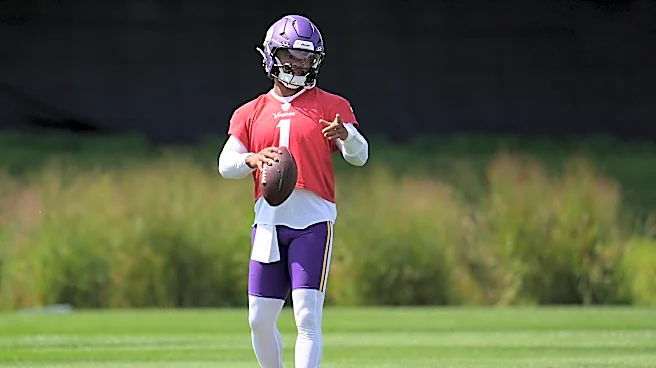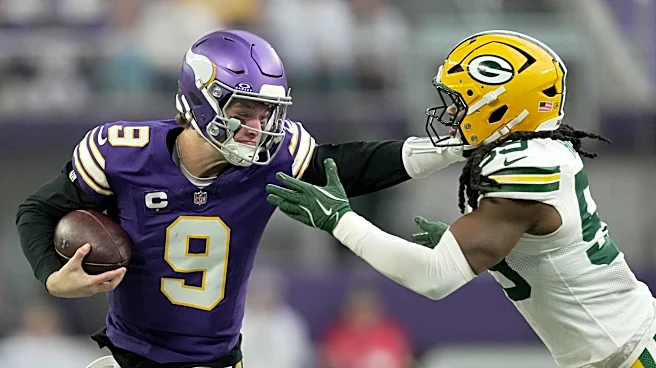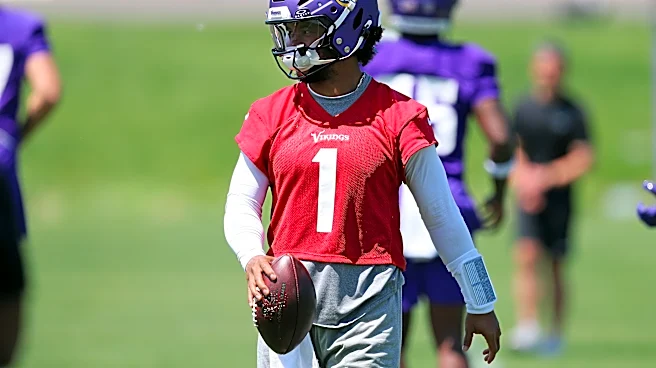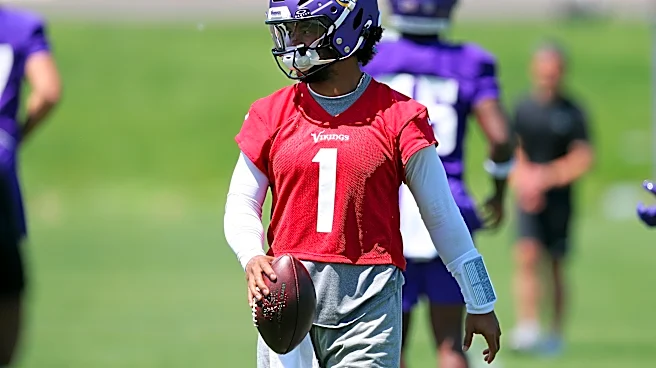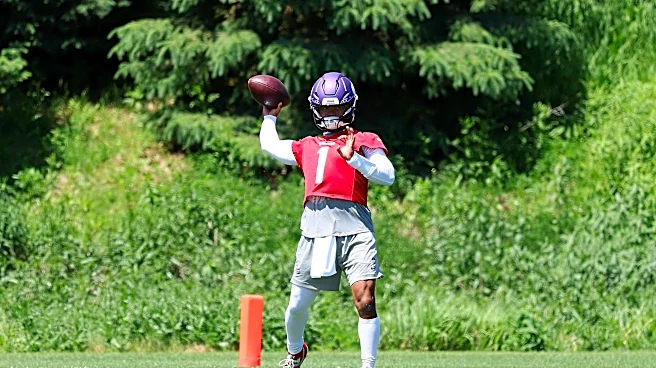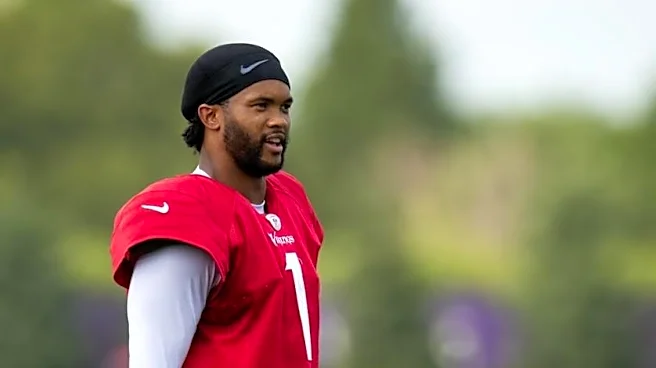



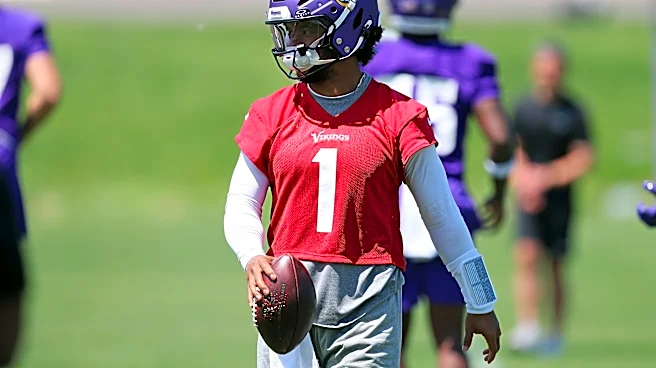
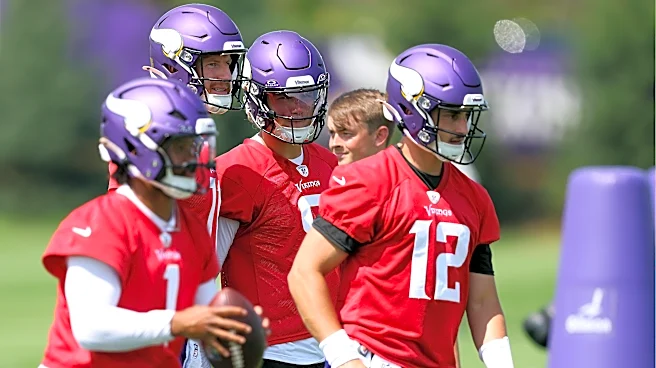
The Minnesota Vikings have named Kyler Murray as their starting quarterback this season, as widely expected, ending the competition with J.J. McCarthy after two weeks of training camp. From the beginning, many/most were skeptical about the competition, figuring Murray would eventually be named the winner. And from Kevin O’Connell’s comments before the night practice on Sunday, indicating that the timeframe to make a decision on the starting quarterback had not changed, it appears that naming a starter
after the night practice was the original plan. But now that the decision has been made, let’s look at again at Kyler Murray as the Vikings’ starting quarterback, look back at the rationale and merits of the quarterback competition, and what may be next for J.J. McCarthy.
Let’s begin with a review of the quarterback competition.
Critiquing the Quarterback Competition
From the moment the Vikings signed Kyler Murray, there seemed to be little doubt that he would be the starting quarterback this season. The reason was straightforward enough- Kyler Murray has the better track record as a starter when it comes to accuracy and just about every quarterback metric and has also demonstrated the minimum required skillset to be a quality starter in the NFL: processing ability, accuracy, poise in the pocket, and proper mechanics. J.J. McCarthy is still developing those fundamentals.
More than anybody, Kevin O’Connell understood where each quarterback was at with their skillsets, but still he chose to have a competition rather than simply naming Kyler Murray the starting quarterback shortly after he was signed. So what was the rationale for doing so? What was he hoping to gain?
Part of the rationale for having a competition was simply out of respect for J.J. McCarthy. When you have an incumbent starter on the roster, it is respectful to allow that player to compete for the starting job with any new acquisitions or others on the roster that have earned the right. Handing the starting job to Murray without any competition may have been seen as an indictment of his ability and potential growth since last season. Another reason for the competition may have been to give some motivation to McCarthy that may help accelerate his development. After all, he did not compete for the starting job in either his rookie or second season. Darnold was the presumed starter from the get-go his rookie year, and McCarthy was in his second year. The competition might also help Kyler Murray sharpen his tools, while also giving O’Connell the chance to see how well/quickly he learns the scheme before naming him the starter.
The downside to having a competition is having the eventual starter- Murray- receive fewer reps in the offseason program and fewer first-team reps in training camp. Given the shorter training camps and offseason program compared to years ago, each rep in practice has become increasingly valuable in helping a new quarterback learn the scheme and develop rapport with his teammates, especially his receivers. O’Connell seemed to hedge against that downside by gradually shifting more of the first team reps to Murray during the first two weeks of training camp and maintaining his two-week deadline to name Murray the starter and give him all the first team reps going forward. Continuing the competition much beyond that would begin to compromise Murray’s ability to develop the rapport with the first team needed to be effective by the start of the regular season.
All that led many to suspect that the competition wasn’t fair- it had a preordained result- and that McCarthy never really had much of a chance at winning the competition. And looking back on it now, that pretty clearly was the case. But compared to the alternative- no competition at all- this was perhaps the best solution considering the needs of McCarthy, Murray, and the team.
In terms of gains from the quarterback competition, I’m not sure there was anything significant. McCarthy seemed very much like he was last year, so the competition factor didn’t appear to have the desired effect on him. Nor did it have much of a discernable effect on Murray either. He said early on in a press conference that he wasn’t really worried about the competition and was more focused on learning the offense. And so to the extent he had reduced reps the competition didn’t really help him.
So, if that was indeed the case, it didn’t seem like the competition did much other than perhaps cushioning the blow a bit for McCarthy, which may be perceived positively in some ways by both McCarthy and the team. That isn’t nothing. In his first press conference since Murray was named the starter, McCarthy seemed to accept it gracefully and expressed his desire to remain with the Vikings and do whatever he can to help the QB room, team, and organization.
What’s Next for Kyler Murray
For both Kyler Murray and Kevin O’Connell, the bet in his signing with the Vikings is for Murray to be the next reclamation project after Sam Darnold. If Murray is able to deliver on that wager, with 2024 Darnold-like performance metrics or better, it’s unlikely the Vikings will let him walk like they did Darnold. It’s clear that O’Connell has better luck whispering to veterans than he does young and developing quarterbacks, so it’s unlikely he would stand in the way of extending Murray. New Vikings GM Nolan Teasley will also have a significant say in the matter, but he came into the league making two Super Bowl runs with a mobile quarterback that was too short in Russell Wilson so it wouldn’t be surprising if he was willing to sign off on extending Murray if he has a good season. At what price tag will be a question but it looks like the Vikings have built in room in their salary cap for a possible Murray extension.
But more immediately, Murray needs to continue the path to learning the offense and developing rapport with his teammates and receivers. There have been plenty of growing pains over the course of the offseason program and training camp for Murray, as he’s worked through miscommunications, bad snaps, interceptions, and lack of timing/rapport with receivers at times- all while also battling a mostly dominant Brian Flores defense. It hasn’t all been bad by any means- he’s delivered some high-level throws as well- and his results aren’t much different than they were with Kirk Cousins and Sam Darnold before him as they too struggled with all of the above in 2023 and 2024, especially early in training camp. So panic is premature at this point. There is a month until the first regular season game and that is a lot of time for Murray to improve across the board. His first practices since being named the starter have been encouraging.
And what kind of a season Murray will have, and how well he’ll fit in O’Connell’s scheme, will continue to be a subject of debate. At this point in 2024 expectations for Sam Darnold were low. He was expected to be a mediocre bridge quarterback until McCarthy was ready, probably in 2025 but maybe sooner. All those expectations proved to be wrong.
For Murray, expectations are higher- in part because of the success of Darnold with the Vikings in 2024. There is also the fact that the Vikings won nine games last season with bottom-of-the-league quarterback performance. Murray simply being average may result in double-digit wins and a return to the playoffs. There is also the fact that Murray’s performance in the two seasons prior to joining the Vikings was much better than Darnold’s was, and in Murray’s last full season (2024) he basically equaled Darnold’s performance with the Vikings that year by most metrics:
Overall PFF Grade Murray: 82.1. Darnold: 80.7
PFF Passing Grade Murray: 77.9. Darnold: 77.5
Adjusted Completion % Murray: 75.9%. Darnold: 76.5%
Adjusted EPA/Play Murray: 0.161. Darnold: 0.151
EPA/Play Murray: 0.150. Darnold: 0.127
Success Rate Murray: 51.3%. Darnold: 50.9%
Completion % Murray: 71.4%. Darnold: 70.2%
Completion % Over Expectation (CPOE) Murray: 2.1%. Darnold: 3.9%.
CPOE+EPA Composite Murray: 0.116. Darnold: 0.121
PFF Big-Time Throw % Murray: 4.7%. Darnold: 5.4%
PFF Turnover-Worthy Play % Murray: 2.4%. Darnold: 3.7%
Yards Per Attempt Murray: 7.1. Darnold: 7.8
Average Depth of Target Murray: 7.4. Darnold: 9.3
Murray played with an inferior Arizona team in 2024 compared to what Darnold had with the Vikings that year and faced more unfavorable game situations in almost every game, not to mention a weaker supporting cast. 2024 wasn’t Murray’s best season either.
But the debate about talent vs. environment will only be settled in Murray’s case by his performance on the field this season. Whether Murray’s struggles were intractable flaws in his game or more of a by-product of a poor organization and team around him in Arizona will be viewed from the perspective of his performance with the Vikings this season. There isn’t much doubt that the Arizona Cardinals were something of a dumpster fire throughout Murray’s tenure there and that the team Murray will be quarterbacking this year is better than any team he had in his seven seasons with the Cardinals.
What’s Next for J.J. McCarthy
It’s been a tough run for J.J. McCarthy’s pro career so far. It’s clear now that McCarthy was the Vikings’ second-choice in the 2024 draft after Drake Maye. And after Sam Darnold’s performance in 2024, he was no longer essential to the team having a QBOTF. But despite all that, the Vikings stuck with McCarthy in 2025 and in all likelihood it cost them the division title and a playoff run compared to if they extended Sam Darnold on a medium deal and dealt McCarthy to the highest bidder. At that point he may have yielded a Day Two draft pick. The Vikings were forced to look for alternatives to McCarthy for this season after McCarthy’s league-bottom performance last season and were lucky to land at least an average starting quarterback in Kyler Murray without using any draft capital and for the veteran minimum.
And now that Kyler Murray has officially been named the starter, that leaves McCarthy competing for a backup job with Carson Wentz while trying to develop the necessary skillset to be a quality starter, in year three of his rookie contract. There is zero chance his fifth-year option will be exercised and next year is the last of his rookie contract.
The going trade rate for a quarterback with league-bottom metrics and who has been fully healthy for (apparently) even fewer than the ten games he started out of the 34 possible isn’t much, particularly with a $6 million cap hit this year and a $7 million cap hit next year- which is high for a backup quarterback with those results. Still, at age 23 there may be some interest out there for McCarthy as a backup, hoping a change of scenery may aid his development. I’m guessing a late day three pick would be the best that could be hoped for at this point.
But whether to trade McCarthy or not will be up to Nolan Teasley. There isn’t much incentive to trade him at this point from a draft capital standpoint but trading him would save the Vikings around $7 million in cap space between this season and next. I suspect Kevin O’Connell would be at least as comfortable with Carson Wentz as the primary backup as McCarthy. But ultimately the decision to trade him or not may be centered around what they think his development trajectory will be over the next two years. But it seems doubtful at best that Kevin O’Connell will choose McCarthy as his starting quarterback next year without his having shown significant improvement in regular season games, and he may not have the opportunity to play in any this season.
McCarthy, for his part, said he wants to remain with the Vikings and do what he can to help the team, that he likes the organization, state and fan base.
In the meantime, McCarthy will be shown in preseason games, which may attract trade interest as the rest of the league evaluates their quarterback rooms.
Follow me on X/Bluesky @wludford