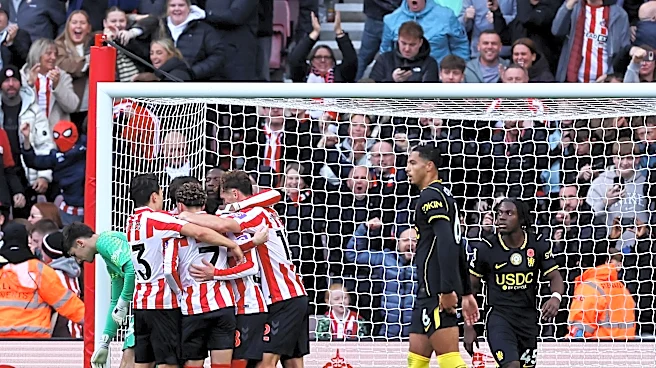





I’ve had few moments of relief like that when the full-time whistle blew at the Stadium of Light last weekend.
Of course, the wins against the Mags have brought elation, last season’s draw against the eventual champions gave me immense pride, and plenty of results last season brought great happiness. As my nail-biting was allowed to stop and I was able to digest the game, it became clearer why.
No Sunderland fan is unfamiliar with a relegation battle, or even a drastic turn in fortune between seasons.
The contrast between the success and overwhelming highs Régis Le Bris has brought and this season’s performances has left me equal parts frustrated and upset. I had almost reached the point of apathy before the Chelsea result, not because I don’t care, but because I was slowly coming to the conclusion that perhaps Le Bris had run his race on Wearside.
That’s not exactly something I was ready to process yet, having done my best to avoid the uncomfortable conversations going on around me. As the team sheets rolled out and the group chats lit up, there appeared to be some common questions:
“What has Ahoka got to do to start?”
“Hume at right wing again?”
“Why can’t he get out of his own way?”

Well, what a difference a couple of hours can make. As it turns out, Régis knows what he is doing; I’m not ashamed to say I was left with egg on my face. Questions still remain, but, as a victory can often do, they are now of a different nature, or at the very least, with a different framing.
“How much has this season been down to Xhaka?”
“Hume on the wing, maybe not what we want, but is he what the side needs now?”
“That felt like last season. What changed? And what was he trying to do before today?”
Let me stress, I don’t know better than Le Bris. I do enjoy trying to get inside his head, though, so let’s try to figure out what happened against Chelsea.
TraiJa Vu: Why Did That Feel So Familiar?
It took all of ten minutes for Le Bris’ set-up against Chelsea to replay the greatest hits of last term. The side felt more defensively organised and combative and, notably, abandoned playing out from the back. The more direct build-up style went a long way towards avoiding so many of the costly mistakes made this season.

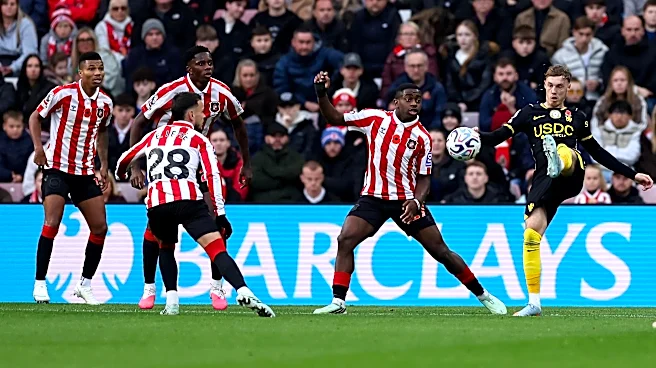
Against Chelsea, the defensive line was notably deeper, with both full-backs clearly instructed to remain deeper. Le Fée (#28) was notably more conservatively positioned than in previous outings, firming up what was almost a 4-5-1 when out of possession. In the first game of the season against Ipswich (centre), you see a far more structured team than the one you see against Brighton (left).
Somewhere between the start of the season and last weekend, the side had lost its structure and, arguably, its identity. It certainly appears that against Chelsea there was a clear game plan to sit deeper, be disciplined in our shape and back ourselves against Chelsea’s attack.
Shape is only one side of this. Despite operating with a low block, Sunderland also provided significantly more threat than had been shown so far this season.
When looking at what the Black Cats did with the ball, you again see a clear decision by Le Bris. Against a side who look to press us, we opted for a more duel-heavy approach, backing ourselves in one-on-one duels against a side who would much prefer to control the game systematically.
You can look at the obvious example of this, which is Brian Brobbey, but the whole side felt like they were up for a battle against Chelsea. Sadiki was much improved with his ground coverage and defensive screening. Reinildo was at his intelligent best, timing his interventions against Palmer, Neto and Estêvão brilliantly.
That balance between a conservative defensive shape and a physical offensive mindset was excellently found by Le Bris. There’s a phrase in boxing: “You fight a boxer, and you box a fighter.” Régis Le Bris went for the former of those approaches, and it paid off.
Aside from the win against Fulham, it is my opinion that we’ve looked our best in the defeats against Manchester City and Arsenal. I don’t think this is any coincidence. In those games, you have to accept that you will largely have to surrender control of the game. Remaining defensively responsible and taking your chances when they arise is the best course of action; trying to impose a style of play on these sides will more than likely ensure you come out second in that contest.
What remains to be seen is whether Le Bris reserves this plan for the bigger sides or whether this is a shift in approach for Sunderland.
Regardless of whether this style is something that the side can rally behind, there was a larger point here. Playing that defensive system, with that rigid shape, can only be done successfully if there is buy-in and commitment from the players to stick to those principles.
You can look at the average player positions and see that Régis clearly had the players on his side.
As we all know, a game of football has its ebbs and flows. One thing I was impressed by was the impact of our substitutions. Whilst the contributions of Isidor, Angulo and Rigg were somewhat limited, I’d like to highlight how they were used as a medium for Le Bris to carry his message onto the field.

This is perhaps 15 seconds after Chris Rigg and Angulo were brought onto the pitch, after Talbi has taken a speculative shot from outside the area. Rigg has come onto the pitch relaying messages, and look at how the side is lined up in a clear 4-4-2 shape. From a frantic transitional piece of play, Le Bris has reorganised his side in seconds by relying on his players to pass on his messages.
Rigg and Angulo’s substitutions indicate that Le Bris’ messages are not only being clearly relayed to the squad, but that the players are immediately listening to them. After the Zagreb game, Noah Sadiki said: “I don’t think the gaffer is the problem. We are making the mistakes. He’s not making the mistakes.”
Without evidence, these words are lip service. Le Bris still has the backing of the dressing room, and the value of that can’t be understated.
Trai Hume: Utility-Man or Necessary Evil
I’m not sure Sunderland have replaced Patrick Roberts yet. When Chemsdine Talbi joined, we assumed he would be utilised on the right. Jocelin Ta Bi is yet to be given a run of games in the Premier League after his injury last season, and we’ve not recruited a true out-and-out right winger since the Ivorian’s transfer in January.
Le Bris has settled on using either Hume or Meunier as the furthest-forward player on the right and, whilst it’s not exactly sexy, it has its benefits.
Whilst Morgan Rogers left the North East with little to show for his over-inflated price tag, his direct dribbling kept Meunier honest. Having Hume drop into the right-back position allowed Meunier to double up on Rogers from an inside position. On the opposite flank, when Meunier knew the Northern Irish international was slotting into the back line, it allowed the defence to shift when Palmer and Neto looked to link up on the right flank.
I can clearly see the benefits. Trai is someone you can entirely rely on to cover the amount of ground that enables him to solidify the defence whilst providing an outlet going forward. Where his tackling can be rash at times, he is clearly trusted to be disciplined and help support the back line when needed. Furthermore, if we’re looking for a more direct, duel-focused approach, you would probably back Hume in a physical battle over Ta Bi or Talbi.

What it does do is hamper our attacking output. His early shot would have been more favourable to a left-footed right winger like Ta Bi or Matías Soulé, who we were heavily linked with this summer. His dribbling ability is somewhat limited, meaning full-backs defending him are less likely to require their winger to support them, leaving them able to counter if Sunderland lose possession. Moreover, whilst it’s by no means terrible, I feel like his final ball could be improved by a player who has traditionally been more attack-minded.
Régis has seen enough of Hume at right wing for him to be a known quantity in that position. Should the Frenchman want to be brave, he could invert his logic and see if the end result is improved. Where you can play a defender and ask him to attack when able, could you play an attacker and ask him to remain more defensively responsible than he would typically be?
In the latter case, whoever is at right-back could still have their opposition winger doubled up on, whilst going forward you could gain more of a dribbling and penetrative threat.
It is not a criticism of Hume to say his deployment on the wing provides a firm foundation without significant offensive returns, but we know this story now. I’d be interested to see if Le Bris could try an alternative.
Ahoka: A Great Headache to Have
Jules Ahoka will be the first player Sunderland sell for more than £60 million. Not to tout around what is an incredibly exciting talent just as he’s arrived, but he appears to be very special. His decision-making and confidence show a maturity far beyond his years, and whilst at times he can be found wanting in positional discipline, he has the physicality to get himself out of trouble.
Whilst the early signs have been fantastic, it is always important to stress that a young player’s progression is rarely linear. You can take a look at the likes of Jadon Sancho, Jack Wilshere or Dele Alli to understand this. For every Lamine Yamal or Kylian Mbappé, there are so many others whose potential can appear wasted due to a bad move, injuries or personal issues.
This can also be applied closer to home. Looking at the trio of African central midfielders we have at the club, Habib Diarra was perhaps the most highly regarded at the time of their arrival. Having been injured for roughly half of the games he’s been available for, the Senegalese midfielder could find himself on the fringes of Ghisolfi’s squad planning by the end of the season.

And really, I think that is the point to be made about Jules Ahoka, more so than Noah Sadiki, given he had only four senior appearances under his belt before moving to Wearside. Whilst his ability is shining incredibly brightly currently, it could so easily dim or flicker.
With Xhaka’s injury, he now has his opportunity to solidify himself as a starter. But upon the Swiss captain’s return, Régis Le Bris has a difficult decision to make. Xhaka’s passing metrics have still shone this season; however, I’ve been somewhat confused by some of his positional decisions. At 34, he still appears to want to press significantly high up the field. This often leaves him with a large amount of distance to recover, giving Noah Sadiki a significant amount of ground to cover.
Often, the eye test rarely lies, and Xhaka hasn’t looked like the player we saw last season. Whilst there have been a lot of unfounded rumours around his injury and his commitment to Sunderland, to me it just looks like he needs a rest, mentally and physically.
Only he will know the degree to which his head was turned in the summer. Combining that with a poor start to the season and the Covid revelations that came out, you can understand why his focus on the pitch may not have been crystal clear. I think that whilst he has some work to do in the recovery room, the time away from the pitch may help him as much as the ice baths.
Like it or not, the respect Xhaka has from the rest of the squad cannot be overstated. His experience and leadership have proven to galvanise the side, and whilst Nordi Mukiele, Luke O’Nien or Reinildo can provide commanding voices, the Swiss’ role as captain is key.
Really, this injury to Xhaka may have come at the best time for both him and Jules Ahoka. Ahoka certainly took his opportunity against Chelsea and was deservedly awarded man of the match. He will likely continue to start and be given more chances to shine as Xhaka returns to fitness. As Xhaka does that, he can reflect on the season so far, give his body a rest from international and domestic football, and recharge his batteries.
Jules Ahoka is Sunderland’s shiny new toy; Granit Xhaka is perhaps one that just needs a bit of a polish. I’d expect Xhaka to reclaim his position as a starter. I don’t think that is the worst thing for Ahoka either, given the small amount of senior football he has under his belt and how much he has left to learn. Personally, I wouldn’t mind seeing the pair operate together, as I’m sure Noah Sadiki wouldn’t complain about a break.
It is too early to say whether the win over Chelsea will prove to be a turning point in our season. It did, however, show that the tactics of last season can still bear fruit this term. Trai Hume’s utility to the side can’t be denied. I’d be interested to see if instructing a winger to remain defensively responsible could yield similar or better results. Jules Ahoka truly announced himself to the Premier League and has given Le Bris a fantastic headache to deal with.
I’m choosing to believe that the Chelsea result will prove to be a foundation for the rest of the season.