

Real Madrid’s meeting with PSV has brought the 1988 European Cup semi-final back into focus. Hugo Sánchez and Rafael Martín Vázquez have revisited the chances, frustration and lingering disappointment of that tie, while Frank Arnesen has offered the perspective of the team that advanced at their expense.
Today’s Madrid Daily also includes Toni Nadal’s account of Rafa’s connection to the club following his arrival on the board.
Hugo Sánchez: “It was our great opportunity to win one”
For Hugo Sánchez, the disappointment of Eindhoven remains tied to the belief
that his Real Madrid generation should have added a European Cup to its domestic success.
Speaking to MARCA, the former striker recalled the demands of the competition and the opportunity Madrid believed they had in 1988.
“Yes, I agree that it was the closest we came to reaching the European Cup final back then. Those were different times, with very difficult draws and a competition where only the national champions played. The difficulty was greater, I think, and sometimes it was all very unfair because the draw could get you the second leg away, with all the challenges those European stadiums faced back then.”
Sánchez also acknowledged that the identity of the opposition contributed to the sense of a missed opportunity.
“The memory isn’t pleasant, because we were very close to advancing and winning against a rival, like PSV, that wasn’t one of the toughest. I mean, it wasn’t a Bayern Munich, like the one we faced the previous season, 1986-87, in that same semi-final stage.”
He remembered the first leg at the Bernabéu as the point at which Madrid surrendered an advantage they could not recover.
“We were the favorites. We let victory slip away at home (1-1). I scored the penalty… and with the score at 1-0, and just a few minutes left, they equalized at the Bernabéu. That draw weakened us because of the away goals rule in the match in Holland.”
Van Breukelen and the chances that stayed with him
The return leg left Sánchez with particularly vivid memories of the opportunities Madrid created and the goalkeeper who stood in their way.
“We were very hurt by that day in Eindhoven, because, with the five consecutive Leagues that we won, it was an opportune moment to win that European Cup.”
His attempted bicycle kick remains central to that recollection.
“In the second leg, we had several chances. They were aiming for a 0-0 draw and played defensively, while we, on the other hand, played aggressively. Butragueño had one early on, but we couldn’t convert. I also remember the bicycle kick I attempted with five minutes remaining, which also failed to go in. Their goalkeeper, Van Breukelen, was the hero, saving that shot, which was very special to me. From that match on, he became a national hero in the Netherlands.”
Sánchez remains convinced that reaching the final would have changed the European legacy of that side. He also offered his own hypothetical assessment of what Madrid might have achieved under the modern competition format.
“If we had reached the final, I’m sure we would have won it, and even easily [it was against Benfica]. In fact, PSV won it. Just like Bayern (the runners-up), Steaua before them, and Milan in ’88-’89. We were the motivation and the springboard for our rivals. That’s why we have the bitter taste of not winning any, and the PSV final was the closest we came. It was our great opportunity to win one. And I’ll go even further: in those five years of league titles, with the current Champions League rules, we would have won at least three of the five European Cups.”
For Sánchez, the European Cup was the missing achievement in an otherwise decorated period.
“We missed that great opportunity to make history. We lacked that title to complete what was then Real Madrid’s second golden era after Di Stéfano’s. We won five league titles, two UEFA Cups (I only won one), and we could have made our mark with the European Cup, but it was sad not to.”
Asked about the atmosphere after the final whistle in Eindhoven, he recalled anger over the lack of added time and the confrontation that followed.
“It was a difficult time. The referee wasn’t complicit with them, but he didn’t give us any extra time, not even the five minutes we deserved. He barely added any stoppage time and was in a hurry to leave with the score at 0-0. Míchel, Buyo, and I went to complain to him, and I think Míchel was sent off, and then he was suspended for two or three matches because our protest was strong. There was a lot of anger and disappointment in the locker room. A great sadness, because winning that European Cup was the only thing we lacked in that generation.”
Sánchez to AS: “Perhaps there was overconfidence”
In a separate interview with AS, Sánchez returned to the same tie, acknowledging that Madrid’s progress through the earlier rounds may have encouraged them to underestimate the challenge ahead.
“It was a tie where we thought it would be an easier path after eliminating Napoli and Bayern Munich. We had won two UEFA Cups and saw the possibility of finally winning a European Cup after so many years of waiting. We were very motivated and the team was on a winning streak. But perhaps there was overconfidence. The elimination was very unpleasant.”
He again described the opening goal, the frustration of the return leg and the saves that have remained with him.
“The first leg started well with a penalty I won and converted, making it 1-0. But near the end of the match at the Bernabéu, they equalized, and that goal was a real blow. The away goals counted double, so it was hard to accept. The return leg in Eindhoven was on April 20th; I remember the date perfectly. A disappointing 0-0 draw despite creating numerous chances. Hans van Breukelen—I’ll never forget his name because he was so unusual—was the hero of the match and of all of the Netherlands. They celebrated as if they’d won the World Cup. The Dutch goalkeeper made some incredible saves. I remember one from Emilio and another bicycle kick from me five minutes from the end, and he somehow managed to stop it. It was a tremendous disappointment. Those of us with strong personalities, and there were several of us in that Real Madrid team, went to angrily confront the referee after the match, demanding to know why he hadn’t added a single minute of stoppage time despite all the time they’d wasted. Míchel and I were the most vocal, and then they sanctioned us.”
Sánchez also expanded on his pride in the team and his belief that its European record did not reflect its quality.
“The competition format penalized us cruelly. If it had been with the current system, we would have won three European Cups back then. That great generation, Real Madrid’s second golden era after Di Stéfano’s, deserved much more, and it’s not fair that they didn’t win a single European Cup. We were the Real Madrid of the Quinta del Buitre and the Quinta de los Machos, a nickname I coined, including the fitness coach Fernando Mata and the president himself, Ramón Mendoza. But my pride comes from having played for the best team in the world, the most decorated, and the most beloved and admired…”
Historical clarification: Linskens’ equaliser at the Bernabéu came in the first half. The subsequent 0-0 in Eindhoven left the tie level at 1-1 on aggregate, with PSV advancing under the away goals rule.
Arnesen: “We deserved to reach the final; it wasn’t luck”
AS also spoke to Frank Arnesen, whose memories come from the other side of the tie. For the former PSV midfielder, the semi-final formed part of a season that ended with the Dutch league, Dutch Cup and European Cup treble.
“It was fantastic to be part of that squad.”
Arnesen accepted Madrid’s status as favourites but stressed the qualities PSV brought to the contest.
“Real Madrid were the overwhelming favorites to reach the final, but we had a very experienced team. We were very solid in defense and in midfield.”
His own first leg began with an error that helped Madrid take the lead.
“I made a mistake after four minutes (a misplaced pass) and we conceded a penalty.”
He subsequently played a part in the equaliser.
“Then came a very strange goal (Buyo failed to clear a central ball). It was scored by Linskens, after an assist from me.”
For Arnesen, PSV’s performance at the Bernabéu justified the position they took into the second leg.
“The first leg was actually quite even, and we went to Eindhoven with a great result in the bag.”
He also remembered a return leg in which PSV had opportunities of their own.
“We were the better team in the first half at the Phillips Stadium. We had two great chances, a shot that hit the post…”
Madrid’s late pressure nevertheless required a decisive contribution from Van Breukelen.
“In the last 20 minutes, they pressed very, very hard to win the game. And near the end, Van Breukelen made a spectacular save (from Hugo’s bicycle kick). We deserved to reach the final; it wasn’t luck. It was a huge disappointment for them.”
Martín Vázquez: “One of the biggest disappointments of my career”
Rafael Martín Vázquez also revisited the tie in an extensive interview with AS, tracing Madrid’s route through Napoli, Porto and Bayern before explaining why the elimination against PSV was so difficult to accept.
Asked what a Madrid–PSV meeting brings back, he said:
“It brings back memories. That semi-final is perhaps one of the biggest disappointments of my career. It was a high point for us because, seeing how the European Cup unfolded that season, we showed signs of being able to win it. I think we were the better team, but in the end, what happened, happened. And that old rule about away goals counting against us didn’t work in our favor either.”
The strength of the opponents Madrid had already eliminated made the setback more painful.
“Yes, that’s true. Besides, back then it wasn’t like it is now. It was much more demanding. It was just the champions of each country, there were no seeded teams, and that’s how it happened—we were drawn against Napoli right away. We went into the tie against PSV having played some very good matches, having beaten some very strong opponents. I do have that feeling about the second leg, though; it slipped through our fingers. We tried everything, and I think we were the better team. Their goalkeeper, Van Breukelen, I don’t think he’s ever had another night like that one. In short, we were knocked out, and it was a huge disappointment, to be honest.”
The route through Napoli, Porto and Bayern
Martín Vázquez first recalled the unusual circumstances of facing Diego Maradona’s Napoli at an empty Bernabéu.
“We ended up like this because of a UEFA sanction from the previous season. It was a very strange feeling. I’d never had to play under those circumstances before. But hey, we managed to overcome it all and we advanced.”
Asked about Chendo’s memorable nutmeg on Maradona, he preferred to emphasise the defender’s contribution across both matches.
“Beyond that action, one of the important reasons why we eliminated Napoli was because of the great marking that Chendo did on Maradona in the two games and without practically kicking him.”
The next round brought Porto, with Martín Vázquez remembering Paco Llorente’s role in the comeback at Das Antas.
“That Porto team was fantastic. That was Paco Llorente’s magical night, with those two plays down the left wing that Míchel finished off. That was a historic and fantastic comeback.”
Bayern followed in the quarter-finals, producing another tie in which Madrid had to recover from a difficult position.
“The classics against Bayern. We were losing 3-0 and with little time left in the match, an incredible snowstorm hit. In the end, Butragueño and Hugo scored, and in the return leg we won 2-0 with goals from Jankovic and Míchel. We knocked out another tough opponent, another great rival.”
PSV, the following year’s revenge and Milan
Despite his conviction that Madrid were the stronger side in 1988, Martín Vázquez gave PSV credit for the qualities that made them European champions. He also recalled scoring the extra-time winner when the clubs met again the following season.
“The tie was very close. They were a team that conceded very few goals. They weren’t scoring goals, but they were a great team. To be European champion, it’s not just a matter of luck, of course, you can have a lucky day, but they were a great team. The worst part is that I think we were better, we were in better form, but it wasn’t meant to be. That’s it. And then the following year, after that huge disappointment, we met again in the quarterfinals in another very close tie. There it was 1-1, and here we went to extra time, and in the end I scored the winning goal, 2-1. Well, it was a bit of a revenge we were able to have.”
That victory provided some satisfaction, although Madrid would encounter another formidable opponent.
“It was an opportunity to get rid of that thorn in our side, especially by eliminating the champions, as they were. Then Milan appeared, and that’s when we realized it was going to be much more complicated. We were eliminated by a team like Milan, who were better at that time, because then the following year, when they eliminated us again, they eliminated us in a rather dramatic fashion.”
Asked whether tonight’s match should be viewed as another opportunity for revenge, he put the fixture in its present context.
“I think that’s all water under the bridge. Besides, it’s a mini-league now. A knockout round would be a different story.”
Martín Vázquez was also asked about PSV winning the European Cup without winning a match from the quarter-finals onwards. He pointed to the team’s defensive strength and the quality throughout its squad.
“Yes, but they were a team that dominated possession, and it was difficult to score against them. They had very good players, all internationals. In defense, they had Gerets, Koeman, Lerby, a very good midfielder who later also played for Bayern; they had Vanenburg, Van Aerle too… They had a good team, and Van Breukelen, the goalkeeper, was also very good. They also won the final against Benfica on penalties and knew how to capitalize on it, that’s clear. They were a difficult team to play against; they conceded very few goals and were very hard to beat. That’s why they were European champions.”
Historical clarification: Søren Lerby’s spell at Bayern ran from 1983 to 1986, before PSV’s 1988 European Cup triumph.
The wait for La Séptima and his Marseille connection
On whether winning the European Cup had become an obsession, Martín Vázquez reflected on Madrid’s long wait and the achievements that eventually followed.
“No, although I think it took too long to get the seventh. Just like it’s not normal to win three in five years, as happened later between ’98 and 2002. There were times when it could have been achieved, like the famous one in Paris against Liverpool in 1981. We didn’t reach the final, but we came close. I think life is about breaking records, and what’s clear is that Real Madrid excels in this competition. The history is there. Who would have imagined that one player, or more than one player, could equal Gento’s record of six European Cups? It was unthinkable.”
Madrid did reach the 1981 final, losing 1-0 to Liverpool. Martín Vázquez’s subsequent reference to “we” not reaching a final appears to concern his own Quinta del Buitre generation.
He also discussed his brief Marseille spell and his personal relationship with that club’s European Cup success.
“In every sense, I’m a European champion. The thing is, I left the team after playing in the first round. But I haven’t given that European Cup much importance because you’re not really there when it happens. I was only there for two months, but last year, when Marseille came to play against Real Madrid, they did something really nice: they called me and gave me a jersey. It’s a nice gesture.”
The interview ended with a question about whether he had watched the 1988 final after Madrid’s elimination.
“No, I didn’t see it.”
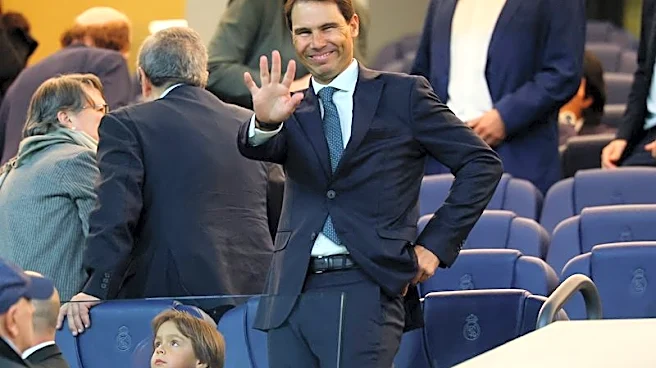
Toni Nadal: Real Madrid is “much more than just a hobby” for Rafa
Following Rafael Nadal’s arrival on Real Madrid’s board, Toni Nadal spoke on Onda Cero’s Radioestadio Noche about the depth of his nephew’s support for the club. His recollections included Rafa searching for somewhere to watch Madrid while travelling for tennis tournaments.
“Rafael is a huge Real Madrid fan, he lives and breathes it… I remember that many times in Australia or New York he would look around at night to see where he could watch the Real Madrid game; for him, Real Madrid is much more than just a hobby, it’s very much in his blood.”
Toni described that attachment as consistent with the commitment Rafa brings to other parts of his life.
“When my nephew does something, he does it wholeheartedly, giving it his all. Rafa is, above all else, a Real Madrid fan. He has influenced his son, who will follow in his footsteps and turn out just like his father.”
He also shared an anecdote about a family divided between Madrid and Barcelona, with the rivalry occasionally spilling into the cousins’ group chat.
“He has a chat group with his cousins, and the family is divided because one part supports Barcelona and the other Real Madrid. My son is a Barcelona fan, and when he makes a comment he doesn’t like, he kicks him out of the chat, comes to me and says, ‘He kicked me out again,’ and ‘punishes’ him for a few days.”