

Going into the 2026 offseason there are many unknowns surrounding the Jets. One thing that isn’t an unknown is that the Jets will be starting a new quarterback Week 1 next year. Now there are various different options, but I’ll take a quick, basic look at the 8 options I feel are most likely and assess at a high-level the pros or cons of each. These options are listed in no order:
Option 1: The Jets draft a QB with their first pick without trading up
At the moment, this is likely the most popular option
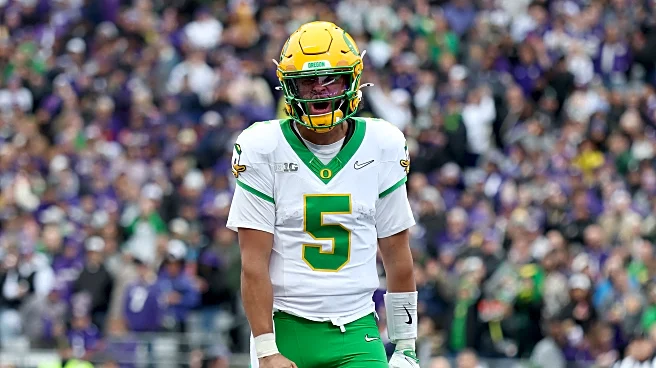
among Jets fans online, and for good reason. There are two quarterbacks who have consistently been mocked inside the top five for weeks now: Fernando Mendoza and Dante Moore. Both prospects have their flaws which I won’t get into here, but from both a statistical and film standpoint, they would almost certainly be first-round picks in nearly any draft class.
The major caveat, however, is whether the Jets will actually be in position to select one of them. That hinges heavily on how the rest of the season plays out. It would be a major surprise if the Jets ultimately end up with the No. 1 overall pick. No. 2 remains very much in play if they lose out, but even that scenario isn’t guaranteed. A win against New Orleans this week alone pretty much shuts down the idea of them picking in the top 2. This very likely would only be possible if they lose out.
Because of that uncertainty, we’re led to the following option:
Option 2: The Jets draft a QB with their first pick with trading up
This is a much tougher sell. Let me start by saying I’m not completely opposed to the idea. Like it or not, if you hit on a true franchise quarterback, nothing else really matters. In that scenario, the trade-up is quickly forgotten because the payoff outweighs the cost.
That said, this is easily the riskiest path, and not because of anything I think about Mendoza or Moore as prospects. The real question I keep coming back to is this: is the Jets’ roster in a strong enough position to justify trading away premium draft capital? In my opinion, the answer is clearly no.
While I do think the long-term outlook of the offensive supporting cast is somewhat underrated (and could become legitimately solid with smart additions this offseason) the defense and overall depth of the roster still require significant work. It’s difficult to justify a team with this many holes sacrificing high-end picks to move up for an unknown commodity at quarterback.
Of course, everything comes down to price. There will always be a point where the cost aligns with the potential reward. But speaking broadly, this option carries too much risk for my taste.
Which brings us to a third way of addressing the position in the draft:
Option 3: The Jets draft a QB later in the draft
Let me preface this by saying that I would strongly support sitting any of the non-Mendoza/Moore quarterbacks in this draft class for Week 1. In that scenario, a veteran spot-starter would almost certainly need to accompany the rookie. While there are examples of Day 2 quarterbacks starting in Week 1 (Russell Wilson being the gold standard) those cases are the exception, not the rule. The list becomes even shorter when looking at Day 3 picks. In fact, the only recent example that comes to mind is Dak Prescott, who was clearly under-drafted relative to his immediate performance.
At this point in the process, there are a handful of intriguing names, but it’s still far too early to know where these quarterbacks will ultimately land on consensus boards by April. Ty Simpson is the most obvious one to start with. Just over a month ago, Simpson was the betting favorite to go No. 1 overall. Since then, his play has dipped significantly, and given his limited starting experience, it’s not out of the question that he ultimately returns to college. With a small sample size of quality tape and some lingering size concerns, he’s trending more toward a Day 2 evaluation at the moment.
Darian Mensah has become the latest hot name following his surprise declaration, but even then, there was minimal buzz surrounding him prior to that announcement. Cade Klubnik and Garrett Nussmeier were two of the biggest disappointments of the college season. Both entered the year with legitimate top-10 (and in some cases top-five) draft buzz, and neither lived up to those expectations. Still, these are the types of players teams seem willing to bet on. Klubnik, in particular, would be a very intriguing Day 2 option, though there’s still a lot more evaluation to be done across the board.
Overall, this remains a reasonable and defensible path for the Jets if there isn’t significant pressure to win immediately. With the amount of draft capital available, selecting a quarterback on Day 2 or early Day 3 and getting them on the field at some point during the season makes sense. That said, the most likely outcome in this scenario is that by the end of the 2026 season, the Jets are once again searching for a quarterback solution for 2027 (see: the current Cleveland Browns).
Now that we’ve exhausted the draft options, let’s turn our attention to the free-agent and trade markets for potential alternatives.
Option 4: The Jets Sign or Trade for Kyler Murray
This option will almost certainly be the most polarizing of the bunch. Opinions on Kyler Murray are all over the map. There remains a dedicated group of believers across NFL media and fanbases who view Murray as an above-average starting quarterback. The Ringer, for example, ranked him 14th in the league entering the season. At the same time, he has long had a vocal group of detractors, both in the media and among fans, largely due to recurring issues that have surfaced both on and off the field.
To me, this option comes down to one thing and one thing only: price. If Kyler Murray is only available via trade this offseason, the Jets should have little to no interest given his contract and inconsistent performance relative to that financial commitment. However, if he were to be cut, the calculus changes entirely. Given the guaranteed money still owed on his previous deal, Murray would almost certainly be available at a steep discount. In that scenario, it becomes difficult to argue against the move, especially if the Jets are not planning to address quarterback early in the draft.
I’ll likely dive deeper into Murray in a future article, but it’s worth noting that if the Jets were to acquire him, comparisons to the Justin Fields reclamation project would be inevitable. I don’t agree with that framing. Murray has been in an entirely different tier than Fields over the course of their respective careers, and the numbers back that up. Regardless, this is clearly an option worth monitoring as the offseason unfolds.
Another option in free agency would be:
Option 5: The Jets Sign or Trade Marcus Mariota
Make no mistake, this is a thin quarterback free-agent class. Outside of Kyler Murray potentially becoming available, Marcus Mariota is realistically the only quarterback on the market who won’t be in his late 30s. He will almost certainly be viewed as the most uninspiring option among those discussed, but sometimes boring is exactly what a team needs. Frankly, being boring might have helped the Jets back in 2023.
While Mariota doesn’t move the needle on paper, he’s been quietly underrated from an advanced metrics standpoint over the past few seasons. His QBR has been average to above average in his last two extended starting stints: this season in Washington and during his final year in Atlanta. In the seasons in between, when he’s primarily served as a backup, he’s generally performed well when called upon. Since transitioning to a full-time backup role in 2020, Mariota ranks 18th out of 50 qualified quarterbacks in EPA+CPOE composite. Not too shabby.
He would bring a baseline level of competence at the position that the Jets have usually lacked, even if he’s not going to wow anyone or solve the long-term quarterback question. Still, at the right price which it likely will be, it’s difficult to argue that this isn’t an option the Jets should at least consider.
Option 6: The Jets Go Ancient: Sign Kirk Cousins or Russell Wilson
To me, this would be a very tough sell. At this stage of their careers, neither Kirk Cousins nor Russell Wilson profile as a starting-caliber quarterback. Wilson, in particular, has been a major disappointment across his last three stops. His game was always heavily dependent on athleticism and pocket mobility to compensate for his height, and once that element declined, so did his effectiveness.
Cousins, meanwhile, simply doesn’t look the part anymore. His name continues to surface every offseason for Jets fan, but at this point, he feels just as likely to retire as he does to take another snap in an NFL game. I felt it was necessary to include this option given how often it’s mentioned, but for me, it’s a hard no. So now that we have exhausted the FA options, what does that leave us?
Option 7: The Jets Trade For A Starting Caliber QB
It’s impossible to know who will actually be available come December, but almost every year a legitimate starting-caliber quarterback unexpectedly hits the trade market. This cycle has already begun. Early rumors in October suggested Trevor Lawrence could be a potential trade candidate if Jacksonville opted for a reset under a new regime. After the past few weeks, that idea has largely cooled. Then there were the inevitable think pieces after a few losses coming out of Philadelphia sports radio floating the idea of Jalen Hurts becoming available.
Either Lawrence or Hurts would command massive draft capital and require taking on significant contracts. Now I highly highly doubt either are made available. Consider me not just skeptical, but outright uninterested if they do.
Now that Tua Tagovailoa has been benched, he will almost certainly be available via trade. Unless Miami is willing to attach multiple premium picks and eat a meaningful portion of his contract, I have zero interest in going down that road.
That leaves me to one and the most popular name (one I’d be remiss not to mention): Joe Burrow. The rumors are already out there. I’m not going to sit here and critique Burrow as a quarterback. While I’ve suggested in the past that he may be slightly overrated, he would still instantly rank among the best quarterbacks in Jets franchise history. That said, I find it extremely hard to believe Cincinnati would seriously entertain moving him. And even if Burrow wanted out, why would the Jets be his destination of choice? More importantly, would the price even make sense?
I’ve already seen proposals involving four first-round picks to acquire him. To me, this ties directly back to the issue with trading premium capital to select a quarterback in the first place. Given the current state of the roster, should the Jets be gutting their draft resources? In my mind, the answer is clearly no.
Option 8: The Jets Trade For A Back Up QB
We’ve seen this approach tried before in NFL history, with mixed results. In an effort to leave no stone unturned, it wouldn’t be surprising if the Jets’ pro scouting department takes a long look at backup quarterbacks around the league who might project as potential starters. The most commonly mentioned name so far has been Mac Jones.
Jones has experienced something of a career resurgence in his limited starting opportunities with the 49ers in 2025. Given that performance and his extremely team-friendly contract ($2.6 million in 2026), his name is bound to surface in offseason conversations. That said, he wouldn’t be the first quarterback to thrive in San Francisco’s system only to struggle elsewhere (see: Jimmy Garoppolo). There’s also the question of why the 49ers would be eager to move on from a cheap, reliable backup when Brock Purdy hasn’t exactly been the picture of durability over the past few seasons. If there is real interest, I could easily see the price climbing well beyond what Jones has actually shown.
The other backup quarterback I’ve seen mentioned is Philadelphia Eagles passer Tanner McKee. McKee remains almost entirely an unknown at the NFL level. Now in his third year with the Eagles after being selected in the sixth round in 2023, his résumé is limited, but not without intrigue. To his credit, McKee has consistently graded well in preseason play over the past three years and performed admirably in his lone start late last season. By most accounts, Eagles beat reporters who’ve watched him practice regularly are high on his development.
Still, the reality is that McKee has thrown fewer than 50 regular-season NFL passes. He would be a true long shot. You could talk me into the idea if the acquisition cost were minimal, but I’d rather not completely blind-dart the most important position on the roster.
Conclusion:
As you can see, there are plenty of different paths the Jets could take to address the quarterback position this offseason. None of them are perfect, and quarterback purgatory is never a place you want to be. Unfortunately, it’s a far too familiar one for this franchise. Many of these options will understandably be met with eye-rolls, but at this point, they represent the most realistic avenues available.
As the picture becomes clearer, both in terms of who’s actually available and where the Jets ultimately land in the draft, we’ll be able to take a deeper dive into some of these scenarios. For now, this serves as a solid introduction to the potential opportunities that could present themselves.
Feel free to share your preferred options in the comments below.