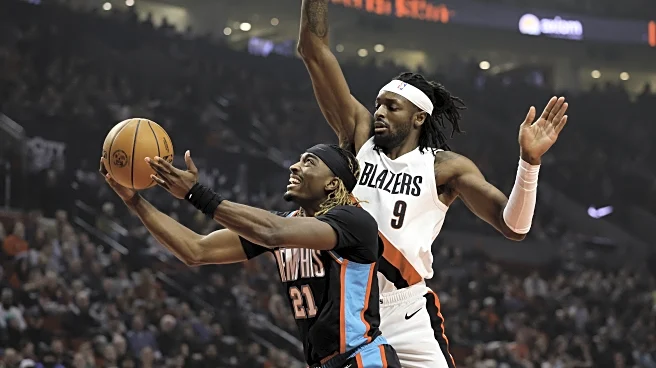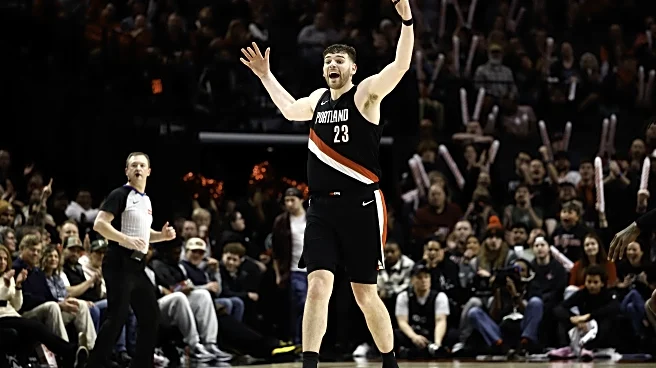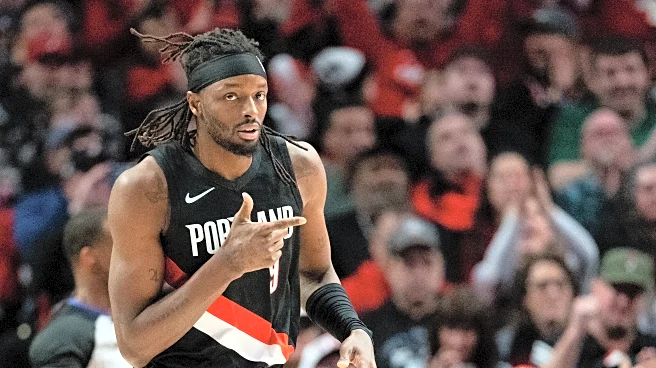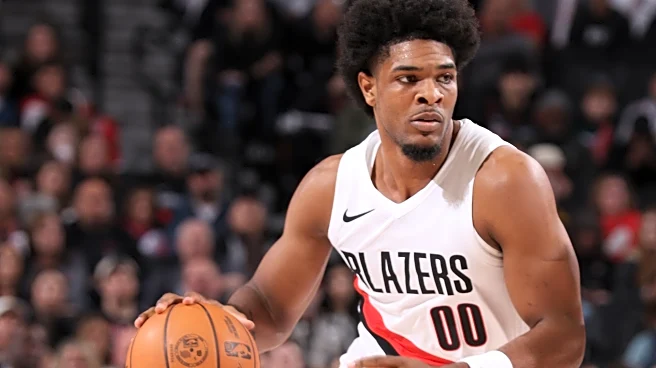

By most measures, the Portland Trail Blazers have had a successful season. They carry a record close to .500 after enduring a mammoth list of injuries. They’re operating without a point guard and they shoot terribly but they still manage middle-of-the-road offensive production. Their defense is decent, their rebounding good. 2025-26 probably won’t go down in history, but it’s not too shabby, all things considered.
Despite that, glaring weaknesses peek their heads above the waterline like icebergs
in an ocean. One of those is the subject of today’s Blazer’s Edge Mailbag.
Hey Dave,
I’ve been pondering this question for a while, and thought it might resolve itself when Jrue got back, but why do the Blazers have such a hard time inbounding the ball (especially at the end of games) ?!?
You know they have all been taught it since they were kids, and the coaches have surely gone over many, many times. I’d imagine that coaching, young/inexperienced players, and injuries have all played a part in it but why haven’t they been able to figure it out? What’s the solution and who deserves the most blame?
Daryl
I’m not sure anyone deserves blame, per se. It’s a side effect of the roster and the way they play.
Look at Portland’s offense normally. Obviously it varies. There are wrinkles. But consider their main, first-unit offense. What does it look like?
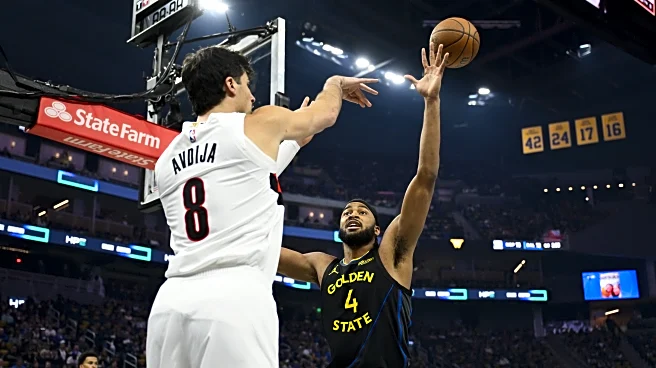
The classic set is Deni Avdija (sometimes Jrue Holiday) up at the top near the three-point arc, maybe one person setting a loose pick that isn’t used half the time, then penetration breaking down the defense for a layup. Failing that, you have the following options off of penetration:
- Kick to the corner to Toumani Camara
- Pass to Jerami Grant on the far sideline for a possible three or his own drive
- Get the ball to Shaedon Sharpe on the near sideline and let him operate
- Hope Donovan Clingan rebounds whatever goes up
Failing that, all heck breaks loose and you just take what you get.
Any way it goes, the speed and chaos of the offense is a feature, not a bug. The approach is open-ended, almost improvisational. Even the Blazers don’t know which of those five options (the layup plus the other four) is going to be the best idea on a given trip, or if something else will develop altogether.
This works great (or at least well enough) when you’re running the ball down the middle of the floor on a random play in the third quarter. They can do anything! The ball can go any direction! The defense can’t prepare! They’re scrambling everywhere!
For a multitude of reasons, it doesn’t work nearly as well on a sideline inbounds with 2.3 seconds left on the clock. Here’s why.
First of all, notice that we said “sideline”. There’s a reason the Blazers initiate their offense from the top center of the floor. It’s omnidirectional. Ball and players have 360-degree latitude. Inbounding from the sideline, at least one of those directions is taken away. The field through which the ball can travel is narrowed, which means the defense can key in tighter to specific spots. Defenders themselves—on inbounder and receiver alike—take away even more space and passing angles.
The contraction of space changes the questions for the Blazers. No longer is it a matter of, “How fast are you?” or, “How creative can you be?” or, “What are you willing to dare?” The relevant topics on the inbounds pass are, “How tight are your timing and communication?” and, “How sure are your hands?”
Look at Portland’s turnover rate in their normal offense. It’s not good. Worst in the league! But they’re willing to sacrifice those turnovers as a cost of doing volume business in the shot-attempt department. That works (or well enough, anyway) when you consider a complete set of 90-100 shots taken during the game. Over time, the creative shots in the loose offense will balance out the miscues…or so they hope.
When the offense narrows down to one shot, one play, in a single defined space by a single player, the math doesn’t math so well anymore. That scenario takes away most of the strengths of Portland’s offense (speed, wide-open court, lots of options, hitting where the defense isn’t) while leaving the weaknesses (poor ball-handling, not great isolation-scoring ability, messy execution) fully in place. Basically you mute the best aspects of the Blazers’ attack while turning the parts you don’t want to see (but have to live with) up to 11.
Let’s say I’m playing a board game. 12 spaces lie ahead of me. If I land on spaces 1-3, I lose. On spaces 4-12, I’m ok. If you give me two six-sided dice to roll, I’m probably going to be ok. I’ll get some 2’s and 3’s, but I’ll live with them because the majority of my rolls will avoid disaster. But what happens if an opponent plays a card that removes one of those dice from my grip? Now I can only roll a single 6-sided die. The board looks the same, but I can’t even get to spaces 7-12 anymore. And three of the numbers between 1-6 lead to disaster, which now comprises half of the possible outcomes. All of a sudden my options don’t look so good anymore.
That’s exactly what those end-of-game, sideline-inbounds plays do to the Blazers’ offense.
It gets worse, too. Look at Portland’s top players. How many of them do you want catching the ball in that limited-space, short-seconds, fully-defended scenario?
Toumani Camara is an amazing player when he shows his strengths. Isolation scoring isn’t one of them. He’s not going to be getting the ball on that inbounds play. Donovan Clingan is even worse, and he’ll be 22 feet from the basket to boot. That leaves Avdija, Grant, and Sharpe as viable candidates. Now you’re down to three players the defense has to hawk, not five, further narrowing the already-narrowed options for the offense.
That’s modified by the following:
- How many times have Avdija, Grant, and Sharpe all been healthy at the same time this season to even get in the game together?
- How often does Deni start his offense from the sideline? How comfortable is he there even if the catch is made?
- How good is Shaedon’s first escape dribble to get past defenders?
- If you don’t use Clingan in this situation, which of his substitutes are better or fix the situation? Are you helping or just giving up the potential for an offensive rebound?
- As the season has wound on, the Blazers have figured out this weakness and started to use Caleb Love in these situations because at least he’s an apt isolation scorer. But is Love the guy you want the game riding on? Is he a solid look to score, or even catch the ball in a coordinated play?
None of these things is an absolute bar to someone scoring. But you can see how we’re able to chip away even at the strong parts of Portland’s attack in these situations, making their success less likely.
Basically what you kind of end up with is, “I hope Jerami Grant catches it!” Defenses know this too. So they deny and overplay Grant and…bingo. The ball goes right into their hands when the Blazers try to pass it to him.
And that, my friend, is how a seemingly-easy play becomes not as easy as advertised.
Obviously we’re overdrawing here a little bit. Not every Portland inbounds ends in disaster! They’re fine most times. But if you see a disproportionate number of turnovers or bungles off of those plays, now you understand why. They don’t actually employ this kind of offense regularly. (At most they run over it in practice, but that’s different than running it game after game, hundreds of times on the court in the daily course of things.) They don’t have perfect personnel to execute it. They’re not actually that experienced, individually or together. And this is exactly the kind of scenario that isn’t forgiving to all those shortcomings.
One more question…did you like this article? We don’t ask you to pay us, fund this work, or anything like that. But once a year we band together to send people who aren’t us—local children and youth in need in the Portland community—to see the Blazers play in person. These kids wouldn’t get to go on their own without the tickets we provide and the adults in their lives organizing the trip. If you like what we do, instead of paying us, could you maybe send one of them? Whether you donate one ticket or a hundred, you’re helping bring joy into their lives and changing the world in a small, good way. Here’s the website where you buy directly from the Blazers, then they put the tickets you purchase in our pool for participants. The cost is negligible…a few bucks per ticket. Time is running short. The game is in March and we need to tell the groups of kids to plan for the event. Please help them out by donating a ticket (or more) today!
Thanks for the question too! You can always send yours to blazersub@gmail.com and we’ll try to answer as many as possible!