
Hard Rock Stadium will host a national championship game on January 19 (with Miami as the away team) that nobody predicted but everybody should have seen coming. The No. 1 seed Indiana Hoosiers will face
the hometown No. 10 Miami Hurricanes in a matchup that pits two teams that continued to surprise the nation as the season progressed. But look closer, and you’ll find two programs built from similar blueprints – just written in different dialects.
Both were doubted. Both were dismissed. And both built championship campaigns on the backs of elite defensive play, transfer portal mastery, and quarterbacks nobody else believed in.
The Portal as Philosophy
When Curt Cignetti arrived in Bloomington in December 2023, he brought a number of players with him from James Madison (13, including Miami native CB D’Angelo Ponds) and immediately hit the transfer portal for more (18). It wasn’t desperation – it was strategy. The Hoosiers lost 39 to the portal but Cignetti’s philosophy focused on starters with experience over stars.
The results speak volumes. Of the 51 scholarship transfers Indiana has added under Cignetti across two years, the vast majority became immediate contributors. Linebacker Aiden Fisher and Ponds earned All-America honors. For 2025, Cignetti reloaded with 23 more transfers, including, of course, Heisman quarterback and Miami native, Fernando Mendoza.
Mario Cristobal has been running the same playbook in Coral Gables, just with a bigger checkbook and program reputation. Since taking over in December 2021, Miami has maintained a top ten transfer class per 247Sports across four portal cycles.
Miami’s boldest gamble came with former Georgia quarterback Carson Beck, who commanded a reported $3-4 million NIL package despite recovering from elbow surgery. Beck declared for the NFL Draft on December 28, reversed course, and entered the portal on January 9. A similar narrative that had occurred the year before with current Tennessee Titans.
Miami closed the deal and the investment worked. Beck has thrown for 3,581 yards and 29 touchdowns while leading Miami to its first national championship game since 2002. He followed Ward, who transferred from Washington State in 2024, threw for 4,313 yards and 39 touchdowns, and became the No. 1 overall pick in the 2025 NFL Draft.
Two schools. Two coaches. Similar formulas of leveraging the transfer portal to find proven talent and win now.
The Quarterback Nobody Wanted
Fernando Mendoza’s recruitment tells you everything about how talent gets overlooked. The Miami native had exactly one Power Four scholarship offer – from California – and it came days before signing day. Yale was his backup plan. He was a 2-star recruit who went to Christopher Columbus High School in Miami. By now we are all aware that is the same school Mario Cristobal attended and also where Mendoza’s father played football alongside Cristobal.
Miami never recruited him.
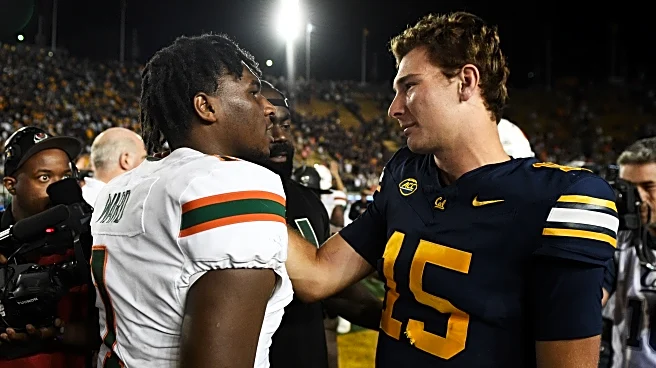
But they did face him. On October 5, 2024, Mendoza brought his California Golden Bears to face No. 8 Miami in a primetime thriller in Berkeley. Mendoza looked every bit the part of a future star in the first half, throwing deep shots and making plays with his legs. He finished 11-of-22 for 285 yards and two touchdowns before Miami’s pass rush wore him down. The Hurricanes pressured him on 42.9 percent of his dropbacks and sacked him twice, disrupting his rhythm. Miami won 39-38 after Mendoza threw a late interception.
Cristobal saw enough that night to know what Mendoza could become with the right pieces around him, but did not ultimately get him to Miami.
Nonetheless, that familiarity could be Miami’s edge. The Hurricanes’ defense led by Rueben Bain Jr. and Akheem Mesidor which has only improved as the playoffs have progressed already has a blueprint for how to rattle Mendoza. Cal’s offensive line ranked 69th in pass blocking in 2024. Indiana’s ranks 17th in 2025, a massive upgrade that has allowed Mendoza to operate with far more comfort.
When Mendoza entered the portal in December 2024, Miami finally came calling. But it was too late. His younger brother Alberto – already a backup quarterback at Indiana – had been selling him on Bloomington for weeks, and Cignetti closed the deal before Miami even finished their bowl game.
In 2025, Mendoza won the Heisman Trophy, the Walter Camp Award, the Maxwell Award, and the Davey O’Brien Award. He threw for 2,980 yards and 33 touchdowns while leading Indiana to a perfect 15-0 record and the No. 1 seed. He is the first Indiana player to ever win the Heisman.
On January 19, Mendoza will play for a national championship in his hometown, which is less than a mile from the University of Miami campus where he was never offered a scholarship.
Carson Beck’s path was different but equally improbable. A four-star recruit who spent two years backing up Stetson Bennett while Georgia won back-to-back national championships, Beck finally got his shot in 2023 and threw for 3,941 yards and 24 touchdowns. But 2024 went sideways with 12 interceptions before a season-ending elbow injury. He declared for the NFL Draft, received feedback that he’d be a second- or third-round pick at best, and reversed course.
Miami offered stability with a stout offensive line, a quarterback-friendly system, and a recent blueprint for success with Cam Ward. Beck signed for $3-4 million, rehabbed his elbow, and led the Hurricanes to 13 wins, also improving as the season has progressed.
Both are sixth-year seniors. Both were overlooked or undervalued at critical junctures. Both are playing their final college game for programs that believed in them when others didn’t.
Defense Still Wins Championships
For all the portal headlines and quarterback narratives – which Miami has found itself in the midst of this week – both Indiana and Miami built their playoff runs on suffocating and well-rounded defense.
Indiana’s defense ranks second nationally in opponent points per game, allowing a mere 11.9 points per game. The Hoosiers have forced 29 turnovers.
Miami’s transformation has been equally dramatic. The Hurricanes also rank fifth nationally in opponents points per game, allowing only 14.8 a match. The Canes have forced 25 turnovers. They’ve overhauled their secondary through the portal bringing
in third-down defense at 30.3 percent—tied with Indiana. They’ve held opponents to 19.7 points per game and overhauled their secondary through the portal, bringing in defensive backs Jakobe Thomas, Keionte Scott, and Xavier Lucas (the latter of whom will need to sit out a half due to a targeting call in the Fiesta Bowl. All three are at least six feet tall, reflecting Cristobal’s emphasis on length.
Both defenses thrive in critical situations. Both force turnovers. Both make opponents earn every yard. And both will decide who wins on January 19.
The Homecoming
This national championship game is a homecoming for everyone except the people who are supposed to be home.
Fernando Mendoza’s homecoming has been discussed ad nauseam and is a cool storyline.
That said, Miami is trying to win its first national championship since 2001 in front of a home crowd that has waited 24 years for this moment. Cristobal, a former Miami offensive lineman who won two national championships with the Hurricanes in 1989 and 1991, is trying to restore the program to the glory he experienced as a player. And he will not go to the grave without doing so.
But Indiana fans travel as is evident by the absurd ticket demand. The Hoosiers packed the Peach Bowl in Atlanta for the semifinal against Oregon, creating what felt like a 90-10 crowd advantage. If even half that many Indiana fans make the trip to Miami, they could turn Hard Rock Stadium into a neutral site instead of the home-field advantage Miami expects.
Two Roads, One Destination
What makes this game compelling isn’t just the storylines – it’s what both programs represent for the future of college football.
Indiana was 3-9 in 2023. Cignetti took over, brought 31 portal players in one offseason, and went 11-2 in 2024 with a playoff appearance. He reloaded with 23 more portal additions for 2025 and went 15-0 with the No. 1 seed. The Hoosiers have many players in their final season of eligibility but he continues to reload in the portal even during their playoff run.
Miami was 5-7 in 2021, Cristobal’s first season. They’ve improved to 13-2 this year, building through the portal each offseason. They signed Cam Ward for one year, turned him into the No. 1 overall pick, then immediately replaced him with Carson Beck for $3-4 million. More good news appears to be on the way for their 2026 QB.
Neither program is built to sustain this through traditional recruiting alone. Both rely on constant portal turnover, high-dollar NIL deals, and proven veteran college players over unproven high school talent. And both have proven it works.
Indiana and Miami aren’t flukes. They’re the future.
But here’s the wrinkle that makes this matchup fascinating: both teams share one common opponent this season – Ohio State. And Miami dominated and beat the Buckeyes significantly better than Indiana did.
Indiana defeated No. 1 Ohio State 13-10 in the Big Ten Championship on December 6, snapping a 30-game losing streak to the Buckeyes. It was a defensive slugfest where the Hoosiers held Ohio State to just nine yards in the first quarter and sacked quarterback Julian Sayin five times. Mendoza threw for 222 yards with one touchdown and one interception. Indiana won as a 4.5-point underdog in part due to missed field goals by the Buckeyes.
Miami, meanwhile, dismantled No. 2 Ohio State 24-14 in the Cotton Bowl on December 31. The Hurricanes held the defending national champions scoreless in the first half for the first time in nine years, dominated in the trenches, and sacked Sayin five times while forcing two interceptions. Miami led 14-0 at halftime and never trailed, winning as an 9.5-point underdog—nearly double the spread Indiana faced.
Both defenses sacked Sayin five times. Both forced key turnovers. But Miami scored more than Indiana’s entire point total just in their second-half possessions alone. The Hurricanes outgained Ohio State 153-45 in rushing yards while dominating time of possession 33:20 to 26:40. Indiana scuffled their way to a victory in that Big Ten title game.
Yet despite this evidence, many are writing Miami off as Indiana opened as an 7.5-point favorite for the national championship (now 8.5). The Hurricanes embarrassed the Buckeyes as 9.5-point underdogs. Indiana barely survived the Buckeyes as 4.5-point underdogs. Miami beat Ohio State more convincingly, covered a larger spread, and dominated more statistical categories. So why is Indiana favored by the a similar margin that Ohio State was against Miami?
The answer likely lies in perception: Indiana is undefeated, the No. 1 seed, and has dominated in the playoffs. Miami is a 10-seed that squeaked through multiple close games and has two bad losses against Louisville and SMU. But the common opponent metric suggests this game should be much closer than 8.5 points – perhaps even a toss-up.
Cristobal’s defense has already seen Mendoza once last season and knows his tendencies. They’ve faced – and beaten – the same defending national champion Ohio State team that nearly beat Indiana. And Miami did it more convincingly. The transitive property doesn’t always hold in college football. But when both teams share only one common opponent, and one team beat that opponent by double the margin and covered nearly double the spread, it’s worth questioning whether the 8.5-point line reflects reality – or just Indiana’s perfect record.
That said, there is one more factor that should give Miami some confidence. Indiana has struggled against physical teams with narrow victories over unranked Iowa (20-15), unranked Penn State (27-24), and Ohio State (13-10), as well as a relatively close game against Old Dominion (27-14). It’s a game of inches, but Indiana is a toe-drag, an opponent’s missed chip shot field goal, and a fourth quarter comeback away from having three losses. Even more, Miami is the most physical team the Hoosiers will face.
The last time Miami played in a BCS/CFP national championship game was January 3, 2003, when they lost to Ohio State in double overtime after a controversial pass interference call. Miami fans have never forgotten. The program went 77-48 in the two decades after that loss, cycling through six head coaches before finally bringing Cristobal home.
Now, 23 years later, Miami has a chance to exorcise those demons in front of a home crowd. But standing in the way is a quarterback from Miami who wasn’t good enough for Miami, leading a program that wasn’t good enough for anyone, playing the best football in the country.
On January 19, a Miami kid who wasn’t wanted by Miami will try to beat Miami for the only trophy that matters.
That’s not a Cinderella story. That’s college football in 2026.