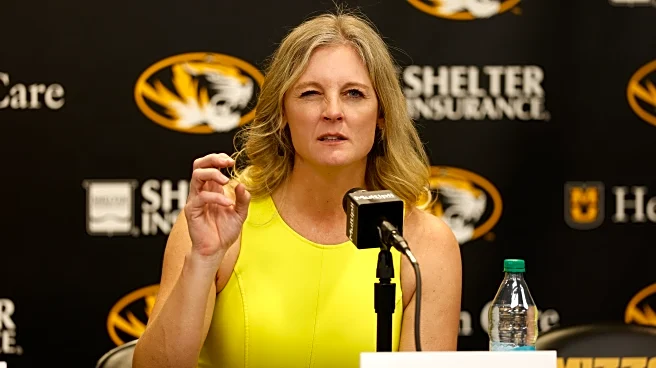


The Mizzou women’s basketball finally closed its season with a loss in the second round of the WBIT. While this is the seventh consecutive season Mizzou has missed the NCAA Tournament, it snapped a two-year postseason drought. Under first year head coach Kellie Harper there was a larger sense of excitement around the program with the additions of new players and a reinvigorated offense. However, a seven-game losing streak to end the regular season and the blowout loss to BYU in the WBIT has left
a bad taste in the mouths of fans.
With the five-month season officially over, let’s take a look at some of the best and the worst from Harper’s first season behind the bench; and what comes next for Mizzou.
The Good
Compared to the final seasons under Robin Pingeton the Tigers say growth in year one under Harper. Mizzou’s 16 overall wins and four in SEC play were the most in the program since the 2022-23 season. The Tigers picked up non-conference wins against power teams like Northwestern and California. In SEC play the team scored key road wins against Mississippi State and Arkansas as part of a three-game winning streak against conference foes.
The offense greatly improved under Harper, jumping from 68.6 points per game last season to 72.4. Grace Slaughter led the way offensively, finishing as the sixth highest scorer in the SEC after averaging a career-high 18.7 points per game. The 3.7 PPG increase her junior year was the main reason she received Second Team All-SEC honors this season.

The secondary scorer was Shannon Dowell, the most impactful transfer addition from the past year. During the 2024-25 season, the secondary scorer was current Texas Longhorn Ashton Judd at 11.6 points. Dowell provided a huge spark with 14.9 points per game to take some of the pressure off Slaughter. A great example of this came when she scored 25 points in the road win over Arkansas, leading the Tigers to a big win away from Mizzou Arena.
Another major improvement that help the Mizzou scoring was an improved efficiency and volume at the free throw line. Compared to the previous year, this year’s Tiger team shot 2.7 more free throws at a 7% better clip. In 2024-25, Mizzou only had two players that shot 80% or better from the line; that number jumped to five this season.
Perhaps the most impressive player was Jayla Smith, making the most of her one year at Mizzou. Smith shot 88.2% from the line on a total of 51 attempts. Smith averaged 7.8 points this year while shooting 43.5% from the field and 29.6% from three. She was a 50/40/90 player for most of the season before her averages went down as her usage increased later in the year.

Freshman Reka Toman was technically a 50/40/90 player for most of the season, but her relatively small usage keeps her from being recognized for her achievement nationally. Toman had the highest free throw percentage on the team at 91.7% on just 12 attempts.
What Went Wrong
While there was plenty of good in the first season of this new era, there is still much to be improved for Coach Harper and her staff. The biggest struggle was the defensive side of the ball. The Tigers allowed 76.5 points per game, ranking 353rd out of 363 Division I teams. Now, some of this is a symptom of playing in the SEC. The conference has 4 of the top 8 scoring teams in the nation. But this issue was prevalent even in the non-con, as Mizzou gave up 100 points in its loss to Troy.
While the Tigers’ halfcourt defense wasn’t terrible this year, they struggled with easy points either off turnovers or opposing offensive rebounds. Mizzou averaged 16.1 turnovers which turned into an average of 16.6 points allowed per game.
Another issue that was less in the Tigers’ control was injuries. Mizzou missed a combined 118 games from players this year, often forced to suit up only 8 or 9 players per game. The bulk of those games were missed by Averi Kroenke, Hannah Linthacum and Sydney Mains, who each suffered a season-ending injury during the preseason.

This short bench seemed to take a toll on Mizzou’s endurance down the stretch, ending the regular season on a 7-game losing skid. This losing streak included losses on the road t0 Harper’s alma mater Tennessee by 45 points and a program-record 53-point loss to LSU. While all losses count the same, these sorts of blowouts can weaken a team’s resume if they find themselves on the bubble towards the end of the season.
What’s Next?
While the Tigers clearly improved during Harper’s first year as the head of the program, the jump wasn’t quite as drastic as many expected. I understand, it can be hard to be excited with another 1st round exit in the SEC Tournament and no postseason. But I have a sneaking suspicion that Coach is just getting started.
The Tigers are projected to lose three players with Jayla Smith, Jordana Reisma and Saniah Tyler all set to graduate. While these were three key rotational pieces for Mizzou (averaging a combined 21.6 points and starting 36 games), the bulk of the roster is set to return.

This includes both Slaughter and Dowell, coming back for their senior seasons. Next year’s team will also include the returns of Kroenke, Mains and Linthacum from injury who add depth at key positions. The rest of the roster will return with a whole bunch of added work and experience to the Harper system in the off-season to develop.
But perhaps most importantly is Harper’s five incoming freshman recruits. The group includes a trio of four-stars talents in the form of Natalya Hodge, Khloe Ford and Jada Maples. Just this past week Ford and Maples each won state titles, ending their high school careers with a bang. You can read more about each of the new additions here.
As the product on the court improved and plenty more talent coming down the pipeline, Mizzou women’s basketball is set to produce its most exciting team in years in 2026-27. But we’ll just have to wait and see.