





At this year’s trade deadline, the Sixers made a trade with the Oklahoma City Thunder that we don’t need to rehash for the sake of everyone’s mental health.
Their reported trade target from that deal is now on the move.
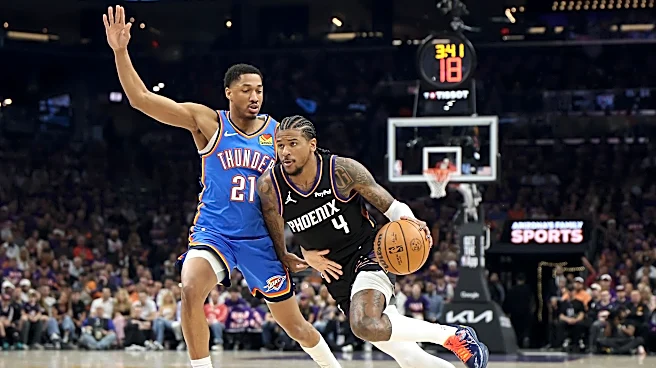
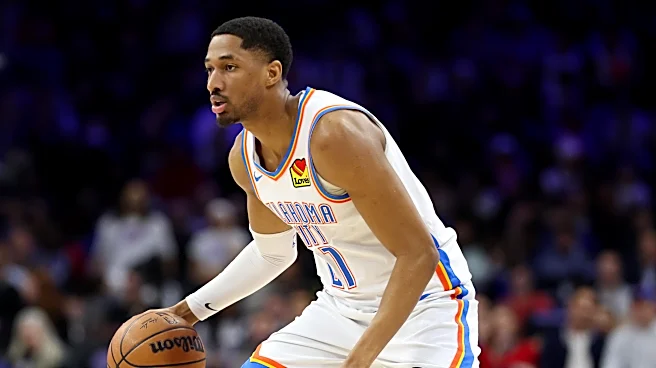
In mid-May, Adam Aaronson of PhillyVoice reported that Thunder guard Aaron Wiggins was the “primary target” for the Sixers. He added “there was hope” that The Trade That Shall Not Be Named “could lead to a deal also involving Wiggins,” but that didn’t materialize at the time.
Four months
later, Wiggins is heading to Atlanta for two distant second-round picks, according to ESPN’s Shams Charania. From OKC’s standpoint, it was a purely financially motivated move.
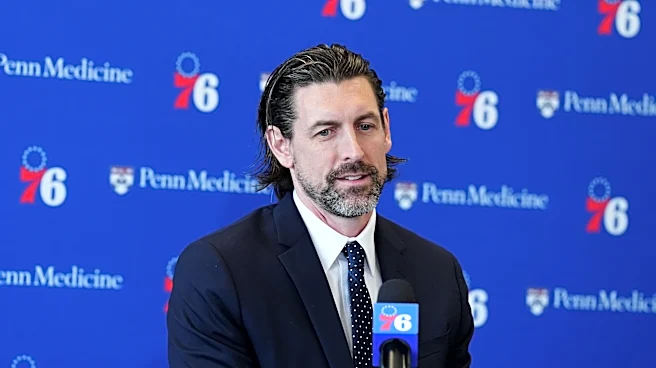
The Sixers have changed front offices since the trade deadline, so perhaps new team president Mike Gansey and vice president of basketball operations Jameer Nelson didn’t value Wiggins the same way that former president Daryl Morey and general manager Elton Brand did. But even if they did, money was the big obstacle in their way, which made Atlanta a far more logical trade partner for OKC.
Why the Sixers couldn’t get Wiggins
The Hawks had an $11 million trade exception after sending Luke Kennard to the Los Angeles Lakers for Gabe Vincent and a 2032 second-round pick at the trade deadline. They wound up sending the better of their own second-rounder and the Lakers’ second-rounder in 2032 along with their own in 2030 to acquire Wiggins.
More importantly, they were able to absorb Wiggins into that trade exception without sending salary back to OKC.
The Thunder appear to be in full payroll-trimming mode before having to decide whether to exercise their team options on Isaiah Hartenstein ($28.5 million), Lu Dort ($17.7 million) and Kenrich Williams ($7.2 million). It wouldn’t be a surprise if former Sixer Isaiah Joe and his $11.3 million salary is the next one out the door.
The Sixers have two small trade exceptions, but neither Wiggins ($9.0 million) nor Joe could fit into either of them. They could technically take either one into the $15.0 million non-taxpayer mid-level exception since it can now be used as a trade exception, but doing so would hard-cap them at the first apron. That should be a non-starter at this stage of the offseason.
The first apron is projected to land around $209 million. The Sixers already have more than $172.7 million on their books for next season, and that’s for only seven players. If they used $9 million of their non-taxpayer MLE to absorb Wiggins, they’d be up to $181.7 million in salary with seven open roster spots. That would leave them less than $27.5 million below their first-apron hard cap.
If the Sixers filled five of their remaining spots with players on minimum contracts, that would add $12.25 million to their books. That’d leave them about $15 million to spend on either Oubre or Grimes, or they could bring back one for around $10 million and spend the remainder of their non-taxpayer MLE on another free agent.
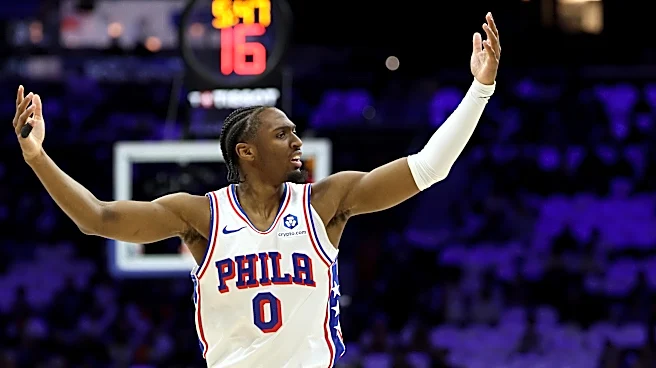
Either way, they presumably wouldn’t want to head into free agency hard-capped at the first apron, particularly not for a player like Wiggins. He’d be a solid addition off the bench, but he’d have minimal chance of cracking the Sixers’ starting lineup thanks to Tyrese Maxey and VJ Edgecombe.
If the Sixers are going to hard-cap themselves at the first apron before the new league year even begins, it needs to be a home run move. Otherwise, they have incentive to see how the Oubre and/or Grimes situations play out in free agency before imposing those kinds of handcuffs on themselves.
The Wiggins deal isn’t likely to be the only trade that goes down this week. Giannis Antetokounmpo is the headliner, while Ja Morant could follow in short succession. Unless the Sixers are trading one of Maxey, Joel Embiid or Paul George, they don’t have the salary-matching contracts to get involved for either one.
In fact, they don’t have the contracts to get involved for hardly anyone on the trade market.
The Sixers’ top-heavy salary structure
Embiid ($58.0 million), George ($54.1 million) and Maxey ($40.7 million) are the only Sixers players who are currently set to earn more than $12 million next year. Edgecombe is next at $11.7 million. Whomever they select with the No. 22 overall pick will temporarily be their fifth-highest-paid player at a whopping $3.6 million.
Despite having so few players under contract, the Sixers are already projected to be over the 2026-27 salary cap. They can’t swing a trade that’s unbalanced salary-wise unless they’re willing to hard-cap themselves at the first apron. (Which, again, should be a non-starter this early in the offseason.)
That top-heavy salary structure is going to limit the Sixers’ options on the trade market this offseason. Salary dumps of productive players should only become more common as teams look to trim their payroll, but the Sixers likely won’t be able to capitalize this offseason.
That shouldn’t be held against Gansey and Co. They’re just playing the hand they were dealt.
They didn’t choose to not outbid Atlanta for Wiggins. They didn’t have a choice in the matter since they couldn’t absorb Wiggins’ contract without sending salary back.
That would have defeated the purpose for OKC, and the same will go for any other team looking to cut costs.
Unless otherwise noted, all stats via NBA.com, PBPStats, Cleaning the Glass or Basketball Reference. All salary information via Spotrac and salary-cap information via RealGM.
Follow Bryan on Bluesky.