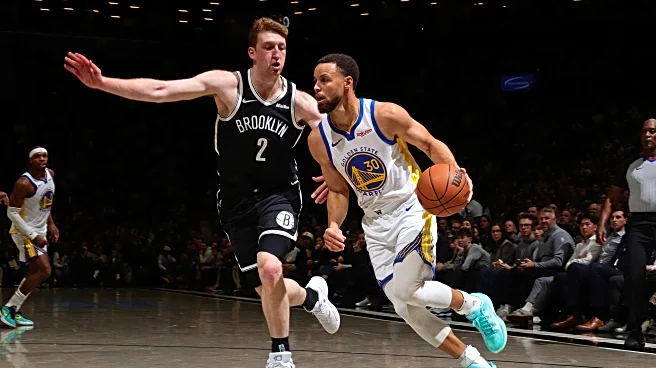


Buddy Hield had not seen much playing time on the floor as of late — until finally, he was dusted off by Steve Kerr against the Toronto Raptors, due to the absence of De’Anthony Melton from the rotation. While Hield’s performance against the Raptors was nondescript, Kerr decided to keep him in the rotation against the Brooklyn Nets the following night despite Melton’s return to play.
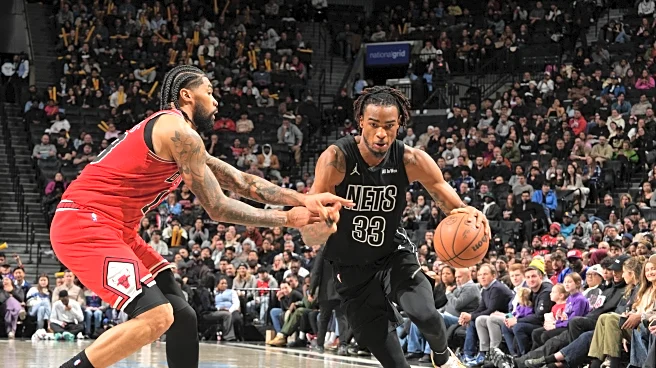
The Warriors won Hield’s minutes by a slight margin (plus-3) — minutes that involved Hield marking Cam Thomas and having
success defending the Nets’ ignitable scoring guard. Thomas found it difficult to get much traction against Hield, who is a deceptively decent on-ball defender whose ball-hawk tendencies have gotten him into situations both for the better and for the worse. Fortunately for the Warriors, the spectrum fell on the former tonight.
It was an offensive possession that involved Hield, however, that was symbolic of how the Warriors took advantage of the Nets’ switch-everything scheme. Early on in the game, a combination of lengthy defenders and switching almost every screening action put a wrench into the Warriors’ offense. It’s no secret that one way to stifle a motion offense that employs heavy ball and personnel movement is to switch everything, should a team have the personnel to switch near endlessly (which the Nets have).
It’s part of why the Nets — under the guidance of head coach Jordi Fernandez — have had the second-best defense in the league during the month of December (non-garbage time, per Cleaning the Glass). Bloodied after a bloody overtime loss to the Raptors the night before, this was no easy task for the Warriors despite the Nets’ deceptive under-.500 record.
Back to the aforementioned offensive possession — one that involved the Warriors’ classic low-post split action, a play Steve Kerr refers to as “5 Out” (because the five-man is the one feeding the ball to the post and setting the screen “out” on the perimeter). The action starts with a “UCLA” screen for Will Richard, set by Curry. This initiating action sets up a switch by Cam Thomas onto Curry, which will be important for the upcoming sequence:
By having Thomas (definitely one of the Nets’ weaker defenders) switch onto Curry, the Warriors take advantage of the Nets’ mantra of switching every screen, in that Thomas fails to switch onto Hield, who is coming off of Curry’s screen. Hield finds himself with an open lane, with Gui Santos on the weak side keeping his defender close to him and every other defender opting to stay in contact with their respective assignments:
Later on in the second half, Kerr draws up a set play that also tests the Nets’ discipline on switches. Called “C” by Kerr, it is an action derived from Mike D’Antoni during his tenure as head coach of the Seven Seconds or Less Phoenix Suns — hence, it’s more general term being “Phoenix.”
Kerr has used this play mostly as an end-of-game (EOG) set, one instance of which was (ironically) against the Suns in a 2023-24 regular season game:
STEPH CURRY YOU MADMAN pic.twitter.com/1rNBgMn0d0
— Joe Viray (@JoeVirayNBA) February 11, 2024
And during the Warriors’ Christmas Day tilt against the Los Angeles Lakers last season, a variant of the set that had each player start at or near the half-court line (mostly, in order to make it harder for the Lakers to foul up three):
What an unfortunate end, because this ATO was actually really well drawn up.
— Joe Viray (@JoeVirayNBA) December 26, 2024
Knowing they were gonna switch everything, Draymond sets the screen on his own man (Reaves, who switched onto Draymond ) to prevent the switch out onto Steph.
Watch Dennis and Draymond closely: Dennis… pic.twitter.com/WZbYkQAeHS
Kerr chose the former setup — closer to the three-point line — to use against the Nets. In essence, “C” is a screen-the-screener set, with Hield clearing to the right corner, Gui Santos setting the screen on Green’s defender, and Green setting a screen for Curry to lift to the top of the arc.
While Curry ends up making the shot, watching Hield’s initial movement to the right corner provides the realization that it does way more damage — and therefore, provides plenty of contribution to the end result — than meets the eye:
With two Nets players attaching themselves to Hield’s movement toward the corner, that leaves only two Nets defenders (minus the one defending the inbound) defending the screen-the-screener action for Curry:
The Nets employed other methods in order to stifle Curry’s scoring binge. Curry easily could have had more than the 27 points he scored against the Nets tonight, on 74.7 percent true shooting, if not for the Nets employing a “switch-to-blitz” scheme — that is, switching a defender onto Curry before sending another defender a few seconds later to double Curry.
It didn’t take long for Curry and Green to dissect the switch-to-blitz coverage:
The possession above influenced another down the line, during which the Nets switched Nic Claxton onto Curry and opted to let the 6-foot-11 center defend Curry on an island, without sending another defender to double. While Claxton profiles as a capable switch-defending big, Curry had his way with him regardless, in what was deemed a three-point play (among several others that weren’t, to Curry’s misfortune, called as such):
After another game in which the Warriors looked like deer in headlights — down by as much as 13 to the Nets — they righted the ship just in the nick of time by zeroing in on the Nets’ switch-everything tendencies and switch-adjacent coverages and adjusting their offense accordingly.