


In about one month, baseball begins again.
On Feb. 12, Rockies pitchers and catchers will report to spring training. On Feb. 17, the position players will follow.
This spring actually represents a renewal and refreshing change for the Colorado Rockies, who are being led by a new front office and coaching staff. As they work on building a new identity for the team and evaluate players, Rockies fans will begin to see what phase one of the rebranding will look like.
On Dec. 8, during manager Warren Schaeffer’s
press conference at the MLB Winter Meetings, he talked about the need for leadership, the creativity and energy PBO Paul DePodesta and GM Josh Byrnes bring, and ideas on trying to “conquer Coors Field” by creating a new team identity.
I wanted to zero in on one of Schaeffer’s points of focus in developing the Rockies pitching identity in order to be more successful. Schaeffer expressed his desire for Colorado pitchers to throw more strikes on the first pitch of at-bats and more strikes overall.
“We need to fill up the strike zone on the pitching side,” Schaeffer said. “We need to attack the zone early. Strike one is huge.”
First-pitch strikes give the pitcher the upperhand in the count and can lead to more favorable outcomes. Among all qualified MLB pitchers (at least 600 batters faced), American League Cy Young winner Tarik Skubal finished No. 1 in F-strike percentage at 71.5%. The Detroit ace posted a 2.21 ERA with 241 strikeouts in 195 1/3 innings over 31 starts with a 70% strike rate and 11.10 K/9. He walked only 33 batters for an average of 1.52 per nine innings. He fills up the strikezone.
In 2026, the Rockies need to follow Skubal’s example of smashing the strikezone.
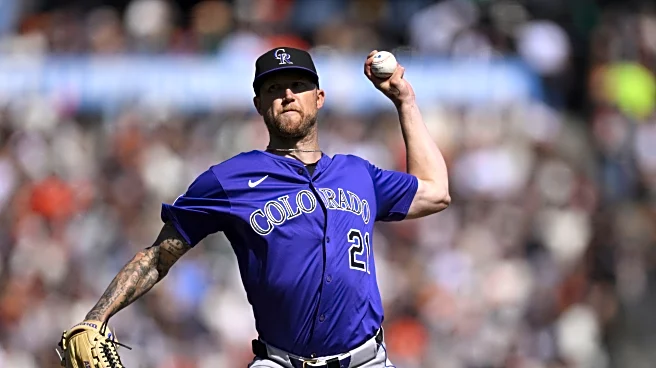
In 2025, Kyle Freeland did a very good job attacking the zone early. Among qualified pitchers, he finished tied for No. 6 in MLB with San Francisco’s Lorgan Webb at 68.5%. Some of the game’s best pitchers landed between Skubal and Freeland and Webb in Miles Mikolas (69.5%), Logan Gilbert (69%), Kevin Gausman (68.8%) and Colin Rea (68.6%).
That being said, first-pitch strikes aren’t everything, as National League Cy Young winner Paul Skenes only did it 60.8% of the time and still managed to post a 1.97 ERA with 216 strikeouts in 187 2/3 innings over 32 starts with a 65% strike rate and 10.36 K/9 with only 42 walks (2.01 BB/9).
But Schaeffer knows the Rockies need to do more to have better results at altitude. So, I thought it would be interesting to see where the Rockies, including pitchers who are no longer on the team and new additions to the 2026 40-man roster, did when it came to first-pitch strike percentage and overall strike percentage.
The table below includes pitchers who faced at least 100 batters in 2025.
The grid contains a wide mix of sample sizes, as well as starters and relievers, but still gives a good idea of where 24 different pitchers landed on first-pitch strikes. Following Freeland’s 68%, the range drops down to 54.9% with Carson Palmquist and Bradley Blalock, who was designated for assignment on Thursday. Newly acquired Michael Lorenzen, the Rockies first free agent signing of 2026, came in at No. 55 among qualified pitchers in MLB with a 62.7% F-strike rate.
There aren’t any mind-blowing secrets in the Rockies F-strike data, but there are some surprises like Austin Gomber, Ryan Rolison and Antonio Senzatela having decently high first-strike percentages despite pretty terrible seasons. On the other hand, Freeland, Tanner Gordon and Jimmy Hergert were arguably the Rockies three best pitchers in 2025 and top the list of current Rockies F-strike percentages.
Freeland’s 68% strike rate was the highest of his career and a team-high 124 strikeouts. The strikes helped Freeland post a 4.98 ERA, his lowest since posting 4.53 in 2022. Gordon led the team in wins and Herget posted the second-best rWAR on the team at 3.0.
If nothing else, hopefully, this provides a benchmark of where current and former Rockies pitchers are at when it comes to first-pitch strikes. If Freeland, Gordon and Herget can maintain those high rates, and other arms in the rotation and bullpen can bump up their first-pitch strike totals, even by just a few percentage points, it could help establish one point of emphasis for the pitching staff in 2026.
Perhaps that could lead to longer starts and get the team closer to pulling out of the MLB ERA basement where the Rockies have been in 2025 (5.97), 2024 (5.47), 2023 (5.67) and 2022 (5.06). Even just stopping the four-year downward spiral would be a good place to start.
Rockies sign Willi Castro | Purple Row
The Rockies signed veteran switch-hitting utilityman Willi Castro to a two-year $12.8 million deal on Thursday. Castro split his time between the Twins and Cubs in 2025, which was a down season after a 2024 All-Star campaign.
Rockies officially sign RHP Michael Lorenzen | Purple Row
Even though this was first reported on Jan. 7, the Rockies made the first free agent signing of the season official on Thursday by inking Lorenzen. The former Reds and Royals RHP signed a one-year, $8 million deal.
Paul DePodesta on Rockies’ additions this offseason | MLB.com
Rockies president of baseball operations Paul DePodesta talks about the benefits of the new staff and new outfielder Jake McCarthy.
Please keep in mind our Purple Row Community Guidelines when you’re commenting. Thanks!