


If you’ve been watching the Celtics this year (you’re reading this on CelticsBlog so of course you’ve been watching), you’ve likely seen a moment that keeps happening, even if it didn’t really register the first time. Or the second.
It’s one of those things that kind of floats in the background of most games. Easy to miss if you’re focused on the scoreboard or whatever Hugo is doing on the bench this time.
But then it happens again.
The ball swings for the opponent, someone catches it on the perimeter,
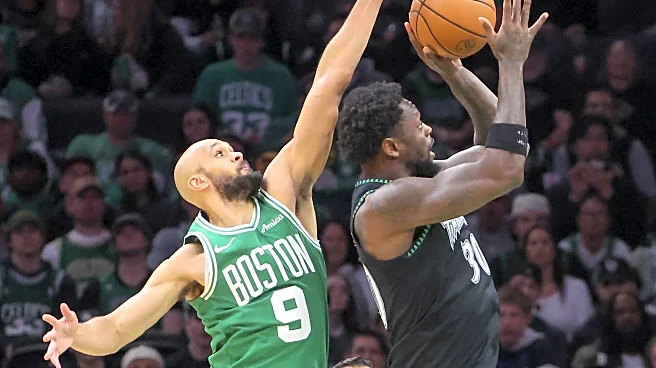
and there’s just…so much space for them to shoot. Not a late closeout, not a guy flying out of control trying to recover. Just a clean look where, for a split second, you’re waiting for a Celtic to show up, and nobody does.
The shot goes up. Sometimes it drops, sometimes it doesn’t (basketball, am I right?). The broadcast cuts to Joe on the sideline, completely calm. No reaction or frustration, and no one on the court pointing or scrambling into the next possession.
Which is what makes the wide-open look feel strange, because it doesn’t feel like a breakdown. It feels…accepted.
At some point for me, the question shifted from “why does this keep happening?” to, “why are we okay with giving up those shots?”
And most importantly…should Celtics fans be okay with it?
The tradeoff is in the numbers
Once you start looking for it, the pattern becomes pretty obvious.
Teams are living on the perimeter against Boston. We’re not talking just late in the clock or out of broken plays. Consistently, possession after possession, the shot profile is getting pushed outward.
And it’s not even that subtle.
Opponents are attempting about 39 threes per game against the Celtics, good for the 5th highest mark in the league. That lines up perfectly with what you’re seeing, but zoom out for a second:
- Celtics opponents are shooting 35.7% from three, almost perfectly league average
- Opponents are taking just 21.8 shots per game within five feet, one of the lower marks in the NBA
- Opponents are converting those rim attempts against Boston at about 62.8%, well below typical efficiency at the basket
Put those metrics together, and the shape of Boston’s defense starts to come into focus.
The goal for Boston isn’t to eliminate shots entirely, but rather control where they come from and what kind of pressure they carry. Right now, that means shrinking the paint, keeping drives from turning into layups or free throws, and letting possessions drift outward when the first option is taken away.
The above is a great example of this. You can see White helping off of Holland tremendously to support Walsh in guarding Cunningham. When Cade feels the double coming, he kicks it to Holland, which prompts Simons to immediately help off of Ivey. Holland makes the right read, and a well-timed screen on Brown helps Ivey get off a wide-open look.
The defensive approach is intended to change the math of each possession. A contested finish at the rim or a late rotation inside usually leads to something efficient — either a high-percentage look or a trip to the line. A three, even a clean one, carries more variance and doesn’t collapse the defense the same way.
So when you see those open looks on the perimeter, they’re often the result of decisions forged months ago in the depths of Joe Mazzulla’s basketball laboratory. That tracks with how he approaches everything. As he said after his WWE appearance earlier this week, “Anytime you can step into someone else’s arena and learn from them, you can always take something.”
In NBA arenas, the Celtics have committed to absorbing the initial action, holding their ground inside, and accepting the next pass instead of overcommitting to take it away. Put another way, every possession is being nudged in a direction. And eventually, something has to give.
Right now, that something is the three-point line.
Everything starts in the paint
If you want to understand what Boston is doing defensively, you have to start inside.
Boston has made a habit of not letting teams get comfortable at the rim. Drives are getting absorbed early, cutters are getting tagged, and actions that usually force a defense to collapse are getting stalled before they fully develop.
The Celtics were on the receiving end of that pressure last week. As Mazzulla put it after the Celtics’ loss to the Timberwolves, “I thought we got into our advantage late in the shot clock, weren’t able to get a good shot, and I thought we just missed some layups or missed some shots as well.”
That pressure doesn’t always show up as a block or a steal, but it does show up in what never materializes.
And in where the possession goes next.
Once that first option is cut off, everything flows back toward the perimeter. The ball swings, the advantage fades, and eventually the offense settles into a perimeter look. Against Boston, that outcome shows up time and time again.
You can see it in the shot distribution. Opponents are taking a heavy volume of deep threes, with roughly 26 attempts per game coming from 25–29 feet. Only the Milwaukee Bucks are forcing more shots from that range this season. Those are possessions getting intentionally pushed farther away from the basket.
They’re not forcing chaos to create those outcomes, either. The Celtics are near the bottom of the league in opponent turnovers, at about 12.5 per game. Gambling and over-rotating are pretty much the opposite of Mazzulla’s brand of ball. His Celtics prefer to stay connected, hold their shape, and trust the possession will bend in their favor.
Everything starts with the paint, and everything else flows from there.
Where Boston quietly wins possessions
If the strategy was as simple as “allow more threes,” it probably wouldn’t hold up. After all, Banner 18 was largely the result of one team fully committing themselves to the power of the très ball.
What makes the Celtics’ current defensive identity work is what happens after the shot goes up.
Boston is pulling down about 46.5 rebounds per game, one of the stronger marks in the league. When opponents miss, the possession usually ends right there. No scramble, no second chance, no extended sequence that puts the defense back under pressure. The Celtics are ending possessions cleanly. Over time, that adds up just as much.
It also explains why the eye test can feel misleading.
Boston does allow a fair number of wide-open threes (roughly 20 per game). The NBA categorizes “wide open” as the nearest defender being six feet away or more. Those are the ones that stick, because they look like mistakes.
Turns out, the results are actually much more stable. Opponents are shooting around 32% on “open” threes (4–6 feet of space) against Boston, which is the 5th lowest mark in the league. So when the Celtics do decide to close out, even if it’s not a tight contest, they’re still impacting the shot effectively.
This isn’t random. It’s a series of calculated risks — when to help, when to stay home, when to live with the next pass instead of taking away the current one.
The bet Boston is making
Every defense makes a bet somewhere.
Boston’s is pretty clear. They’re prioritizing structure, taking away the rim, finishing possessions on the glass, and accepting that a high volume of threes comes with that territory.
And so far, it’s working. The Celtics are sitting around a 111.5 defensive rating, good for fourth in the league. Despite all the threes they’re giving up, that gap between volume and results tells you this isn’t reactive defense. It’s an intentional system crafted by Joe Mazzulla that dictates where offenses can go, possession after possession.
The tension comes from how that system looks in real time.
Threes are volatile. You can defend a possession exactly the way you want, force the shot you’re willing to concede, and still watch it drop. It’s bad enough when the bad guys score two points, but three? That’s a whole extra point!
That’s the part that messes with you watching at home. It looks like something’s wrong. Like a rotation got missed, or someone didn’t close out, or the defense just didn’t show up on time. In reality, the possession likely already went where Boston wanted it to go. The drive got cut off. The paint got crowded. The first option disappeared. Everything after that is just the next layer of the same decision.

So yes, it’s fair to say the Celtics are allowing a lot of threes. But it’s more accurate to say they’re deciding what a possession should look like before it even starts, and trusting it enough to live with how it looks in the moment.
The decisions stem from the head coach who thinks differently about basically everything — the same guy who sleeps with his mouth taped shut, told Charles Barkley he’s always up to get knocked out, and is a massive fan of killer whales. At a certain point, you kind of have to accept he might not be operating on the same plane of existence as the rest of us.
The next time a wide-open three goes up and your first thought is “that’s bad defense,” it’s worth remembering the possession likely went exactly the way Boston wanted it to go.
The drive that never happened. The help that never had to come. The rotation that never got triggered.
What we’re reacting to is often the ending. What Joe is coaching is everything that leads up to it.